
Same-day & Next-day Delivery

Quality Guaranteed

Unlock Your Welcome Offers: FREE Delivery | Up to 80% OFF | Free 30-day JoyPlus trial
Download the APP
Choosing a professional car jack isn't just about looking at the maximum capacity printed on the box. Whether you're changing a wheel, inspecting the chassis or carrying out a repair, the equipment needs to suit your vehicle's weight, its ground clearance and how often you'll use it.
A poorly sized jack can be unusable, or even compromise the stability of your vehicle. Here are the key criteria to check before you buy, along with a selection of models suited to different types of users.
The stated load must be compared to the total weight of the vehicle, not just the weight resting on one wheel. A loaded SUV, a motorhome or a light commercial vehicle can quickly exceed the limits of a small hydraulic jack.
The capacity you choose should be consistent with your intended use. For a light family car, a 2 to 3-tonne model may be suitable, subject to the manufacturer's recommendations. For a 4x4, a pick-up or a commercial vehicle, a 6-tonne bottle jack or equipment of equivalent capacity will often be more appropriate.
A jack that is too tall won't fit under a sports car or a lowered vehicle. Conversely, insufficient maximum height can stop you from lifting the wheel of an SUV.
Before ordering, measure the distance between the ground and the lifting point recommended by the manufacturer. An ultra-low-profile jack starting at 8.5 cm may suit some low cars, while a hydraulic trolley jack offering greater lifting height will be more practical with an SUV.
A jack is for lifting a vehicle, not for holding it up for long periods. For any work under the bodywork, place car axle stands at the designated support points. The ground must be flat, stable and strong enough.
Equipment bearing the CE marking must meet the applicable product requirements. The EN 1494 standard specifically covers mobile or rolling lifting devices for vehicles. These markings are useful, but they do not replace reading the instructions or careful installation.
Compare the rated capacity to the vehicle's total weight in running order, taking into account passengers, fuel and load. A 3-tonne car axle stand may suit some passenger cars, while a 6-tonne car axle stand is better suited to heavy vehicles and garage environments.
Also check whether the stated capacity is for a single stand or a pair. This detail should be clearly shown on the product page.
The lifting range needs to cover two requirements:
For occasional wheel changes, a foldable scissor jack is practical to carry. For regular repairs, a garage trolley jack on wheels offers much more comfortable handling, provided you have enough clear space.
A welded steel structure, a wide base and suitable wheels all contribute to overall stability. The saddle or lifting pad must be placed on the lifting point specified by the manufacturer to reduce the risk of damage.
To protect the sills, some models come with a rubber coating or pad. This detail is particularly useful on sports cars and vehicles with sensitive lifting points.
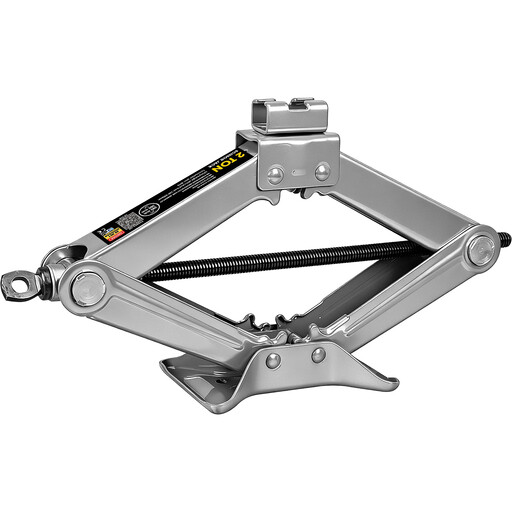
Why this choice suits this profile: Its foldable design stores easily in the boot of a saloon or small SUV for occasional wheel changes. However, always check the capacity stated on the product page before use.
Its stated minimum height of 8.8 cm suits some low vehicles, unlike models that are too tall to fit under the sill.
Forged steel construction, non-slip base and foldable design for easy storage.
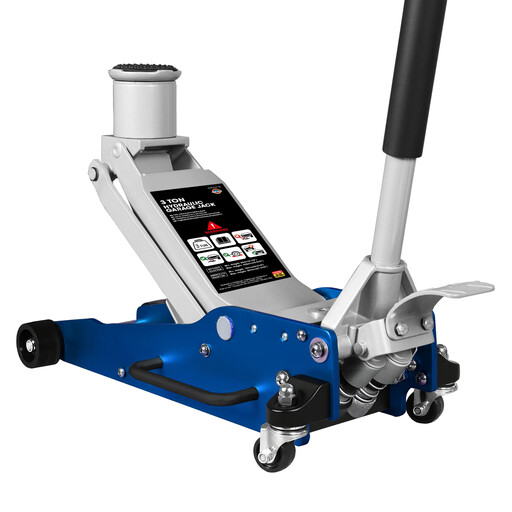
Why this choice suits this profile: This ultra-low-profile jack is aimed at owners of sports cars, low saloons or SUVs looking for an extended lifting range.
Its stated minimum height of 8.5 cm reduces the risk of choosing a jack that is incompatible with low ground clearance.
Stated capacity of 3 tonnes, dual pump and tool-free height extension. The product page mentions EN 1494 and CE markings.
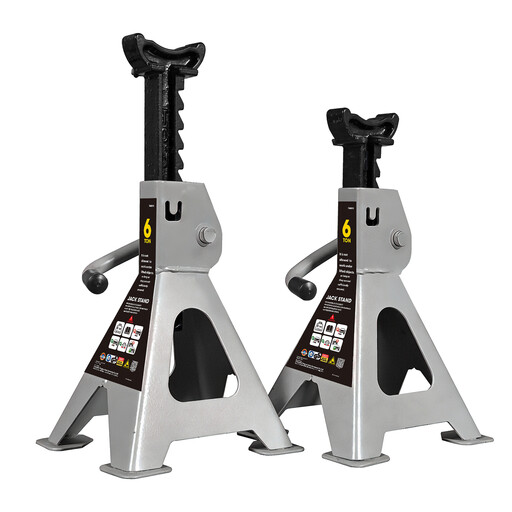
Why this choice suits this profile: This pair of axle stands is suitable for large SUVs, 4x4s, light commercial vehicles and motorhomes used regularly.
Its adjustment range of 38.8 to 58 cm avoids relying on a support that is too low for high-chassis vehicles.
Welded steel, cast iron rack and stated capacity of 6 tonnes per pair. The product page mentions EN 1494 certification.
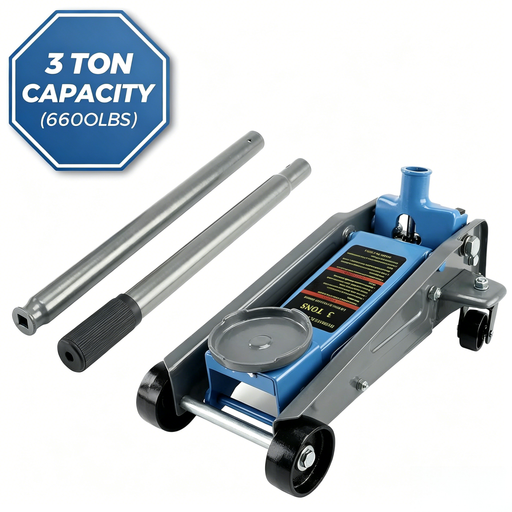
Why this choice suits this profile: This hydraulic trolley jack on wheels is suitable for regular use at home, in a garage or workshop, for compatible cars and SUVs.
Its range of 13.5 to 46 cm covers more configurations than a jack limited to a single vehicle category.
Stated capacity of 3 tonnes, two steel wheels and two 360° swivel castors.
To work safely, consult your vehicle's manual and locate the lifting points. Apply the handbrake, place wheel chocks if necessary and loosen the wheel nuts slightly before lifting the car. Once the axle stands are in place, lower the jack gradually so that the load rests properly on the supports.
Regularly inspect the welds, wheels, rack and any signs of leaks. On a hydraulic jack, keep the mechanism clean and follow the manufacturer's maintenance recommendations. Any equipment that is deformed, rusty or leaking must not be used.
We have put together a comprehensive, real-time updated selection of products that meet these demanding criteria and European safety regulations.
Start by checking the total weight of your vehicle in its documentation. The jack's capacity must be compatible with this figure and with the lifting configuration. For a heavy SUV or a commercial vehicle, a higher capacity may be necessary.
The jack can be used to lift the vehicle during a wheel change, but it must not support the car alone during a repair or any prolonged work under the chassis. For these tasks, use suitable axle stands positioned correctly.
Routine maintenance mainly involves keeping the jack clean, checking for leaks and following the manufacturer's recommendations. The cost depends on the parts that need replacing and how often you use it. An inspection before each use helps you spot signs of wear or faults quickly.