
Livraison le jour même ou le lendemain

Qualité garantie

Débloquez vos offres de bienvenue: Livraison GRATUITE | Jusqu'à -80 % | 30 jours d'essai gratuits à JoyPlus
Téléchargez l'application
A pressure washer can quickly tackle mud on a car, marks on a patio or ingrained dust on garden furniture. But an impressive specification sheet does not necessarily mean the appliance is right for your needs. Between the maximum advertised pressure, impractical accessories and sometimes limited battery life, some models can become a chore to use after only a few sessions.
Here are the criteria to consider before choosing an electric or cordless pressure washer, along with a selection of models suited to different uses in France.
Figures given in bar or PSI often refer to the maximum pressure advertised by the manufacturer. They are not enough to assess the appliance’s real-world performance. Water flow, measured in litres per hour, also plays an essential role in rinsing surfaces and washing away dirt.
A model displaying 180 bar may be well suited to a very dirty driveway or fence, but too aggressive for car bodywork, especially with a narrow nozzle. Conversely, a more compact model may be perfectly adequate for routine washing of a bicycle, balcony or a few pieces of garden furniture.
A hose that is too short, difficult to reel up or prone to kinking can turn a simple cleaning session into a real chore. For a patio or façade, check its length, whether it has a reel and how easy the appliance is to move. Wheels and a carry handle are particularly useful when you need to cover a large area.
With a portable pressure washer, compactness generally comes first. However, you will need to accept a more limited working area and move the appliance regularly.
A conventional electric pressure washer will generally connect to a tap. Some cordless models are self-priming and can draw water from a bucket or another fresh-water source. This is useful for washing a car in an outdoor area, a boat or gardening equipment. However, you should still check that the hose and connectors are compatible.
For a car pressure washer, choose an adjustable nozzle or a wide spray to limit overly aggressive splashing on seals and paintwork. A detergent bottle or a pressure washer with foam cannon makes it easier to apply shampoo, provided you use a compatible product and follow its instructions.
For paving slabs, walls, fences and driveways, a model advertised at 150 bar or 180 bar offers greater power reserves. However, the pressure must still be suitable for the surface: wood, delicate joints and certain types of paint require a sufficient working distance and the right nozzle.
An electric pressure washer is ideal for longer jobs, provided you have a protected socket and a cable that is long enough. A cordless model offers welcome freedom of movement, but its battery life depends on the battery capacity, the mode selected and how often you stop.
Before ordering a cordless pressure washer, check whether the battery and charger are included, the stated charging time and whether an additional battery can be purchased.
A multi-function nozzle can replace several attachments and make storage easier. For washing a car, choose a gun with adjustable spray, a foam bottle and, if needed, a soft brush. For a patio and garden pressure washer, a long hose, rotary lance and floor-cleaning attachment can save valuable time.
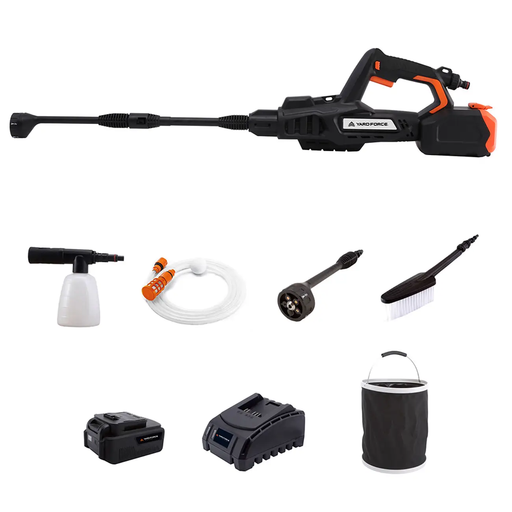
Why this choice suits this profile: Its cordless design and ability to draw water from a bucket or another fresh-water source make it ideal for light cleaning jobs involving cars, balconies, outdoor furniture or gardening equipment.
The 5-in-1 nozzle means you do not need to accumulate lots of accessories. The specifications state a maximum pressure of 45 bar / 665 PSI and a flow rate of 360 l/h: figures that are better suited to routine maintenance tasks than heavy-duty stripping work.
Stated 20 V 4 000 mAh battery, foam bottle, collapsible bucket, brush and overload and overheating protection.
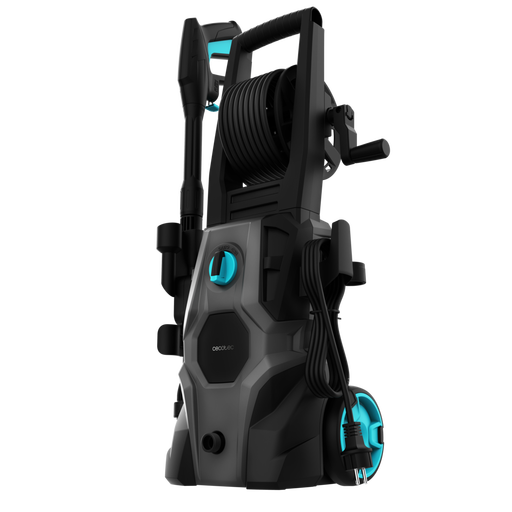
Why this choice suits this profile: This 2 000 W electric model is aimed at homeowners who want to clean a car, patio, balcony or the area around a swimming pool regularly.
Its 8 m high-pressure hose, stated 9 m working radius and wheels mean you do not have to keep moving the appliance around the area being cleaned.
Advertised pressure of 150 bar, flow rate of 450 l/h, aluminium pump, adjustable soap bottle and accessories for floors, wheels and corners.
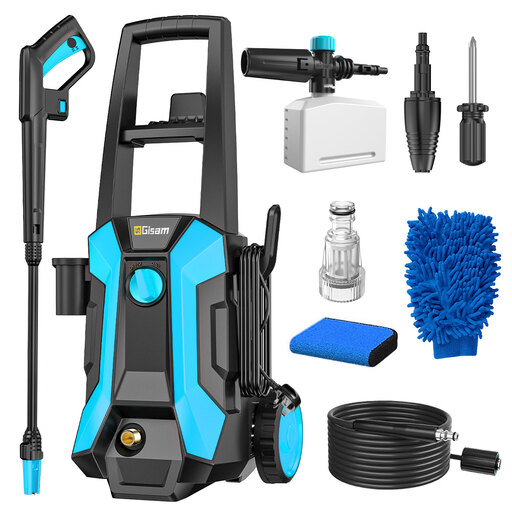
Why this choice suits this profile: Its stated power and 8 m hose make it suitable for large areas such as driveways, fences, patios and outdoor floors.
The integrated reel prevents the hose from trailing on the ground or becoming tangled. For a car, use the rotary nozzle carefully and maintain a sufficient distance.
Stated 2 200 W motor, stated maximum pressure of 180 bar, flow rate of 480 l/h, foam cannon, high-pressure spray gun and rotary nozzle.
We have put together a comprehensive, regularly updated selection of products that meet these demanding criteria while complying with European safety regulations.
A model fitted with an adjustable nozzle, foam cannon and wide spray is generally suitable for routine washing. The advertised pressure should not be your only criterion: the ability to adjust the flow rate, hose length and inclusion of a soft brush are just as important. A cordless model is particularly practical when there is no nearby power socket.
For a concrete patio or durable paving slabs, a model advertised at between 150 and 180 bar may be suitable, depending on the condition of the surface. Start with a wide nozzle while standing at a safe distance, then gradually increase the intensity if necessary. On wood or delicate joints, a gentler setting reduces the risk of damage.
The cost depends on water consumption, electrical power and how long the appliance is used. A stated flow rate of 450 l/h does not mean that the appliance constantly uses this amount: the motor may stop as soon as you release the trigger. To limit consumption, prepare the area, work in sections and switch off the spray while moving between them.