
Livraison le jour même ou le lendemain

Qualité garantie

Débloquez vos offres de bienvenue: Livraison GRATUITE | Jusqu'à -80 % | 30 jours d'essai gratuits à JoyPlus
Téléchargez l'application
A pressure washer can quickly remove mud from a car, greenish marks from a patio or ingrained dust from garden furniture. However, the figures highlighted on the packaging are not always enough to make the right choice. A very powerful machine may be impractical on a balcony, while a portable model may not deliver enough water flow to clean a large driveway.
Before you buy, make sure that the pressure, water flow, portability and accessories match your needs. Here are the main pitfalls to avoid, along with a selection of models suited to different uses.
A figure of 180 bar or 225 bar is bound to attract attention. In most cases, however, it refers to the maximum pressure stated by the manufacturer. The pressure actually delivered depends in particular on the nozzle used, the water flow, the length of the hose and the water supply.
When washing a car, excessive pressure or a highly concentrated jet can damage delicate paintwork, seals or certain plastic components. Conversely, a heavily soiled patio requires sufficient water flow and a suitable nozzle. It is therefore better to compare the pressure-flow combination rather than focusing solely on the number of bar.
A powerful electric pressure washer requires a suitable socket, a water inlet hose and enough space for storage. If your garage is far from the patio, or if you regularly wash a vehicle in a location without a power socket, a corded model can quickly become inconvenient.
A cordless or portable pressure washer can generally operate with a bucket, tank or another source of clean water. This freedom is useful for bicycles, garden furniture, balconies and small outdoor jobs. The trade-off is that you need to keep an eye on battery life and the available water flow.
A foam bottle, rotating nozzle or high-pressure gun can make cleaning easier, but you should check compatibility before buying. Examine the type of connector, the hose length, whether a filter is included and the availability of wear parts.
For a car, a pressure washer with a foam tank or detergent bottle distributes the product more evenly. However, foam does not replace rinsing or hand washing when dirt is heavily ingrained.
A 2000 W pressure washer may be suitable for a home with a patio, car and outdoor furniture. For regularly cleaning a large driveway or fence, a machine rated at 2200 W and 180 bar will offer more power in reserve, provided that the electrical installation and water supply can keep up.
An electric model is generally suitable for longer cleaning sessions thanks to its stable power supply. Remember to check the cable length, operating range and protection against moisture for the socket.
A battery-powered machine offers greater mobility. Some models feature a self-priming function, allowing them to draw water from a bucket or clean water tank. This is practical for a car pressure washer used away from home, although the flow rate is often lower than that of a corded machine.
An adjustable or 5-in-1 nozzle makes it easy to switch from a concentrated jet to a wider spray. On painted surfaces, always start from a safe distance with a wide angle, then gradually move the jet closer if necessary.
Also check for:
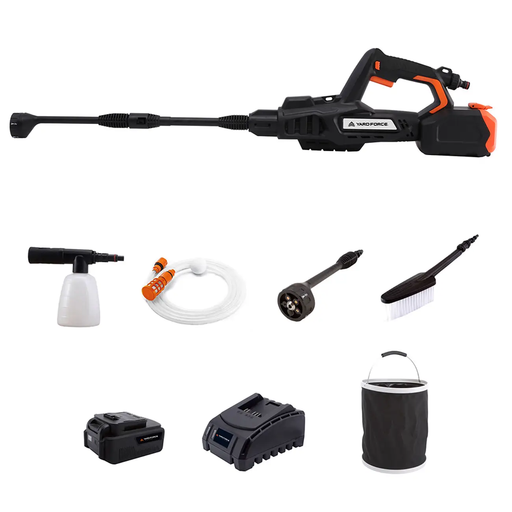
Why this choice suits this profile : Its cordless design and self-priming system, which draws water from a clean source, are ideal for small cleaning jobs around the car, patio or garden, without complicated installation.
The 5-in-1 nozzle avoids the need to accumulate accessories, while the folding bucket makes it easier to use when access to a tap is limited.
Stated pressure of 45 bar, flow rate of 360 l/h, foam bottle, plus overheating and overload protection.
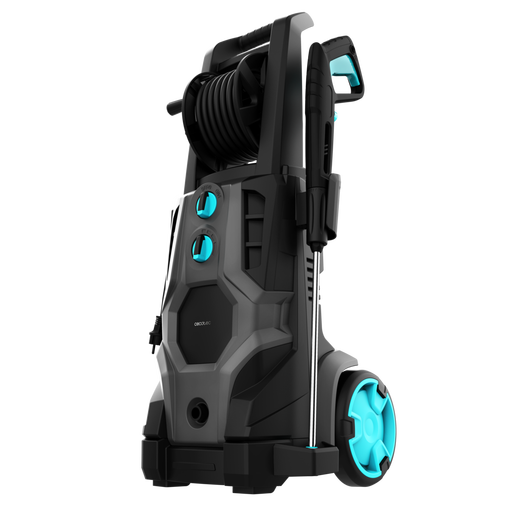
Why this choice suits this profile : This corded model is aimed at homeowners who want to clean patios, façades, swimming pools, cars and furniture regularly, with a machine designed for large surfaces.
Its wheels, handle and stated 14 m operating range mean you do not have to move a powerful machine too often.
Stated power of 3200 W, maximum pressure of 225 bar, flow rate of 540 l/h, aluminium pump and adjustable soap bottle.
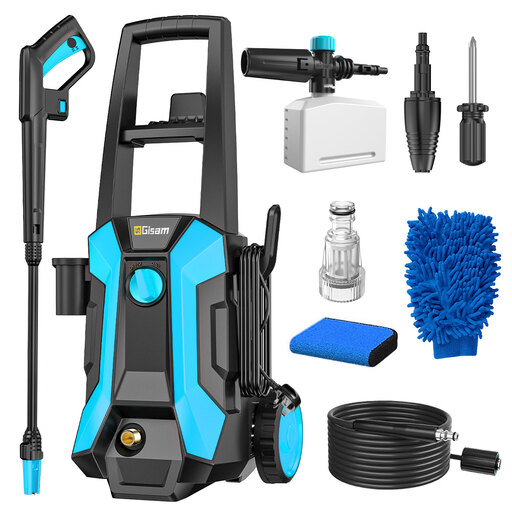
Why this choice suits this profile : Its equipment and stated flow rate make it suitable for regular work on fences, driveways, gardens and large outdoor surfaces.
The integrated reel and 8 m hose make storage easier and reduce twisting during use.
Stated motor power of 2200 W, maximum pressure of 180 bar, flow rate of 480 l/h, foam nozzle and high-pressure gun.
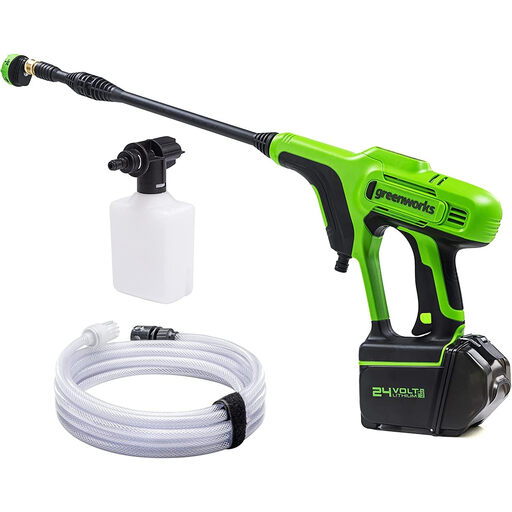
Why this choice suits this profile : Lightweight and powered by a 24 V battery, it is ideal for cleaning bicycles, barbecues, balconies and garden furniture, especially when the water comes from a bucket or clean water butt.
Its compatibility with Greenworks 24 V batteries and 6 m suction hose allow it to be used without a power socket or direct connection to a tap.
Stated pressure of 24 bar, flow rate of 180 l/h, 5-in-1 nozzle, foam bottle and 6 m kink-resistant hose.
We have put together a complete, real-time updated list of products that meet these demanding selection criteria and European safety requirements.
Before each cleaning session, remove any impurities from the water and check the connections. When cleaning a car, use a wide nozzle, keep a reasonable distance and avoid seals, electrical sockets and fragile parts. On a façade or fence, first test the machine on an inconspicuous area to check how the coating reacts.
After use, switch off the power, disconnect the hose and drain any remaining water. Clean the filter and nozzle, then store the machine away from frost and excessive moisture. With a cordless model, remove the battery before maintenance and store it in accordance with the manufacturer’s recommendations.
For occasional car washing, moderate pressure combined with an adjustable nozzle is generally sufficient. The flow rate, foam bottle and ability to adjust the jet are more important than an extremely high maximum pressure. A corded machine is suitable if you have a tap and power socket nearby; a cordless model will be more convenient when you are on the move.
Yes, provided the water is clean and free from leaves, sand or debris that could damage the pump. Use a suitable filter and check that the machine supports self-priming. The portable models featured here are designed to draw water from a bucket or another clean source, according to their stated specifications.
The cost depends on the motor power, how long the machine is used, the price of electricity and the volume of water consumed. A 2000 W machine used for 30 minutes theoretically consumes around 1 kWh, excluding stop phases and load variations. The automatic trigger stop can reduce water and electricity consumption during pauses.