
Livraison le jour même ou le lendemain

Qualité garantie

Débloquez vos offres de bienvenue: Livraison GRATUITE | Jusqu'à -80 % | 30 jours d'essai gratuits à JoyPlus
Téléchargez l'application
A pressure washer can transform washing your car, patio or garden furniture into a far less tiresome task. But you need to choose the right machine. The unpleasant surprises don’t always come from the power stated on the box; more often, they come from a poorly suited model, a hose that’s too short, or accessories that are more about marketing than usefulness.
A product listing that boasts 150 bar or 180 bar is certainly eye-catching. However, this value usually refers to a maximum pressure measured under specific conditions. Real efficiency also depends on the water flow rate, expressed in litres per hour, the quality of the pump, and the nozzle you use.
For a patio or fence, a high flow rate can save you valuable time. On a car, though, a jet that’s too concentrated or a poorly chosen nozzle can damage the paintwork, seals, or certain delicate surfaces.
An electric pressure washer needs to be plugged into a suitable socket and connected to a water supply. Remember to check the length of the cable, the length of the high-pressure hose, and the stated working radius. A powerful machine quickly becomes frustrating to use if its hose won’t let you easily get around the house.
A cordless pressure washer runs on a battery and can sometimes draw water from a bucket, tank, or any other clean container. This freedom is especially handy on a balcony, when camping, or for washing a car far from a tap. The trade-off is that you need to pay close attention to the battery life and charging time.
A foam cannon, a brush, or a rotating nozzle won’t make up for a poorly sized machine. For a car, a pressure washer with a foam sprayer makes applying detergent easier, but you should then rinse with a reasonable pressure. For a patio, a suitable nozzle or a ground-cleaning attachment will often be more useful than a simple high-pressure gun.
Here are some useful benchmarks for comparing machines:
Never direct the jet at a person, an animal, an electrical socket, live equipment, or any fragile part of a vehicle. Start from a good distance with a wide nozzle, then gradually increase the intensity if needed.
For a 20 V pressure washer, check the battery capacity, expressed in amp-hours, and whether the charger is included in the box. A model sold without a battery can be a good option if you already own compatible batteries from the same range.
A battery-powered machine avoids the hassle of a cable, but it’s generally intended for short to medium sessions. For a large patio, a house wall, or several vehicles, an electric pressure washer is often more practical thanks to its continuous power supply.
Self-priming allows you to draw water from a bucket or reservoir, provided the water is clean and the hose is properly connected. A dirt filter reduces the risk of blockages or premature pump wear. Also check:
The products below are suited to different uses. The features listed are those stated on the product pages.
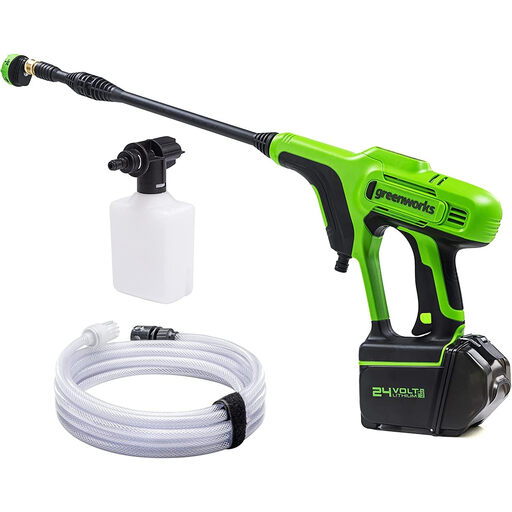
Why this choice suits this profile: Its compact size is ideal for balconies, bikes, garden furniture and occasional washes. Depending on the configuration you choose, the battery and charger are sold separately.
The listing clearly states the 24 bar pressure, the 180 l/h flow rate, and compatibility with Greenworks 24 V batteries. This means you can estimate the real cost before placing your order.
5-in-1 adjustable nozzle, 6 m suction hose, and the ability to draw water from a bucket, tank or clean water source.
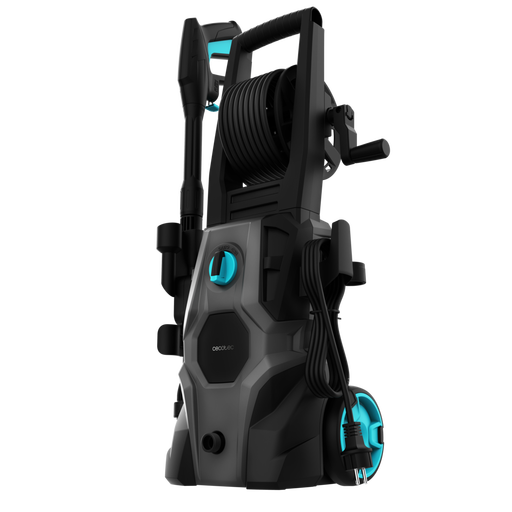
Why this choice suits this profile: This 2,000 W electric model is designed for households that regularly clean cars, patios and pool surrounds, with a stated working radius of 9 m.
The data separately details the 150 bar pressure, the 450 l/h flow rate, the motor power and the included accessories. So the comparison isn’t based solely on the pressure figure.
Aluminium pump, adjustable soap bottle, dirt filter, wheels, and accessories for floors, wheels and corners.
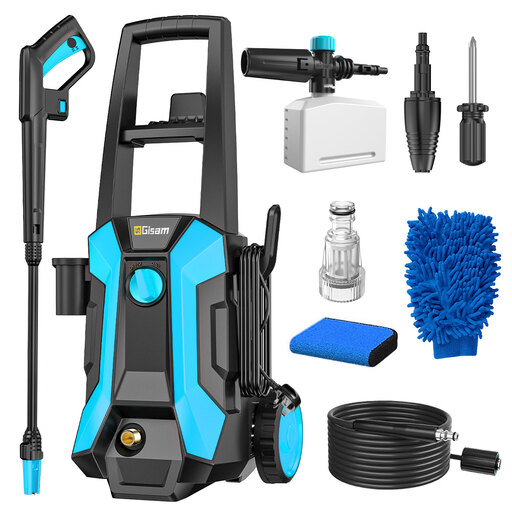
Why this choice suits this profile: With its 2,200 W motor, stated flow rate of 480 l/h and 8 m hose, it’s built for large outdoor areas and regular tasks.
The hose reel and 8 m hose make storage and manoeuvring much easier – two aspects that are often overlooked when choosing a powerful machine.
High-pressure gun, foam sprayer, rotating nozzle and long hose for the car, fence, patio, garden or driveway.
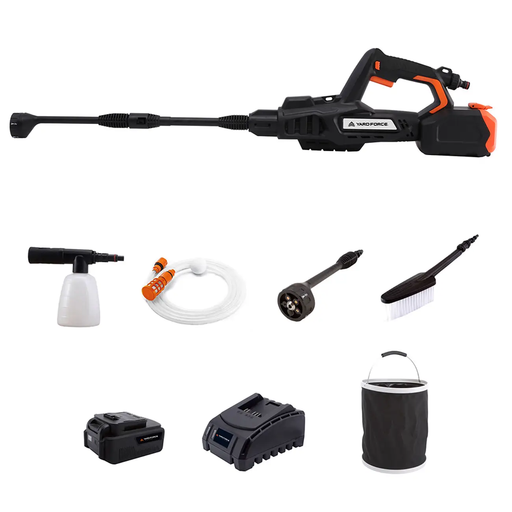
Why this choice suits this profile: This portable cordless pressure washer is designed for washing a car, outdoor furniture or a small area of the garden when no mains socket is available.
The listing details the 20 V battery, its 4,000 mAh capacity, the 360 l/h flow rate and the self-priming feature. This information helps you better assess cordless use.
Stated pressure of 45 bar, 5-in-1 nozzle, foam bottle, brush, quick-connect hose and collapsible bucket.
We’ve put together a comprehensive, real-time selection of products that meet these demanding criteria, as well as European safety standards.
After each session, rinse the hose and nozzle, drain any remaining water, then store the machine away from frost. With a battery-powered model, remove the battery before cleaning and store it in a dry place. A blocked nozzle can reduce the flow rate and put extra strain on the pump.
The running cost depends on the operating time, the electrical power and the volume of water used. A 2,000 W machine used for 30 minutes theoretically consumes around 1 kWh, not accounting for idle periods or real-world efficiency. The stated flow rate gives you a rough idea of water consumption, while a trigger with automatic shut-off helps reduce it during pauses.
A moderate pressure combined with a wide nozzle is generally better than a highly concentrated jet. Keep a safe distance, avoid seals, and don’t direct the jet at electrical components. A foam sprayer can also help loosen dirt before rinsing.
Portable models are fine for small areas and regular maintenance. For a large patio or a heavily soiled surface, an electric machine with 150 to 180 bar and a higher flow rate will often cut down on work time. Also remember to compare battery life and charging time.
Use clean water, check the connections, clean the filter regularly, and never run the pump without a water supply. Follow the manufacturer’s recommendations, protect the machine from frost, and choose a nozzle suited to each surface.