Households preparing several portions in advance
When several meals are frozen after one or two cooking sessions, net capacity, access to containers and category separation matter more than a simple product label.


Start by choosing according to the amount you need to store at once, how easily you need to access individual portions and the space available. An upright freezer makes everyday sorting easier, a chest freezer prioritises a large floor-standing reserve, while a fridge freezer is suitable when the freezer compartment genuinely holds enough for your stock.
When several meals are frozen after one or two cooking sessions, net capacity, access to containers and category separation matter more than a simple product label.
To regularly store frozen food, meat, vegetables or bread bought in larger quantities, compare the usable freezer capacity, footprint and temperature stability rather than the appliance’s total capacity.
If the appliance is to be installed outside a temperature-controlled room, check before buying that the model’s climate class and ambient temperature range match the actual conditions in the room.
Start by working out your peak stock level, then compare the interior layout, freezing specifications and installation conditions for the model you are considering.
| Priority | What to check | Your needs |
|---|---|---|
| Usable freezer capacity | Compare the net capacity of the freezer or freezer compartment, not the total capacity of the fridge freezer. Also check the freezing capacity in kg/24 h when adding a large amount of food at once. | I want to store both bulk shopping and prepared portions at the same time, without overestimating the available space. |
| Organisation and access | Look at the drawers, shelves, compartments and removable components. For a chest freezer, plan to use baskets, categories and labels. | I want to find a portion or bag quickly, even when the stock is varied and frequently replenished. |
| Cold-temperature stability | Look for comparable information on temperature stability and freezing performance. Check advertised features, such as an open-door alarm, on the exact model’s product page. | My appliance will often be opened or loaded after shopping, and I want to compare performance on a clear basis. |
| Installation room and energy use | Match the climate class to the temperature of your kitchen, garage or utility room. Compare the A to G energy label and annual consumption between appliances of a similar type and capacity. | I need to be able to install the appliance in the intended room without assuming that it is suitable for all ambient temperatures. |
Total capacity includes the fridge section. An appliance may appear spacious while offering little room for prepared portions and frozen shopping.
Check the net capacity of the fridge and freezer separately, along with the freezing capacity of each model.
A garage, unheated utility room or very warm kitchen may exceed the range specified by the manufacturer. In that case, you should not assume that food will be preserved correctly or that energy consumption will remain as stated.
Estimate the room’s minimum and maximum temperatures, then check the model’s climate class and instructions before ordering.
A large capacity does not guarantee that portions will remain visible and easy to take out. The drawers and compartments in an upright freezer meet a different access requirement.
In a chest freezer, plan categories, baskets and an inventory. If you eat varied portions every day, compare upright freezers with drawers as well.
Baskets, dividers and labels can be useful for organising the contents.
Since 2021, the energy label for fridges and freezers has used a scale from A to G. The old ratings are not directly comparable.
Compare the applicable energy label, displayed annual consumption and net capacity between appliances of a comparable type.
A range of upright, built-in and freestanding freezers to consider when vertical organisation and flexibility are important.
A range that includes chest freezers for households with floor space available and looking for substantial storage capacity.
A range of built-in and freestanding fridge freezers for combining fresh-food storage and freezer capacity in one space.
A range of upright freezers, particularly for layouts where the door-opening direction may affect installation.
Joybuy options for comparing an upright freezer, a fridge freezer and several chest freezers designed for prepared portions and shopping bought in advance.
 Image unavailable
An option worth considering if portions need to be separated and accessed frequently.
Advertised capacity of 161 L, No Frost protection, three freezer drawers, two drawers, LED display, alarm and reversible door. Advertised temperature range from -14 °C to -22 °C.
Check the climate class and ambient temperature range before installing it in a garage, unheated utility room or warm room.
 Image unavailable
Worth considering when replacing your fridge at the same time as meeting a limited need for freezer space.
Advertised capacity of 262 L, Low Frost system, width of 54 cm, height of 176 cm and reversible door.
The advertised ambient range of 16 to 38 °C is not suitable for an outbuilding that falls below 16 °C. Manual defrosting is still required.
 Image unavailable
This dedicated chest freezer is designed to provide substantial storage for frozen food and prepared meals when floor space is available.
Advertised capacity of 291 L, LED lighting, five-level digital control, removable basket and defrost drain.
Check the selected mode, fridge or freezer, as well as the climate class. Deep storage requires organisation by category.
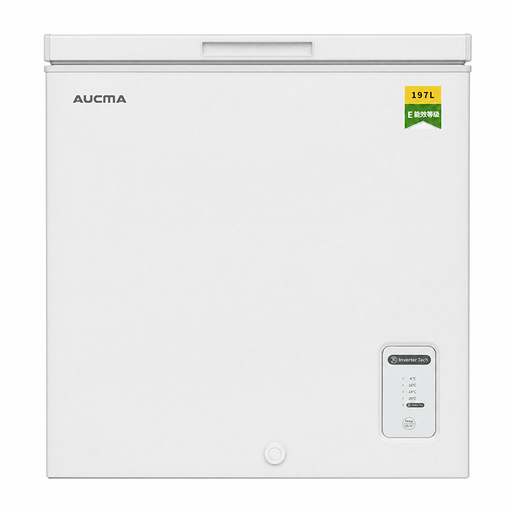 Image unavailable
Dedicated storage in a more compact chest-freezer format for prepared portions and frozen products.
Advertised capacity of 197 L, five-level digital control, removable basket, adjustable feet and defrost drain.
Confirm the selected operating mode and climate class. No No Frost function is indicated, so manual defrosting is required.
 Image unavailable
A compact chest freezer to consider when space is limited and storage needs are moderate.
Advertised capacity of 99 L, 4-star freezing capacity, adjustable thermostat, removable wire basket, sliding lid and castors.
99 L may not be enough for a large household’s storage needs. Check the climate class and plan for manual defrosting.
Take stock of your peak storage needs rather than your average consumption: portions prepared at the same time, how often you shop in bulk, bags of frozen food and bulky ingredients. Then compare the net capacity of the freezer compartment alone or the dedicated freezer, because the total capacity of a fridge freezer includes the fridge section.
No. An upright freezer is better suited if you want to separate and access portions frequently using drawers, shelves and compartments. A chest freezer remains suitable if your priority is a large reserve and you are happy to organise it with baskets and an inventory.
Yes, but only if the expected temperatures in the room remain within the range covered by the climate class declared for the model. ADEME recommends checking the recommended ambient temperature for the room where the appliance will be installed; always compare it with the specifications for the model you choose.
The energy label for fridges and freezers has used the A to G scale since 1 March 2021, according to the DGCCRF. Use it together with annual consumption and compartment capacities to compare appliances with similar functions and capacities.
It depends on the available net capacity and the temperature and freezing specifications stated by the manufacturer for that compartment. Do not treat it as equivalent storage to a dedicated freezer until this information has been provided for the specific model.