
Livraison le jour même ou le lendemain

Qualité garantie

Débloquez vos offres de bienvenue: Livraison GRATUITE | Jusqu'à -80 % | 30 jours d'essai gratuits à JoyPlus
Téléchargez l'application
Is your cat turning its nose up at its bowl, gaining weight, or suffering from a sensitive digestion? A premium wet cat food can meet its needs – but only if you look beyond the marketing claims. Texture, water content, protein sources and nutritional profile all play a part in how useful the product really is on a daily basis.
A recipe that contains a lot of meat isn't necessarily balanced. Start by checking for the phrase "complete cat food". This means the product has been formulated to make up the daily ration, in line with the nutritional information stated on the packaging.
In contrast, a liquid cat treat, such as a tuna cream, is usually a complementary food. It can be offered from time to time, but should not replace a complete wet food.
A grain-free wet cat food may suit owners who want to avoid wheat, maize or rice. However, this claim alone is not enough to judge the overall quality of the recipe. Also look at the ingredients list, protein content, fat content, minerals and the presence of taurine.
The term "premium" is not a universal regulatory guarantee. It is therefore better to compare precise data than to rely solely on the brand's positioning.
A large pack may seem more economical, but an opened tin usually needs to be kept in the fridge and consumed within 24 hours, according to the manufacturer's instructions. For a cat that eats small portions, 125 g to 200 g formats help reduce waste. Pouches of 300 g or 400 g are better suited to households that organise several meals or live with multiple cats.
For the main ration, choose a complete cat food suitable for its age and physical condition: adult, senior, neutered or prone to weight gain. The phrase "complementary food" applies more to toppers, broths and treats.
The products shown below are listed as complete foods, with the exception of INABA Churu liquid treats, which are intended for complementary use.
A meat-rich pâté should clearly identify its main animal sources. A single-protein recipe features just one animal species, such as chicken, lamb or kangaroo. This can make it easier to rotate recipes and help identify an ingredient that is poorly tolerated, without being a medical guarantee.
Recipes based on less common proteins, such as horse, kangaroo or insects, may appeal to households looking for a different composition. If your cat has a diagnosed allergy or needs an elimination diet, ask your vet for advice.
Wet cat food generally contains much more water than dry food. The product sheets shown here display a moisture content between 76 % and 85 %. The fat content also varies: a recipe with 3.5 % fat cannot be directly compared to one with 8.5 % fat without taking its moisture level into account.
Follow the recommended amounts and adjust them according to your cat's weight, activity level and body condition. For the MjAMjAM recipes featured here, the recommendation is generally between 200 and 400 g per day for an adult cat weighing around 3 to 5 kg. A bowl of fresh water should also always be available.
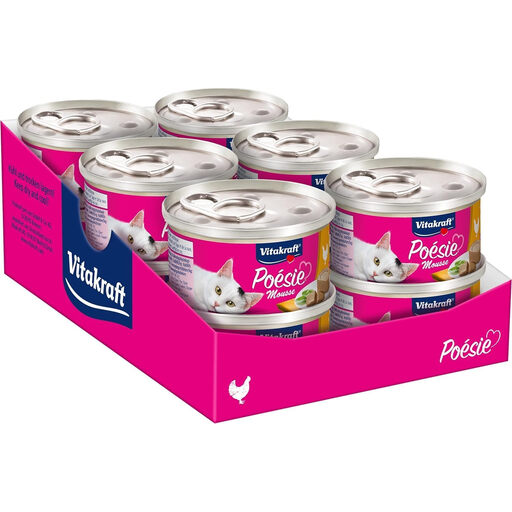
Why this choice suits this profile: The pack of 12 x 85 g portions lets you try a mousse texture and serve regular amounts without having to store a large open tin.
Its status as a complete food is clearly stated, unlike a simple treat or topper.
Individual format, mousse texture, grain-free recipe with no added sugar, according to the product sheet.
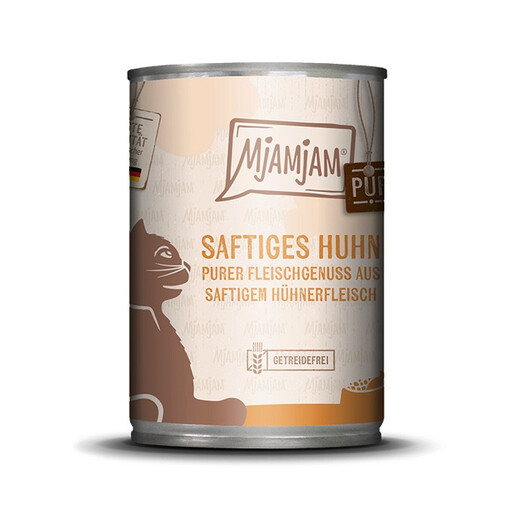
Why this choice suits this profile: This chicken pâté contains 71 % chicken, hearts, liver and gizzards, with a single-protein recipe and a 400 g format.
The proportion of chicken and the analytical constituents are detailed, rather than summed up in a simple advertising slogan.
Complete food, 11 % crude protein, 79 % moisture and added taurine, according to the sheet.
Why this choice suits this profile: The pack of six 300 g pouches suits households that buy regularly and are looking for a single-protein recipe based on kangaroo.
The sheet details the composition, the absence of grains and the complete food status. Unopened pouches are easy to store separately.
71 % kangaroo meat and offal, 4.5 % fat and practical portions for bulk buying.
Why this choice suits this profile: This senior cat pâté is presented as a single-protein complete food, with 70 % chicken and a 200 g portion that is easy to divide up.
The recipe is explicitly intended for senior cats and details its ration, minerals and nutritional additives.
10.2 % crude protein, 5 % fat, 80 % moisture and taurine stated at 1,500 mg/kg.
We have compiled a comprehensive, real-time updated list of products that fully meet these strict selection criteria and European safety regulations.
It all depends on the cat's weight, activity level, age and the energy density of the recipe. The products we looked at often recommend between 200 and 400 g per day for a cat weighing 3 to 5 kg. Start by following the instructions on the packaging, then regularly monitor your pet's body shape and weight.
Choose a recipe whose sheet states the energy content or indicates a formulation suitable for weight control. The MjAMjAM range includes a chicken recipe designed for cats prone to overweight, with 3.5 % fat and rations calculated according to the target weight. For long-term use, it is best to ask your vet for advice.
No. Liquid treats, such as INABA Churu with tuna, are intended to supplement the ration, be given by hand or added to the diet. The sheet states that they do not replace a complete food. They should remain occasional and be factored into the daily ration calculation.