
Livraison le jour même ou le lendemain

Qualité garantie

Débloquez vos offres de bienvenue: Livraison GRATUITE | Jusqu'à -80 % | 30 jours d'essai gratuits à JoyPlus
Téléchargez l'application
For DIY enthusiasts, creators, and technicians, selecting the right precision tools can often be a daunting task. Navigating the gap between marketing promises and actual performance makes it challenging to find tools that truly combine efficiency, durability, and functional design. The goal of this guide is to provide clear benchmarks to help you select equipment tailored to your projects, whether it's model making, electronics repair, or creative DIY.
Before diving into specific models, it's helpful to understand the technical specifications that truly make a difference. Here are a few key points to guide your decision.
For a portable multi-tool, motor quality is paramount. Brushless motors are a significant advancement: they run cooler, are generally quieter, and offer a longer lifespan compared to traditional motors.
An adjustable speed range is also a hallmark of versatility. Low speeds (around 5,000 RPM) are ideal for polishing delicate materials, while high speeds (20,000 RPM and above) are necessary for engraving metal or drilling. The ability to fine-tune the speed ensures a clean finish and prevents damage to your workpieces.
Precision tools are designed for tasks that demand meticulous work. A heavy or poorly balanced tool quickly leads to fatigue and inaccuracy. Opt for lightweight models (around 100-250g) with a body made of aluminium alloy or a robust composite material. These materials provide both lightness and resistance to impacts and corrosion.
Practicality is also in the details: a universal charging port like USB-C is a welcome standard today, as are LED indicators for battery level or selected speed.
A great tool is one that adapts to a multitude of tasks. Compatibility with standard accessories (e.g., 2.3mm or 3/32" shanks) ensures flexibility. Check the quality and variety of the included accessories: sanding bits, engraving cutters, polishing wheels, drill bits, etc.
A well-designed storage system, like a magnetic case or a rotating stand, is more than just a gimmick. It keeps your accessories organised, easy to find, and protects your investment in the long run.
With these criteria in mind, here are two products that stand out for their design and features, meeting the specific needs of demanding hobbyists and professionals alike.
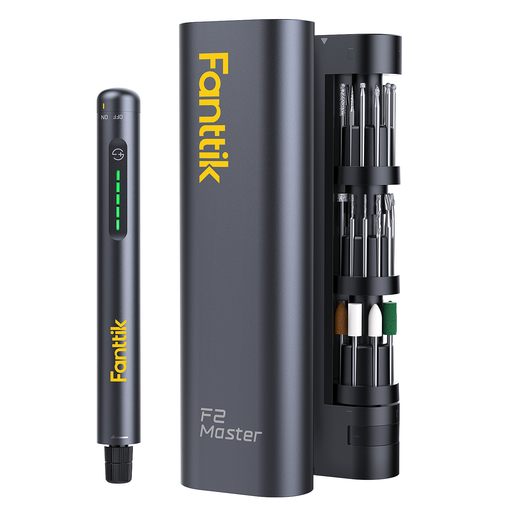
Why We Recommend It
The Fanttik F2 Master is a cordless rotary tool that focuses on performance and practicality. Its brushless motor reaches 25,000 RPM while operating more quietly than many competing models. What makes it particularly interesting is its Revostor accessory hub: a rotating magnetic stand that organises 35 accessories and makes them instantly accessible. No more time wasted searching for the right bit in a plastic box.
Pros
Who Is This Product For?
This tool is particularly well-suited for model making, post-processing 3D prints, precision sanding, and creative DIY projects. Its versatility makes it an excellent mini engraver for personalising objects made of wood, plastic, or soft metal.
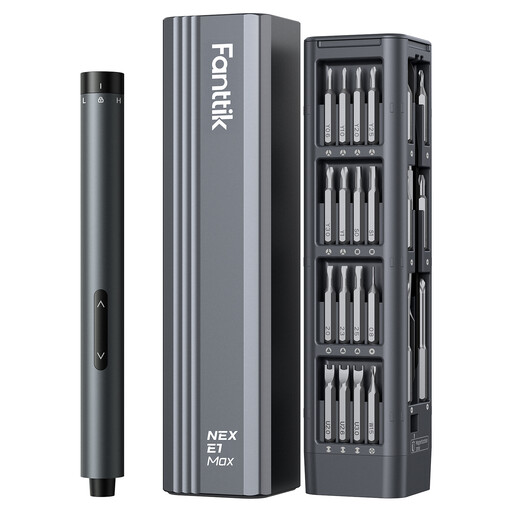
Why We Recommend It
The Fanttik E1 Max is a precision electric screwdriver designed for the most delicate tasks. Its main strength lies in its dual-torque settings (0.05 N.m and 0.2 N.m), allowing you to apply the right amount of force without risking damage to fragile electronic components. The kit includes 50 magnetic bits made of S2 steel, covering almost all needs for repairing smartphones, laptops, watches, or cameras. The pop-up magnetic case is both satisfying to use and highly functional.
Pros
Who Is This Product For?
This is the tool of choice for anyone who assembles or repairs electronic devices. It forms the core of a modern and efficient electronics repair kit, whether for professional technicians or savvy hobbyists looking to replace a phone battery or build their own PC.
The tools featured above meet specific needs for precision and portability. If your project requires a different setup, or if you simply want to compare other configurations, it may be wise to explore a wider range. You can browse a varied selection by visiting our dedicated repair tool kit category to find the set that perfectly matches your needs.
What tool should I use for precision engraving? For engraving on materials like glass, metal, or wood, a cordless rotary tool is often the most suitable solution. Look for a model with a high rotation speed (over 20,000 RPM) and fine engraving cutters. A lightweight tool like the Fanttik F2 Master allows for pen-like control, which is ideal for fine details.
Why use a precision electric screwdriver? A precision electric screwdriver saves a significant amount of time when assembling or disassembling devices with many small screws. More importantly, models with adjustable torque, like the Fanttik E1 Max, prevent the risk of overtightening and damaging threads or circuit boards—a common problem with manual screwdrivers.
How do I choose tools for model making? Model making tools require versatility and finesse. A good basic kit should include a multi-function rotary tool for sanding, drilling, and cutting small parts, as well as a set of precision screwdrivers for assembly. Portability and battery operation are major advantages for working comfortably at your workbench without being hindered by cables.