
Livraison le jour même ou le lendemain

Qualité garantie

Débloquez vos offres de bienvenue: Livraison GRATUITE | Jusqu'à -80 % | 30 jours d'essai gratuits à JoyPlus
Téléchargez l'application
A precision electric screwdriver can save you valuable time when opening a phone, replacing a computer component or assembling a small piece of furniture. But not all models are created equal. A tool designed for laptop screws won't necessarily be up to the job of putting together a shelf.
Before buying an electric screwdriver kit, it's best to avoid three common mistakes: being seduced by a record number of bits, confusing power with precision, and underestimating the importance of charging and storage.
A set of 40, 50 or 60 bits might seem comprehensive. Yet, the number isn't everything. What matters is finding the profiles you'll actually need: Phillips, flathead, Torx, security Torx, hex, pentalobe or tri-wing.
For a screwdriver intended for phones and computers, also check the fineness and length of the bits. Some screws, deeply recessed inside a casing, require an extended shaft. A well-identified assortment stored in a magnetic case is often more useful than a vast collection of bits that are hard to tell apart.
Expressed in N·m, torque is the rotational force applied by the tool. For an electronic screwdriver intended for smartphones, watches or cameras, it's better to favour a low, precisely controllable force. Too much torque can damage the screw head or the thread of the housing.
Assembling furniture, on the other hand, requires more power. A small precision screwdriver won't always replace a more robust cordless model.
Manufacturers often measure battery life when running idle or the number of screws under very specific conditions. In real-world use, the duration varies depending on the torque selected, how often you use it and the resistance of the materials.
A rechargeable mini electric screwdriver with a USB-C port is easy to charge at the office or at home. Also look at the charging time, whether there's a battery indicator, and the possibility of using the tool manually when the battery is flat.
For electronics repairs, look for an adjustable torque screwdriver offering several clearly identified levels. Values between 0.05 and 0.6 N·m are more suitable for the small screws in electronic devices. For furniture and household tasks, several N·m will be more appropriate.
An adjustable clutch doesn't mean you shouldn't start with care. Place the bit fully into the screw head, keep the screwdriver aligned, and stop as soon as the screw is properly tightened. Also respect the maximum manual torque stated by the manufacturer: even in manual mode, the tool isn't designed to withstand unlimited force.
Screwdrivers with magnetic bits make it easier to hold a small screw in place when positioning it. This feature is particularly handy inside a laptop or a narrow casing. However, it doesn't make up for a bit that's poorly suited to the screw.
In particular, check the following points:
A USB-C cordless screwdriver is especially convenient if you already have a compatible charger. Don't just look at the battery capacity, expressed in mAh: also consider the stated charging time. A 350 mAh battery is sufficient for small, occasional jobs, while a capacity of 800 to 2,000 mAh offers more reserve for assembly and extended repairs.
To preserve the battery, use the correct cable and charger, keep the tool dry and avoid exposing it to high heat. The small bits should also be stored in a dry place to limit oxidation.
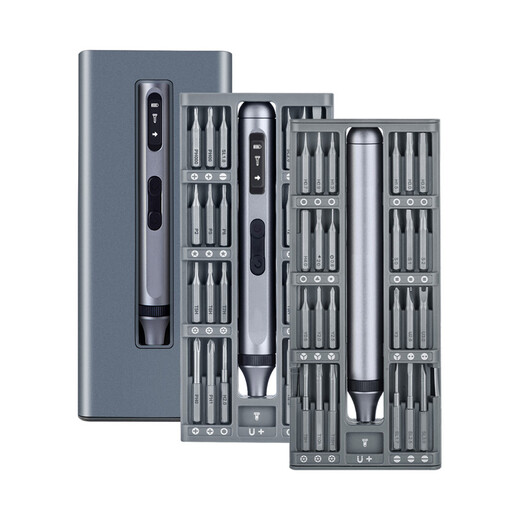
Why this choice suits the profile: Its aluminium body and 48 bits cover everyday repairs, small devices and DIY projects without forcing you to buy multiple tools.
The specifications clearly distinguish the electric torque of 0.3 N·m from the manual torque of 3.5 N·m. The contents of the case are therefore more transparent than a simple promise of versatility.
350 mAh battery, stated charge time of 90 minutes, up to 120 minutes of use when idle, tweezers and pry tool included.
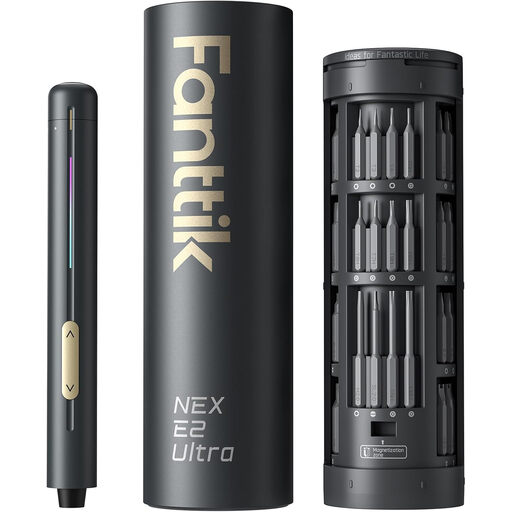
Why this choice suits the profile: It's aimed at those who regularly repair phones, cameras, laptops or watches and want precise control.
Its five torque levels, from 0.05 to 0.6 N·m, let you adapt the force to small screws instead of relying on a single setting.
50 magnetic S2 steel bits, 800 mAh battery, Type-C charging, tweezers and pry tool included.
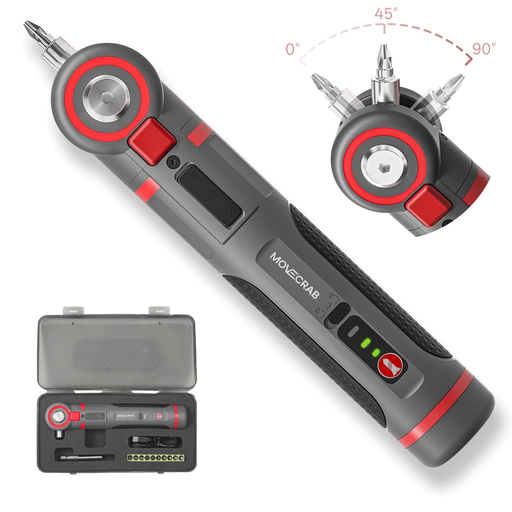
Why this choice suits the profile: Its handle, adjustable to 0°, 45° and 90°, is practical for assembling furniture, reaching awkward spots and carrying out everyday repairs around the house.
The three stated levels, of 3, 4 and 5 N·m, prevent you from applying the same force to an electronics screw and a more robust fixing.
2,000 mAh rechargeable battery, dual LED lighting, safety lock and adjustable head.
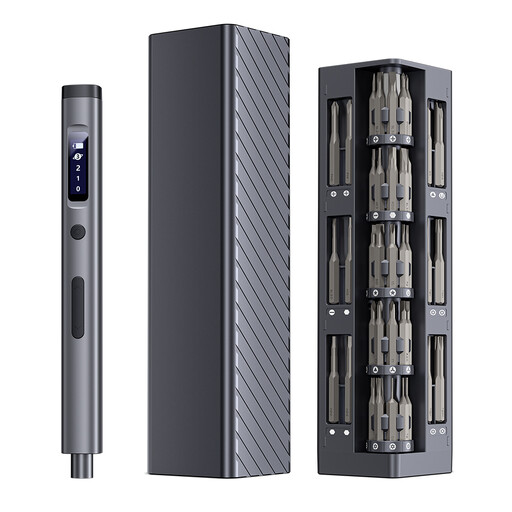
Why this choice suits the profile: Its case is aimed at users who regularly switch between different types of devices and want to keep all their repair accessories together.
The electric torque range, from 0.1 to 0.35 N·m, is clearly stated and accompanied by a separate manual torque of 3 N·m.
52 bits, magnetic case, 500 mAh battery, demagnetiser, ESD-11 tweezers and metal pry tools.
We've put together an updated selection of products that meet these criteria, with formats suited to repairs, DIY and furniture assembly.
Yes, provided you choose a model designed for small screws, with low torque and suitable bits, such as pentalobe, Torx or tri-wing. Avoid models intended for drilling or furniture assembly: their power can be excessive for delicate components.
It depends on the model. The references shown here state around 90 to 120 minutes for some compact kits, while models with a larger battery may take longer. Before plugging in the tool, check the port type, input voltage and the manufacturer's recommendations.
An electric DIY repair kit avoids repetitive twisting and is handy when you need to remove or replace a long series of screws. A manual set remains essential for precisely controlling the tightness, working when the battery is flat, or complementing an electric screwdriver. For versatile use, the two approaches are perfectly complementary.