Shoppers who look for the Fairtrade label
You want to see FAIRTRADE/Max Havelaar certification on the product you buy, rather than relying solely on a brand’s general commitments.


If you require Fairtrade certification for the pralines served with tea and biscuits, choose a product bearing the FAIRTRADE/Max Havelaar label and read the details on its packaging. ETHIQUABLE’s milk praline chocolate bar offers a different, documented fair trade approach, but it isn’t a box of individual chocolates and its Fairtrade/Max Havelaar certification has not been confirmed. Lindt and Ferrero’s commitments on cocoa, on their own, don’t prove that a particular praline carries this label.
You want to see FAIRTRADE/Max Havelaar certification on the product you buy, rather than relying solely on a brand’s general commitments.
You’re looking for praline chocolate to share with biscuits and are happy to break up a bar instead of serving individual chocolates.
You need to check the ingredients and ‘may contain’ statements, particularly for milk, hazelnuts and other nuts.
Start by distinguishing between product certification, the format — a bar or individual chocolates — and the ingredients list. Each one matters for a different reason.
Choose this if: seeing the FAIRTRADE/Max Havelaar label on the specific product is a condition of your purchase.
Worth knowing: according to Fairtrade International, a composite product can carry the label if at least 20% of its total content is Fairtrade. The back of the pack specifies which ingredients are covered.
Choose this if: a bar to share suits you and you’re looking for a stated proportion of fair trade ingredients.
Worth knowing: ETHIQUABLE states that 65.3% of the total weight comes from products certified as fair trade by the World Fair Trade Organization. This doesn’t confirm that the bar carries the Fairtrade/Max Havelaar label.
Choose this if: you prefer individual chocolates from a brand such as Lindt or Ferrero.
Worth knowing: their statements on cocoa sourcing are no substitute for Fairtrade certification on the specific box you choose.
| What to consider | What to check | Who it matters to |
|---|---|---|
| Product certification | Look for the FAIRTRADE/Max Havelaar label on the specific product and read the information on the back of the pack. | If certification matters more to you than a brand’s general policy, you need to be able to identify it on the chocolate you buy. Around 43% of consumers put this proof first. |
| Praline and format | Compare bars with individual chocolates, then check whether hazelnuts are included and what type of chocolate is specified. | When serving tea and biscuits, some people prefer to break up a praline bar, while others want chocolates ready to arrange on a plate. Praline flavour and format are the top priorities for around 29% of consumers. |
| Ingredients and allergens | Read the ingredients list, highlighted allergens and ‘may contain’ statements on the pack you choose. | If the recipe needs to suit someone who is mindful of milk or nuts, the information on the packaging becomes crucial. This is the main concern for around 28% of consumers. |
Lindt and Ferrero describe their cocoa sourcing practices, but these don’t prove that every praline product carries the Fairtrade label.
If this label is essential, check that it appears on the product or that certification is explicitly linked to the product you’re buying.
ETHIQUABLE’s 100 g milk praline chocolate bar is designed to be broken up for serving; it isn’t a selection of individual pralines.
Choose the format that suits how you plan to serve the chocolate with tea and biscuits.
ETHIQUABLE’s praline bar contains milk and hazelnuts and may contain traces of other nuts, according to ETHIQUABLE.
Before each purchase, read the ingredients list and ‘may contain’ statements on the packaging of the product you’ve chosen.
An option if you’re happy with a milk praline bar rather than a box of pralines.
A chocolate brand to explore if you’re open to formats other than pralines.
A fair trade chocolate brand to consider if a bar suits your tea break.
A brand to consider if you’re primarily looking for pralines and also want to look into its approach to cocoa sourcing.
A brand to explore if you prefer individual pralines to serve.
This milk praline chocolate bar is a good match for a tea break with biscuits if you’d prefer a bar to share. Lindt describes its responsible cocoa sourcing approach; if you require the Fairtrade label, check the product before choosing it.
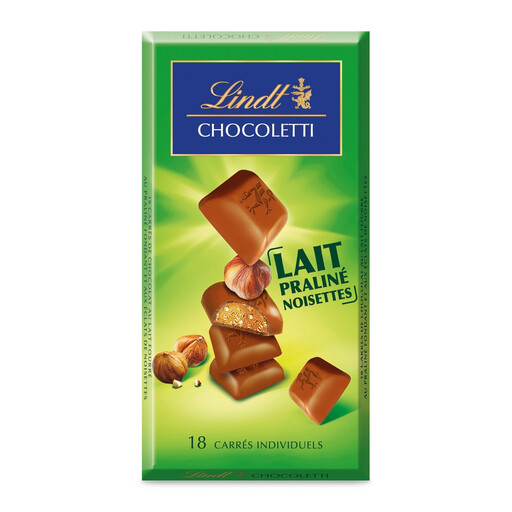 Image unavailable
This 100 g bar is ideal for serving praline chocolate with tea and biscuits if you’d prefer a bar rather than a box of individual chocolates.
Check the packaging for ingredients, allergens and, if required, FAIRTRADE/Max Havelaar certification for this specific product. Lindt’s stated cocoa sourcing approach isn’t enough to confirm it.
No. A brand’s stated sourcing approach doesn’t prove that the chocolate you choose carries the FAIRTRADE/Max Havelaar label. If this certification is important to you, check the product and the information on its packaging.
According to Fairtrade International, ingredients available on Fairtrade terms must be certified, and a composite product must have a total Fairtrade content of at least 20%. Read the back of the pack to find out which ingredients are covered and for more details about their sourcing.
Read the ingredients and ‘may contain’ statements for the product you choose. ETHIQUABLE’s praline bar contains milk and hazelnuts and may contain traces of other nuts, according to the brand. In France, the Ministry of the Economy reminds consumers that allergenic ingredients must be listed and highlighted on food labels.
Carrefour and Auchan stock ETHIQUABLE’s organic smooth milk praline chocolate bar. Check availability with the store or ordering service you plan to use.