What should you check before choosing?
First decide whether you need the product as an ingredient, as chocolate to hand out or as a portion to take with you. The same pack won’t necessarily suit all three uses.
| What matters |
What to check |
Who is this for? |
| Adding it to a recipe |
Whether the product information says it’s suitable for baking; the amount you need and how to store it after opening. |
If I’m making a cream or muffins with the children, I want a praline product that the recipe says can be mixed in, rather than chocolates that need unwrapping. Around 42% of consumers put this need first. |
| Sharing individual portions |
The number of pieces and whether they’re individually wrapped; don’t confuse these details with the total weight. |
When several children are sharing a treat at home, having a separate piece for each child may matter more than having several bars. Around 33% of consumers put this need first. |
| Lunchboxes and allergens |
Allergens on the pack you buy, the school or setting’s rules and any provisions in an individual support plan (PAI). |
If the chocolate is going to school or being shared with a group that includes someone avoiding certain foods, I need to check that it can be offered. For around 25% of consumers, this is the top priority. |
A choice for sharing at home
This praline bar, divided into squares, could work for sharing a small amount at home. It’s neither a multipack of bars nor a product described as suitable for mixing into a recipe.
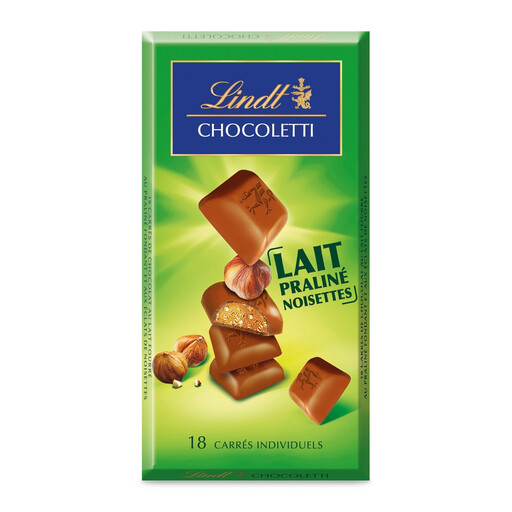 Image unavailable
Lindt Chocoletti milk chocolate and hazelnut praline, 100 g
For sharing a small amount of chocolate at home, this 100 g bar is divided into squares. If you need individually wrapped pieces, check before choosing it. If a child has an allergy or you’re packing a lunchbox, read the information on the pack you buy, particularly details about hazelnuts, almonds, milk, soya and barley.
View on Joybuy
Frequently asked questions
Can you put praline chocolate in a school lunchbox?
First check the pack and the school or setting’s rules. The products featured here contain nuts, and individual wrapping doesn’t guarantee that a product can be brought in. In France, the DGCCRF says that allergenic ingredients must be highlighted on prepacked foods. If your child has an individual support plan (PAI), also follow the provisions for their care, in line with the guidance from the Ministry of National Education.
Should you use praline paste or individual chocolates when baking with children?
To mix praline into a recipe, choose a paste or bar whose product information says it’s suitable for this use. E.Leclerc describes its paste as suitable for baking and fillings; Auchan’s mini chocolates are better suited to handing out.
Does a 3 x 100 g pack contain individual portions?
Not necessarily. The Tablette d’Or product listed by E.Leclerc contains three 100 g bars, which doesn’t mean each child gets a piece ready to hand out. For this use, look for a stated number of pieces and clear information about how they’re wrapped.
How should you store praline paste and mini chocolates?
Follow the instructions for the product you choose. For the praline paste reviewed, E.Leclerc says to seal the container tightly and keep it chilled after opening, for up to 10 days. For the Révillon mini chocolates reviewed, Auchan says to keep them away from moisture and heat, between 15 and 18 °C.


