Hosts who want to plan the serving
For a small gathering, you may prefer to open a few small jars rather than one large one. An assortment gives everyone a choice of flavours to share, while a wrapped bite is already a set portion.


If you want to offer several flavours at a small gathering, a trio of mini jars means you can open less of each recipe, but you’ll need something to spread it on and serve it with. If you’d rather hand out ready-portioned treats, a filled bite is more convenient—though it isn’t a jar of spread. In either case, check the ingredients, allergens and storage instructions. Nutri-Score is voluntary in France, not compulsory.
For a small gathering, you may prefer to open a few small jars rather than one large one. An assortment gives everyone a choice of flavours to share, while a wrapped bite is already a set portion.
If praline flavour is what you’re looking for, compare the ingredients and the hazelnut content where it’s stated. Then check whether the jar is the right size for the number of bites you plan to prepare.
Check the allergens in every recipe before serving. Depending on the product, the examples featured here contain tree nuts, milk or soya; a filled wafer may also contain wheat and barley.
For a drinks party, first decide whether you want to fill the bites yourself or hand out something ready to eat: a small jar can’t do both.
Choose this: if you want guests to try several recipes without opening a large jar of each flavour.
Bear in mind: you’ll need to portion the spread yourself, as well as provide something to spread it on and serving utensils.
Choose this: if you’d like to use praline paste to make your own mini open sandwiches.
Bear in mind: the amount on each bite will depend on how you serve it.
Choose this: if you want to hand out ready-to-eat portions without spreading anything.
Remember: a filled wafer isn’t a jar of praline spread, so check its ingredients separately.
| Criteria | What to check | Who is this for? |
|---|---|---|
| Format and portions | Jar to share or ready-to-eat portions; net weight and number of pieces. | If I want to serve quickly without portioning every bite, a ready-to-serve format matters more than having a range of jars. Around 40% of consumers would put serving convenience first. |
| Praline recipe | Ingredients list and hazelnut content, where stated. | When filling my own bites, I’d rather choose a recipe based on its ingredients than on the word ‘praline’ alone. This would be the main criterion for around 30% of consumers. |
| Allergens | Allergens and ‘may contain’ statements on every pack, including those in an assortment. | If guests have told me about a dietary restriction, I need to be able to check every recipe before serving. Around 20% of consumers would prioritise this check. |
| Storage | Instructions for after opening and how much is likely to be left at the end of the meal. | If we won’t finish every jar, I want to know how to store what’s left. Around 10% of consumers would put post-meal storage first. |
A small jar limits how much you open, but everyone can still serve themselves a different amount. A wrapped bite is a set portion, but it belongs to a different product category.
Decide whether you want spread to share or ready-to-serve portions before comparing net weight and the number of pieces.
On Carrefour France product pages, Sainte Lucie praline paste lists 49% hazelnuts, while Nocciolata La Bianca lists 30% hazelnut paste. These product descriptions are no substitute for checking the ingredients.
Compare the exact recipes based on the flavour and ingredients you’re looking for. Don’t infer nutritional values from the hazelnut content alone.
In France, the DGCCRF states that Nutri-Score is voluntary. If it isn’t shown, you can’t assign a score to the product; the nutrition declaration for prepacked foods is a separate requirement.
If a Nutri-Score appears on the packaging, read it alongside the nutrition information per 100 g, the ingredients and the portion you plan to serve.
Recipes in an assortment may contain different ingredients. A filled wafer may also contain gluten-containing cereals in addition to any allergens in its filling.
Read the label for every recipe, along with any ‘may contain’ statements on the product you’ve bought, before offering it to someone who has mentioned an allergy.
The trio of mini jars featured by Galeries Lafayette Le Gourmet contains 90 g in total and three recipes, including chocolate and hazelnut praline.
The 225 g jar of praline paste is suited to serving when you want to fill the bites yourself.
La Bianca is a hazelnut praline spread available in a 400 g jar.
The brand offers hazelnut and cocoa spread in a jar, as well as B-ready filled wafers.
The brand offers a 200 g jar of praline spread.
These two products suit different ways of serving nibbles: hand out pre-portioned filled wafers or fill bites yourself with praline spread from a jar.
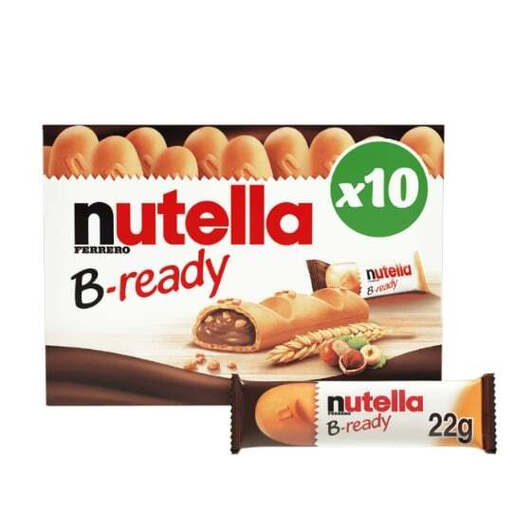 Image unavailable
Consider this if you want to hand out ready-to-eat portions: the pack contains 10 filled wafers weighing 22 g each, rather than praline spread. Check the label before serving to guests who need to avoid hazelnuts, milk, soya, wheat or barley.
 Image unavailable
If you want to fill bites yourself, this 200 g jar contains praline spread to share. Provide something to spread it on and portion it as you serve. It contains hazelnuts and should be refrigerated after opening; check the label on the product you buy.
No. As the DGCCRF explains, Nutri-Score is voluntary in France. For prepacked food, check the nutrition declaration and compare the values per 100 g; if there’s no logo, you can’t infer a score.
No. Its small size doesn’t set how much spread each person has. If you want to hand out a set portion, check the weight of each bite and what it is: a filled wafer isn’t spread in a jar.
Read the product name, ingredients and allergens for the exact product, then check its net quantity, nutrition information and storage instructions. For an assortment, check each recipe individually.
Follow the instructions on the jar you’ve bought, as these vary by recipe. The Paul Bocuse trio featured by Galeries Lafayette Le Gourmet says to refrigerate it for no more than 10 days after opening; Funkie says to refrigerate its praline spread and eat it soon afterwards.
No. Those descriptions don’t tell you which allergens a product contains. Funkie praline spread contains hazelnuts and may contain traces of peanuts and other tree nuts, so check the label on the product you’ve bought before serving it.