Anyone hosting friends for the match
You want to put a pot on the table for everyone to share, rather than hand out an individual portion to each guest.


To serve spread from the centre of the table during a match, choose a pot that’s the right size for your group. If you’re also making lunchboxes, individual portions will be easier to divide up. Check the recipe, though: large pots of hazelnut and cocoa spread, and packs with breadsticks, aren’t necessarily multipacks of praline spread. To compare products, check the nutritional information per 100 g, ingredients and allergens. If no Nutri-Score is shown, you can’t infer a rating.
You want to put a pot on the table for everyone to share, rather than hand out an individual portion to each guest.
You need to count and separate portions to take with you, while distinguishing the amount of spread from any accompanying snack.
You compare the recipe, allergens and nutritional values without assuming that an ‘organic’ label or the absence of a Nutri-Score tells you how nutritious a product is.
First, decide whether you’ll mainly serve the spread from a shared pot or portion it into lunchboxes. If you specifically want a praline recipe, check the product description and ingredients next: a hazelnut and cocoa spread won’t automatically meet that requirement.
| What to consider | What to check | Who it’s for |
|---|---|---|
| Amount for sharing | The pot’s net weight and how much you plan to serve; check that it’s described as ‘praline’ if the recipe matters. | I want to serve guests from a shared pot during the match, without portioning the spread in advance. Around 42% of consumers would prioritise sharing in this way. |
| Portions to take with you | The number of individual portions and the amount of spread in each, excluding any accompanying snack. | For lunchboxes, I’d rather be able to separate the portions than scoop spread from a large pot. Around 33% of consumers would put this need first. |
| Recipe and labelling | The ingredients, allergens, nutritional information per 100 g and Nutri-Score rating, if shown. | Before serving a group, I want to confirm that it’s a praline recipe and check for allergens. Around 25% of consumers would first choose based on ingredients and labelling. |
In France, the DGCCRF distinguishes between the Nutri-Score, which is voluntary, and the nutritional declaration, which is compulsory for the prepacked foods it applies to. So if there’s no logo, you can’t tell what rating the product would have.
Compare the nutritional information per 100 g and the ingredients. Only rely on a Nutri-Score rating if it’s actually shown.
According to E.Leclerc’s product listing, each unit in the Nustikao 3 × 60 g pack contains 40 g of spread and 20 g of breadsticks. The total weight therefore includes the accompanying snack.
Count the individual portions you’ll need for lunchboxes separately from the amount of spread you plan to serve before comparing this pack with a pot.
Allergens may differ between the spread and what comes with it. E.Leclerc’s listing for the Nustikao pack mentions wheat in the breadsticks, as well as milk and soya in the spread.
Check the label on every item in the pack before preparing a lunchbox or serving someone with an allergy.
These products show how formats and recipes can differ: a large pot of hazelnut and cocoa spread, a pot of praline spread and a pack with breadsticks each suit different needs.
Carrefour lists, among other options, an 825 g pot of hazelnut and cocoa spread, which could work well for serving a group.
E.Leclerc lists a 1 kg pot for sharing and a pack of three portions with breadsticks for serving individually.
Carrefour lists La Bianca hazelnut praline spread in a 400 g pot.
Carrefour lists Funkie praline spread in a 200 g pot, worth considering if you’re looking for a smaller container.
E.Leclerc lists a 400 g spread containing 35% hazelnuts, giving you another recipe to compare.
These hazelnut or hazelnut and cocoa spreads are suited to sharing during the match. If you’re looking specifically for a praline recipe or portions ready for lunchboxes, check these details before choosing.
 Image unavailable
Worth considering if you’re serving a group from a shared pot. The listed size is 3 kg, so it isn’t suitable for individual portions. Check the recipe if you specifically want praline spread, and look for the Nutri-Score rating if that matters to you.
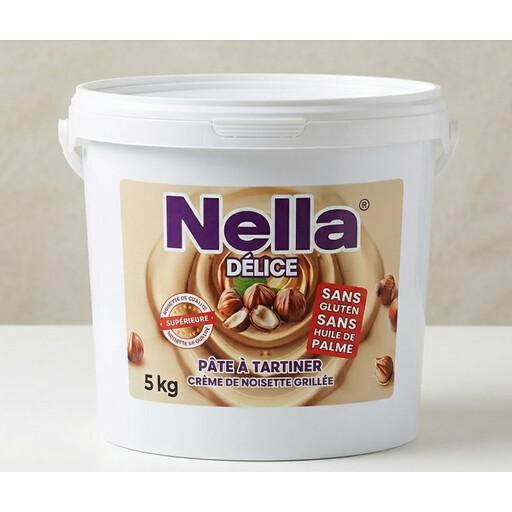 Image unavailable
Consider this if you need a large container for serving a group. This 5 kg pot isn’t a pack of individual portions to take with you. Check that the recipe suits your search for praline spread, and consult the label if you want to know its Nutri-Score rating.
 Image unavailable
Consider this for sharing from a single pot if you’d prefer a 1 kg size to the larger containers shown here. It doesn’t separate the portions for lunchboxes, so also check that the recipe is what you’re looking for and look for the Nutri-Score rating if it’s part of your decision.
No. The DGCCRF says that displaying a Nutri-Score is voluntary in France, while a nutritional declaration is compulsory for the prepacked foods it applies to. To compare two spreads, check their nutritional information per 100 g.
No. If there’s no logo, you can’t infer any rating. For example, Carrefour says that the Nutella brand does not wish to share its Nutri-Score on the product listing for the 825 g pot. You can still check the ingredients and nutritional information separately.
No. According to E.Leclerc, each of the three portions contains 40 g of spread and 20 g of breadsticks. The 180 g is the weight of the whole pack, which contains 120 g of spread.
Check the allergens in the product you choose and in anything included with it. The recipes shown here may contain hazelnuts, milk or soya, among other allergens. The breadsticks in the Nustikao pack mentioned by E.Leclerc also contain wheat. Always refer to the label on the product you’re serving.