For a snack you can take away with no preparation, choose a ready-to-eat item and check that it’s individually wrapped. A multipack of praline spread jars is better suited to sharing at home: you’ll need to prepare a portion for a lunchbox. Nutella B-ready is available in multipacks, but this filled wafer isn’t a spread.
Which format is right for you?
Parents packing a lunchbox
If you need a snack that can be eaten without a spoon or an open jar, look for a sealed, ready-to-eat item. Nutella describes B-ready as an individually wrapped wafer, making it a different option from praline spread. Before packing one for school, check whether a snack is needed at all.
Households sharing several jars
A multipack of jars can make it easier to share spread between several people at home. It won’t provide a ready-to-pack portion on its own, so check how many jars are included and whether the multipack you want is available.
Shoppers checking ingredients and allergens
Compare the exact product you’re thinking of buying: its ingredients, highlighted allergens and nutritional values. Nutri-Score can be a useful guide when it appears on the packaging, but displaying it is voluntary in France, according to the Ministry of the Economy.
What should you check before buying?
For a mid-morning break, first decide whether you want something ready to eat as it is or a spread, then compare the labels and sharing formats.
| Criteria | What to check | Best for |
|---|
| On-the-go format |
Check what the product is, whether each item is individually wrapped and the weight per portion. |
I want to put a sealed item in a lunchbox without decanting any spread. Around 45% of consumers prioritise this ready-to-go format. |
| Ingredients and allergens |
Read the ingredients and allergen information, then compare nutritional values on a like-for-like basis, particularly per 100 g. |
If anyone in my household needs to avoid certain ingredients, I want to check the recipe before choosing a format. Ingredients are the top priority for around 33% of consumers. |
| Sharing jars |
Check the number of jars, their net weight and whether the multipack is available. |
Several people will be using the spread at home, so I’m looking for jars to share rather than individual portions to take away. This comes first for around 22% of consumers. |
Common mix-ups to avoid
-
Assuming a multipack of jars contains lunchbox portions
Several jars give you spread to share, but they aren’t ready-to-eat portions for when you’re away from home.
If you want spread while you’re out, prepare a portion in a suitable container and bring something to eat it with. For a snack that needs no preparation, check that each item is individually wrapped.
Preparing and carrying a portion takes time and requires an extra container.
-
Assuming Nutri-Score is compulsory
In France, the Ministry of the Economy says that displaying Nutri-Score is voluntary. The DGCCRF explains that nutrition declarations are compulsory for most of the prepacked foods covered by the rules. So, the absence of a Nutri-Score doesn’t, by itself, mean that the labelling is incorrect.
Compare the ingredients list and nutritional information, particularly per 100 g. Use Nutri-Score as an additional guide when it’s shown.
-
Choosing based on the word “praline” alone
A filled wafer and a spread in a jar aren’t used in the same way. Their ingredients and allergen information can also vary from one product to another.
Check what type of product it actually is and read the label for the one you’re buying, especially if you need to avoid nuts, milk, soya or cereals.
Brands to know when comparing formats
Nutella
Nutella’s B-ready is a filled wafer with a Nutella flavour, available in packs of 2, 6, 10 or 15, according to the brand.
- Nutella describes B-ready wafers as individually wrapped. Check the pack you choose if you’re buying them for a lunchbox.
- B-ready isn’t praline spread in a jar. According to Nutella’s nutritional information, one 22 g wafer contains 10,4 g of sugars. The brand lists hazelnuts, milk, soya, wheat and barley among its ingredients.
Funkie
Carrefour’s Funkie praline spread comes in a 200 g jar, so you’ll need to portion it before taking it out with you.
- Carrefour’s product information describes an organic recipe containing 28,2% red bean purée and 21% roasted hazelnuts.
- The jar isn’t a ready-to-go individual portion. Check the ingredients list for hazelnuts if this allergen is a concern for you.
Nocciolata
Bianca is a praline spread in a 400 g jar, with a recipe you can compare against other spreads in jars.
- Carrefour’s product information lists 30% hazelnut paste for this product.
- Bianca also contains milk and soya, and the jar doesn’t provide a prepared lunchbox portion.
A multipack snack on Joybuy
This selection is a multipack of ready-to-eat wafers for a snack on the go, not a multipack of praline spread jars. If you need each wafer to be individually wrapped for your lunchbox, check this on the product you choose.
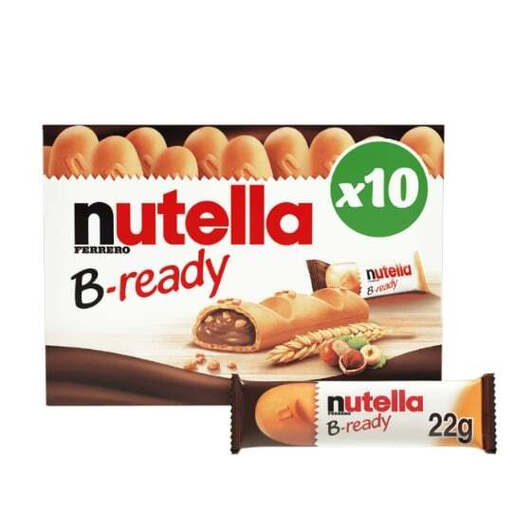 Image unavailable
Nutella B-ready, 10 wafers, 220 g
This multipack is a good choice if you want a ready-to-eat wafer rather than a spread.
It contains 10 wafers weighing 22 g each. If individual wrapping is essential, check before buying. Also check the allergen information on the label for the product you choose.
View on Joybuy
Frequently asked questions
Is Nutri-Score compulsory on spreads sold in France?
No. According to the Ministry of the Economy, displaying Nutri-Score is voluntary. The DGCCRF says that nutrition declarations are compulsory for most of the prepacked foods covered by the rules. Check these to compare fat and sugar content on a like-for-like basis.
Is a multipack of jars enough to prepare a lunchbox?
Not if you’re looking for a ready-to-eat portion that needs no preparation. You’ll need to portion out the spread and bring a container, as well as something to spread it on. An individually wrapped wafer avoids this preparation, but it isn’t a spread in a jar.
Which allergens should you check in these spreads and wafers?
Always read the ingredients list for the product you’re buying. Carrefour’s product information for Nocciolata Bianca lists hazelnuts, milk and soya; Nutella also lists wheat and barley for B-ready. The DGCCRF says that allergens must be highlighted in the ingredients list on prepacked foods.
Should you always pack a snack for school?
No. The Anses says that it’s not advisable to routinely add eating occasions at school outside structured mealtimes. Choosing an easy-to-carry format doesn’t mean that every child needs a snack every day.


