Organisers serving straight from the jar
You’re looking for a spread to spoon or spread onto crêpes and biscuits, with minimal preparation on the day of the festival. The product description and instructions matter just as much as the jar size.


If you’re serving crêpes or biscuits at a festival, choose a spread rather than praline paste intended for baking. Work out how much you’ll need, then check the recipe, allergens and storage instructions for the jar you’re considering. A larger size alone doesn’t mean it’s right for your service or budget.
You’re looking for a spread to spoon or spread onto crêpes and biscuits, with minimal preparation on the day of the festival. The product description and instructions matter just as much as the jar size.
You need to allow for enough product without choosing a size based on the jar alone. Consider the net weight alongside the number of portions and any other toppings you’re planning to serve.
You need to know exactly what’s in the product before offering it to a group. Depending on the recipe, check for hazelnuts, almonds, milk, soya or any traces listed on the packaging.
Choose this if: you need to top bread, crêpes or biscuits directly.
Bear in mind: recipes and storage instructions vary from jar to jar, even when the products are intended for similar uses.
Choose this if: the praline is going into a recipe rather than being served straight from the jar.
Bear in mind: you’ll need an extra preparation step. Auchan says to mix Vahiné’s paste and add La Patelière’s to baked goods.
| Consideration | What to check | Who it matters to |
|---|---|---|
| Quantity and size | Consider the net weight alongside the number of portions and any other toppings you’re planning to serve. | If I need to serve a large number of people without opening lots of jars, having enough usable product comes first; around 50% of consumers prioritise this. |
| Recipe and allergens | Read the product description, instructions and allergen information for the exact product, including any traces listed. | When I’m serving a group with different dietary requirements, I need to know exactly what’s in each recipe; this is the top priority for around 30% of consumers. |
| Storage and serving | Check the jar’s specific requirements for transport, storage and keeping it after opening. | For a stall where jars will be open during service, I need to be able to follow their storage instructions; around 20% of consumers put this first. |
La Patelière describes its praline paste as an ingredient to add to baked goods, while Vahiné says to mix its paste until smooth. These products aren’t necessarily suitable for serving straight from the jar.
If you’re not planning to prepare anything on site, choose a product explicitly described as a spread.
A paste that needs preparing can take extra time and equipment during service.
The DGCCRF says Nutri-Score is voluntary in France. So, on its own, the absence of a Nutri-Score label doesn’t mean a spread is non-compliant or lower quality.
To compare products, check their ingredients and nutritional values. For relevant prepacked foods, nutrition information is given per 100 g or 100 ml.
Product listings from Carrefour and Auchan show that praline products may contain nuts, milk or soya, depending on the product. Some recipes also warn that traces may be present.
Check the label on each variety before serving, and keep the information somewhere easy to read.
Organic praline spread sold in a 200 g jar.
La Bianca is an organic praline spread with milk and hazelnuts, sold in a 400 g jar.
Praline paste in a 225 g jar, which is different from products explicitly intended for spreading.
200 g almond and hazelnut praline paste intended for use in recipes.
200 g praline paste, which Auchan describes as an ingredient to add to baked goods.
These spreads are suitable for serving without any baking preparation. Some contain cocoa and hazelnuts, while NELLA PRO is described as a hazelnut spread. Check that the recipe is what you’re looking for before choosing a size.
 Image unavailable
This 200 g jar is a good option when you’re looking for a spread. The recipe contains hazelnuts; follow the product listing’s instructions and store it in the fridge after opening.
 Image unavailable
Consider the 3 kg jar if the quantity you need for repeated service warrants this size. Check the packaging for allergen information and storage instructions for your stall.
 Image unavailable
This 250 g jar of cocoa and hazelnut spread is a handy small size for serving straight from the jar. Check the ingredients on the exact product for anyone with allergies.
 Image unavailable
The 1 kg jar makes it easier to plan how much spread you’ll need for serving on crêpes or waffles. Bear allergens in mind, and protect the jar from heat and light in line with the product listing’s instructions.
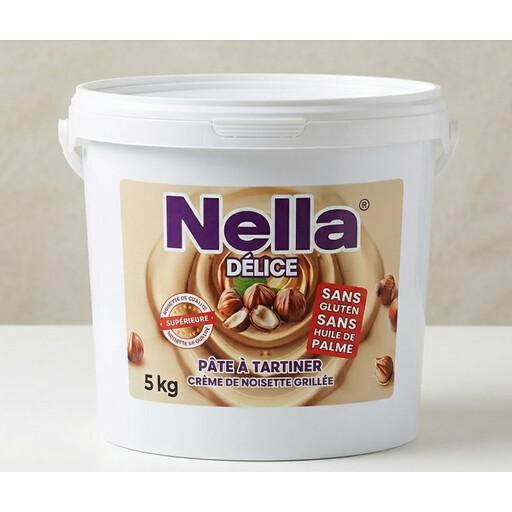 Image unavailable
This 5 kg size may suit high-volume service if a hazelnut recipe is what you want to offer. Check the packaging for allergens and storage instructions after opening. Don’t assume it contains cocoa or is described as praline spread.
No. The DGCCRF describes Nutri-Score as a voluntary label, so the absence of a logo isn’t enough on its own to judge a product. For relevant prepacked foods, check the nutrition information instead, particularly the values given per 100 g.
Check the label on the exact jar, including any traces listed. According to Carrefour and Auchan’s listings for these products, recipes may contain hazelnuts, almonds, milk or soya. Vahiné’s listing also mentions possible traces of eggs and other nuts.
No: follow the instructions for each product. Auchan’s listing for La Patelière says to keep it in the fridge for 21 days after opening, while its listing for Nocciolata La Bianca says to store it between 15 and 25 °C. Don’t apply these instructions to a different jar.