Buffet organisers planning for predictable demand
If you’re planning several breaks or breakfasts, a 3 kg or 5 kg tub may be worth considering, provided you plan for demand, storage and serving from an opened container.


For several servings with predictable consumption, start by looking at 3 kg tubs. A 5 kg tub requires sufficient demand and suitable storage once opened. A 1 kg jar or individual portions are better suited to serving smaller amounts over time, but are not interchangeable with a catering-size tub. In every case, check the recipe, allergens and instructions for the product you’re serving. The DGCCRF points out that Nutri-Score is voluntary and does not replace the applicable nutrition declaration.
If you’re planning several breaks or breakfasts, a 3 kg or 5 kg tub may be worth considering, provided you plan for demand, storage and serving from an opened container.
If you need to distribute the spread across several serving points or minimise handling of a shared container, pouches and individual portions are other formats to consider.
If you don’t know all your guests’ dietary requirements, the ingredient list, allergens and storage instructions for the product you’re serving matter just as much as the container size.
For a conference, first choose a serving method that suits the expected quantity, then check the recipe and label information for each product.
Worth considering: for several servings close together, when consumption is predictable.
Plan for: serving hygienically and keeping track of the tub after opening.
Worth considering: if you need a large quantity or will also use the spread in baking.
Plan for: using and storing a larger container once it’s open.
Worth considering: to serve across several tables or avoid using a shared tub.
Plan for: more units and packaging to distribute or manage.
| Criteria | What to check | Consumers concerned |
|---|---|---|
| Container size | Estimate consumption per serving and check how many containers come in a pack before choosing 3 kg or 5 kg. | If I need to cater for several breaks, I want enough product without being left with a large, opened tub that’s difficult to manage; around 36 % of consumers make getting the quantity right their top priority. |
| Serving arrangements | Work out how many serving points you need and whether the product will be served in individual portions or from a shared container. | When the buffet is spread across several tables, I’d rather minimise handling at each station; around 29 % of consumers prioritise this kind of convenience. |
| Recipe and allergens | Read the ingredients and allergen information for the product delivered, along with its instructions for after opening. | If I don’t know all my guests’ dietary requirements, I need to be able to tell them which allergens are in the product actually being served; around 21 % of consumers put this check first. |
| Nutrition information | Compare the nutritional values per 100 g; check the Nutri-Score if it appears on the product. | When comparing two recipes, I want to read their values on the same basis rather than rely on a single logo; around 14 % of consumers make this their top criterion. |
The DGCCRF describes Nutri-Score as voluntary labelling: its absence alone doesn’t mean a product is non-compliant. Nor does its presence tell you everything about the ingredients or allergens.
Compare the nutritional values per 100 g and the ingredient list. Use Nutri-Score as an additional guide when it is displayed.
You need to be able to serve a 3 kg or 5 kg tub hygienically and store it according to the instructions for that particular product. The largest size isn’t necessarily right for a one-off conference.
Plan for consumption per serving, note the opening date and follow the instructions for the product you’ve bought.
Ingredients and possible traces vary between spreads. A name such as ‘praline’ isn’t enough to establish the allergens in the product being served.
Keep the label or product specification for the product you’re using and use it to communicate allergen information, especially if the spread is served out of its packaging.
These examples of catering ranges show how pack sizes and recipes can differ. Always check the specific product you choose for your buffet.
Pomona EpiSaveurs lists a Bonne Maman hazelnut and cocoa spread in a 3 kg tub.
The brand offers a hazelnut spread with hazelnuts from Lot-et-Garonne and cocoa in a 3 kg tub.
GEDAL lists a Cémoi spread for catering, stated to contain 13 % hazelnuts, in a 3 kg tub.
Valrhona Selection offers a Pariani hazelnut and cocoa spread in a 5 kg tub for professional use, including baking.
The Transgourmet catering catalogue includes a 1 kg pouch and Nutella portions of 15 g and 25 g.
These products let you compare two large containers with a 1 kg jar for serving smaller amounts over time. The jar shown is not the pouch or individual portions mentioned among the other formats.
 Image unavailable
Worth considering for several servings if your expected consumption justifies a 3 kg container.
Plan how you’ll serve from the shared container and check the allergens and instructions for after opening on the product delivered.
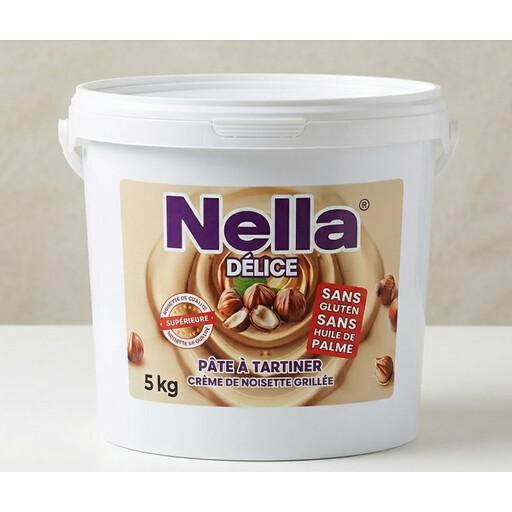 Image unavailable
The 5 kg size is worth considering if demand is predictable or if the spread will also be used in baking.
If you’re specifically looking for a hazelnut and cocoa recipe, check the ingredients for this product. Also check its allergens and instructions for after opening before serving.
 Image unavailable
This 1 kg jar may suit a smaller service or several serving occasions, provided you plan how to present and store it.
This is a jar, not a pouch or individual portions; check the allergens on the jar before serving.
No. The DGCCRF states that Nutri-Score is voluntary. For prepacked food, check the nutrition declaration and any other applicable information, but don’t treat the absence of the logo as non-compliance.
Check the exact product, its ingredients and allergens, its date and batch number, and its storage instructions. Keep this information accessible if the spread is served out of its packaging.
Use the information on the label and in the product specification for the product actually being served, then make the relevant allergen information clearly available to guests. Don’t infer the ingredients from the word ‘praline’ alone or from another recipe by the same brand.
It may be suitable if consumption is predictable enough and you can organise serving and storage after opening. If demand during the break is uncertain, also consider a 3 kg tub or a smaller pack.
No: follow the instructions for the product you’ve bought. For its 3 kg tub, Lucien Georgelin advises storing it away from heat and moisture and consuming it within a month of opening; don’t apply this timeframe to another product.