Travellers who want to eat without spreading
If you’re not taking bread or a utensil, a ready-to-eat snack is a better fit than a jar. Nutella describes B-ready as an individually wrapped wafer, not praline paste in a jar.


For eating on the train, choose a jar of praline paste if you’re taking something to spread it on and a utensil to serve a portion. A small portion of paste is still meant to be spread, while an individually wrapped snack can be eaten without any preparation but belongs to a different category. In either case, check the recipe and ingredients of the product you choose.
If you’re not taking bread or a utensil, a ready-to-eat snack is a better fit than a jar. Nutella describes B-ready as an individually wrapped wafer, not praline paste in a jar.
You can choose a jar if you’re taking something to spread it on, a utensil and an amount that suits your journey. To avoid carrying more than you need, compare formats based on how much you’re likely to use.
The hazelnut content and the presence of milk, soya or other ingredients vary between recipes. Read the label on the exact product, then check its nutritional information if you want to compare different spreads.
First, decide whether you want to spread something during your journey. You can then compare products for their format, useful quantity, recipe and nutritional information to find the best fit.
| Criteria | What to check | Who it matters to |
|---|---|---|
| Ease of eating | Are you taking something to spread it on and a utensil? A portion of paste isn’t eaten in the same way as a ready-to-eat snack. | If I want to eat on the train without opening a jar or making a sandwich, the packaging is my top priority; around 30% of consumers would prioritise this convenience. |
| Amount to take | Compare the weight of the container with the portion you plan to use and the space available in your bags. | For a single snack, I’d rather take an amount that suits my meal than a jar I’ll only partially use; around 30% of consumers would make the useful quantity their priority. |
| Recipe and ingredients | Read the ingredient list for the exact product, especially the hazelnut content and whether it contains milk or soya. | If I’m looking for a particular praline recipe or need to avoid an ingredient, the format name alone isn’t enough; this would be the main concern for around 20% of consumers. |
| Nutritional information | Compare the values per 100 g, especially sugars, fat and salt. Check the Nutri-Score if it’s shown on the product. | If I’m choosing between two recipes, I want to compare their nutritional values on the same basis; around 20% of consumers would prioritise this comparison. |
In France, the Ministry of the Economy states that displaying the Nutri-Score is voluntary. The DGCCRF says that the nutrition declaration for relevant prepacked foods is given per 100 g or 100 ml. So if a product doesn’t show a Nutri-Score, you should still check its nutritional information and ingredients.
A larger container may hold more than you need for your journey, even if you’re planning to spread some paste.
Choose an amount that suits your snack and how much you want to carry after your meal.
The Sainte Lucie praline paste listed by Carrefour stands out here for its recipe and 225 g jar.
The Funkie praline paste listed by Carrefour combines hazelnuts with a red bean purée base.
The La Bianca product listed by Carrefour is a hazelnut and milk praline paste.
The Nustikao product listed by E.Leclerc is a hazelnut and cocoa spread in a 400 g jar, rather than a product specifically described as praline paste.
Nutella describes B-ready as an individually wrapped wafer for eating without spreading.
These two spreads suit different needs: a jar of praline paste to serve with something to spread it on, or a small portion of chocolate and hazelnut spread to take with you. Neither is a ready-to-eat snack that you can enjoy without any preparation.
 Image unavailable
This jar is a good choice if you’re taking something to spread it on and a utensil to serve your portion on the train.
Format: 200 g jar. Once opened, follow the storage instructions on the packaging.
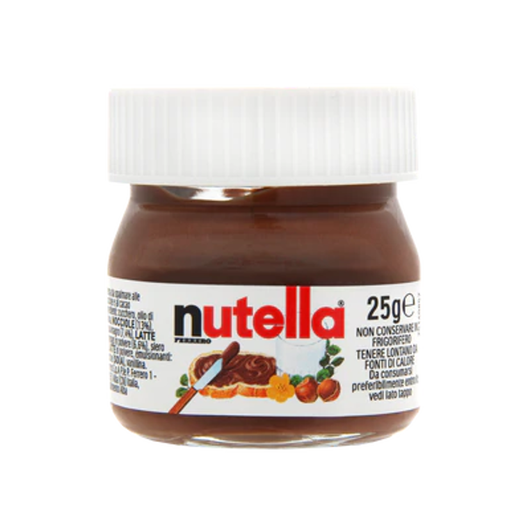 Image unavailable
This small portion is for travellers who want to take spread with them without carrying a large jar.
Format: 25 g. This is a chocolate and hazelnut spread, not a product specifically described as praline paste. Take something to spread it on and check whether you’ll need a utensil.
No. According to the Ministry of the Economy, displaying it is voluntary in France. For relevant prepacked foods, the DGCCRF states that the nutrition declaration is given per 100 g or 100 ml, so check it even when the jar displays a Nutri-Score.
First compare the amount you’ll actually use during your journey, then look at the ingredients and nutritional values per 100 g. A small jar and a large one aren’t interchangeable if you don’t want to carry the remainder after opening.
No. Always check the ingredient list and any ‘may contain’ warnings on the exact product packaging. The praline products listed by Carrefour contain hazelnuts, and some also mention milk or soya.
Not necessarily. A portion of spread is still intended to go with something to eat, and you may need a utensil. If you want to eat without spreading anything, choose a ready-to-eat snack instead, bearing in mind that it’s a different type of product.