For a ganache or batter where the praline needs to be mixed in, start with a bar marketed for baking and check that its ingredients suit your recipe. If you’d rather have pieces, decoration or a portion to enjoy alongside your dessert, a filled bar or individually wrapped squares are better suited to the job. Bear in mind, though, that inclusions can change the texture of a melted mixture.
Who are these formats for?
People baking in small quantities
For a small yule log, cookies, a brownie or a ganache, your choice depends on how much you need to mix in and the role the chocolate plays in the recipe. Auchan, Carrefour and E.Leclerc list praline bars intended for desserts, in 170 g or 200 g formats.
People looking for a portion or a distinct texture
Squares, a filled bar or bite-sized chocolates can be used as pieces or decoration, or enjoyed alongside your bake. In this case, the filling and inclusions matter just as much as the quantity you use.
People who pay close attention to ingredients
If you need to check for particular ingredients, look at the exact product before adding it to your dessert. Product information from Auchan and Lindt France lists different ingredients, particularly nuts, milk and cereals.
What should you look for before buying?
First decide whether the praline should melt into your mixture or remain distinct on the plate. Then check the format, ingredients and quantity for the product you’re considering.
| Criteria |
What to check |
Who is it for? |
| Mixing into the recipe |
Whether it is described as being for baking or desserts, and whether it contains a filling or inclusions. |
If I’m making a ganache or batter, I’m looking first for a base that’s suited to that step; around 36% of consumers prioritise this need to mix it in. |
| Portion and texture |
The shape of the squares or bites, the net weight and any crunchy pieces. |
For decorating a small dessert or serving a treat alongside it, I want a recognisable portion. This is the main priority for around 29% of consumers. |
| Ingredients and allergens |
The ingredients, highlighted allergens and any ‘may contain’ statements for the exact variant. |
When I’m cooking for someone who needs to avoid certain ingredients, I have to check the specific product before choosing it; around 21% of consumers put this check first. |
| Amount needed |
The net weight of the bar and the quantity required by the recipe. |
For a single bake, I’d rather buy an amount I can use up or store. Around 14% of consumers make choosing the right quantity their top priority. |
Two common mix-ups to avoid
-
Treating a bite-sized chocolate like a bar for baking
A filling, nuts or crunchy pieces might work well in a dessert as pieces or decoration, but they can change the texture of a ganache you want to keep smooth.
Before choosing, work out what role the chocolate needs to play in your recipe, then check the product description and ingredients for the exact product.
-
Assuming all praline products contain the same allergens
Ingredients vary between products. For example, Lindt CREATION Lait Praliné Feuilleté includes almonds, hazelnuts, milk, wheat, barley and soya.
Before using it for guests with allergies, check the label on the product you’ve bought, including highlighted allergens and any ‘may contain’ statements.
Brands to know when choosing
Nestlé Dessert
Auchan describes its 170 g Praliné bar as chocolate for baking.
- The product information lists 20% roasted hazelnuts and a minimum cocoa content of 36%.
- It lists hazelnuts and milk, among other ingredients. Check the pack you buy for any other allergen information, too.
Carrefour Original
Carrefour lists a 200 g praline dessert bar.
- The product information lists 32% praline and a minimum cocoa content of 39% in the milk chocolate.
- Check the ingredients for this product before using it as a substitute in a recipe.
TABLETTE D’OR
E.Leclerc describes its 200 g product as a praline speciality for desserts.
- Its product information lists 50% praline and states that it is made in France.
- The description ‘praline speciality’ doesn’t mean you can use it in place of dark chocolate in a recipe without checking first.
Lindt
Lindt France lists CREATION Lait Praliné Feuilleté as a 150 g filled chocolate bar.
- Its filling combines almond and hazelnut praline with crisp wafer pieces, which could work well if these pieces are part of the dessert you have in mind.
- These inclusions aren’t suitable for a mixture that needs to stay smooth. Check the allergens for this product, too.
Ferrero Rocher
The Ferrero Group describes Ferrero Rocher as a bite-sized chocolate built around a hazelnut and coated in chocolate.
- Its format could work as a bite served alongside a bake or as a decoration that stands out.
- Before using it in a recipe, check the ingredients and allergens on the packaging for the exact variant.
Praline squares on Joybuy
This selection features praline-filled squares for an individual portion or decoration. If your recipe calls for a smooth melted base, check separately that the product is suitable for this use.
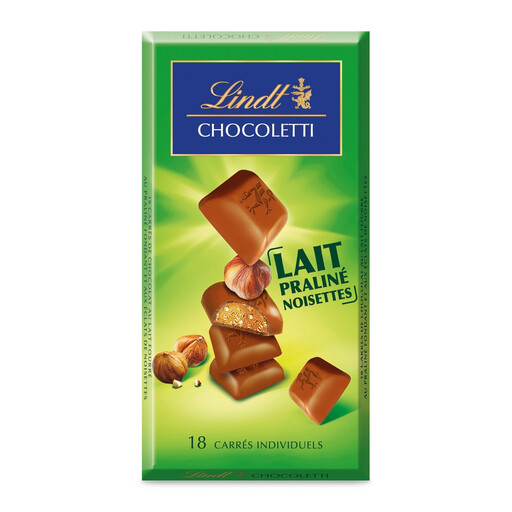 Image unavailable
Lindt Chocoletti milk chocolate and praline bar, 100 g
The individual squares, filled with hazelnut praline, work well as a portion or decoration when you want the square to remain recognisable.
The bar contains 100 g. Before adding it to a melted mixture, check that its texture suits your recipe. For allergen information, refer to the packaging of the variant you buy.
View on Joybuy
Frequently asked questions
Is a praline bar always suitable for ganache?
No. For a smooth ganache, first look for a bar marketed for baking, then check its ingredients and the instructions in your recipe. A filled or crunchy bar is a better choice when you want the pieces to be part of the finished result.
How should I store a bar before making dessert?
Follow the storage instructions on the packaging of the product you’ve bought. For its Dessert Praliné bar, Auchan’s product information recommends storing it in a cool, dry place away from light, between 15 and 18 °C. Don’t assume these conditions apply to every other bar.
Where can I check the allergens in a praline bar?
Read the label for the exact variant, paying particular attention to highlighted allergenic ingredients and any ‘may contain’ statements. The DGCCRF and Service-Public.fr outline French rules on allergen information. The word ‘praline’ alone doesn’t tell you everything about a product’s ingredients.


