
Livraison le jour même ou le lendemain

Qualité garantie

Débloquez vos offres de bienvenue: Livraison GRATUITE | Jusqu'à -80 % | 30 jours d'essai gratuits à JoyPlus
Téléchargez l'application
Even with the handbrake on, a vehicle can roll a few centimetres on a slope, wet ground or an uneven surface. Whether you have a car, trailer, caravan or motorhome, a rubber car wheel chock provides simple, effective mechanical support.
Not all models are made equal, though. A chock that’s too light may slip, a weak base can deform, and a model without a handle can be awkward to retrieve from beneath the vehicle. Here are the features to check before you buy, along with options to suit different needs.
A heavy chock isn’t necessarily more stable. Its shape, contact angle and base profile all affect how it meets the tyre and the ground. Check the dimensions and the manufacturer’s specifications rather than relying on the stated weight alone.
A trailer wheel chock on dry concrete won’t behave in the same way as it would on wet grass, gravel or an oil-stained surface. An anti-slip wheel chock should have a sufficiently wide base, with a textured surface or grooves to help limit movement.
Take claims such as “all-terrain” with a pinch of salt: you’ll still need to check the slope, ground conditions and vehicle weight.
A parking wheel stop with pegs and screws is suitable for a garage or private parking space. It’s not much use for a motorhome that’s regularly moved. Conversely, a portable chock won’t position your vehicle as precisely as a garage wheel stop fixed to the ground, particularly if you want to park at the same distance from the wall every time.
Rubber is popular for its gentle contact with the tyre and its ability to help prevent slipping. For outdoor use, look for a material described as weather-resistant and resistant to moisture, and, where specified, to hydrocarbons or oils.
A lorry or motorhome wheel chock must also withstand the demands of a heavier vehicle. Refer only to the load stated on the product page: a chock can’t turn a slope into a perfectly safe parking space.
The height and width of the chock should suit the tyre diameter and vehicle weight. A compact model may be suitable for a small car, while a motorhome or loaded trailer will generally need a more substantial design.
Also check the shape of the surface that makes contact with the tyre. A sufficiently high, sloping profile makes it easier to secure the wheel, while a ridged base can improve grip on some surfaces.
A wheel chock with a handle is easier to position and remove, particularly when there’s little space between the tyre and the ground. Reflective strips on a parking stop can improve visibility at night or in a poorly lit car park.
Finally, make sure you know whether you’re looking at a portable or fixed option. A rubber parking stop supplied with a mounting kit needs a suitable surface and careful installation. Before you start, check that the screws, wall plugs and instructions are included.
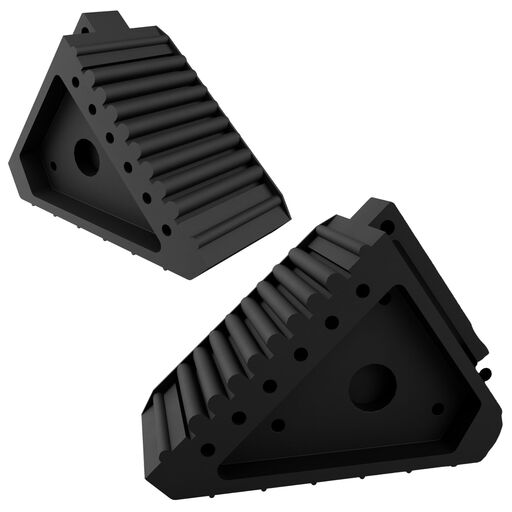
Why it suits this type of user: This four-piece set is suitable for a car, trailer or vehicle with several wheels to secure. The built-in handles make the chocks easier to handle and store.
The ridged, contoured base helps reduce the risk of a smooth chock slipping on uneven ground. The rubber is described as oil- and weather-resistant.
Set of four chocks, built-in handles, stated dimensions of approximately 20 × 10 × 15 cm and rubber construction.
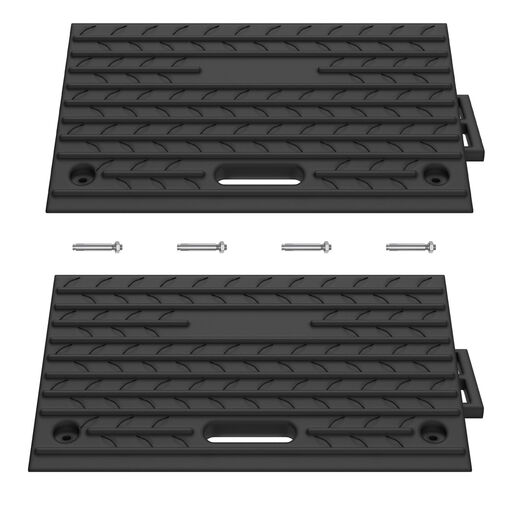
Why it suits this type of user: Its generous dimensions make it a good choice if you want to mark out a parking space precisely in a garage, courtyard or car park.
The wide ramp helps prevent the vehicle from stopping abruptly against an obstacle. It can also be fixed in place permanently and has a channel for water to drain away.
Set of two, stated load capacity of 2 000 kg, anti-slip surface and construction designed to withstand outdoor conditions.
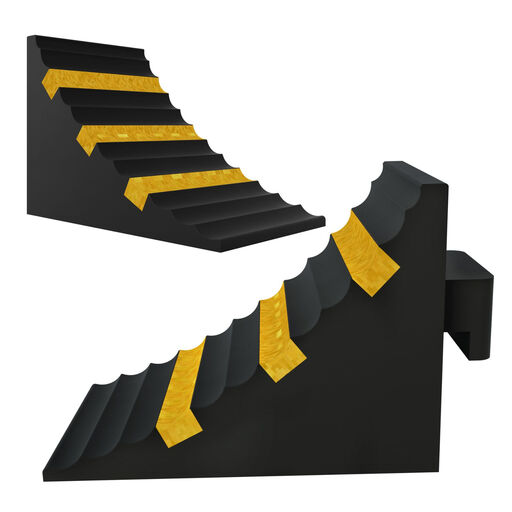
Why it suits this type of user: Its substantial size is ideal for owners of vans, lorries, trailers or motorhomes looking for a large, portable chock.
Its 25 × 16 × 19 cm dimensions and ridged profile help reduce the risk of using a chock that’s too small for a heavy vehicle or slightly sloping ground.
Four chocks, wide handles, a deeply textured base and a design described as suitable for cars, lorries, trailers and motorhomes.
Compare the chock’s height with the tyre diameter and take the vehicle’s weight into account. A compact model may be enough for a small car. A loaded trailer, van or motorhome will generally need a wider, taller chock. Always refer to the maximum load specified by the manufacturer.
No. It’s an additional parking safety accessory. Use the handbrake, the “P” position on an automatic gearbox and any stabilising equipment in accordance with your vehicle’s manual.
Its lifespan depends on how often it’s used, the weight it supports, storage conditions and exposure to oil, frost or UV rays. Check the base and contact area before each substantial use. Replace the chock as soon as you notice any cracks or visible deformation.