
Livraison le jour même ou le lendemain

Qualité garantie

Débloquez vos offres de bienvenue: Livraison GRATUITE | Jusqu'à -80 % | 30 jours d'essai gratuits à JoyPlus
Téléchargez l'application
Whether for a night hike, a roadside emergency, or a simple power outage at home, a powerful flashlight is more than just a gadget—it's an essential piece of equipment. The problem? The market is flooded with models making tempting promises with often incomprehensible spec sheets. Navigating the maze of lumens, battery types, and marketing claims can be a real challenge.
As the Head of Product Recommendations at Joybuy, my mission is to help you see things more clearly. Together, we'll break down the most common pitfalls so you can make an informed decision that's perfectly suited to your actual needs, not the sirens of marketing.
Buying a flashlight seems simple on the surface, but a few common mistakes can quickly turn your purchase into a disappointment. Here are the key points to watch out for.
The lumen measures the total light output from a source. To catch the eye, many manufacturers display astronomical figures, like 10,000 lumens, to grab your attention. While a high lumen count signifies raw power, it doesn't guarantee the beam's effectiveness. A poorly designed flashlight might produce a very bright but overly diffuse light that's useless over long distances. The quality of the optics and the beam's concentration (measured in candelas) are just as crucial for achieving a long throw.
A claimed runtime of several hundred hours? That's often measured in the most power-efficient mode, which may only emit a few lumens. It's therefore imperative to check the runtime at the power levels you actually plan to use. The battery type is another decisive factor. Disposable batteries end up being expensive, while a non-replaceable integrated battery can render your flashlight useless after a few years. A USB-C rechargeable flashlight is now the most convenient and universal solution, allowing you to charge it with the same cables as your other devices.
The term "tactical" is often overused to describe rugged flashlights built for extreme conditions. Unfortunately, many entry-level models co-opt this label without possessing the necessary qualities. A true compact tactical flashlight must be made from aerospace-grade aluminum alloy, have a high IP (Ingress Protection) rating against water and dust, and be shock-resistant. A fragile model that gives up the ghost at the first downpour is tactical in name only.
To ensure you choose a flashlight that will meet your expectations, focus on these few objective technical parameters.
Don't rely solely on lumens. To truly understand a flashlight's performance, analyze these three indicators:
A good professional flashlight should offer intelligent power management. Be sure to check the runtime for each power level. The inclusion of a USB-C port is a significant advantage today in terms of convenience. Some high-end models even offer a dual charging option, combining USB-C with a proprietary magnetic charging system.
The IP (Ingress Protection) rating is an international standard that assesses a device's resistance to solid objects (dust) and liquids (water). The first digit indicates protection against solids, the second against liquids. For outdoor use, an IPX8 rating is an excellent benchmark: it guarantees the flashlight can be submerged in over a meter of water without damage.
Rather than an endless list, we've matched specific models to well-defined user profiles. The goal: to help you find the flashlight that's truly right for you.
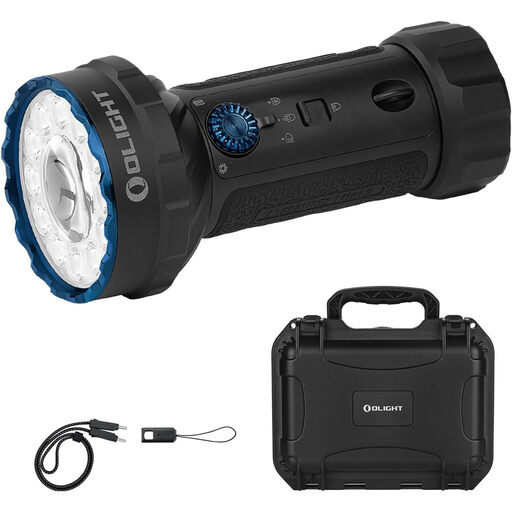
Why this model? For those who make no compromises on performance. It's the ideal flashlight for intense outdoor activities, nighttime operations, or security professionals who demand maximum power and reliability in a manageable form factor.
This model offers verifiable performance (10,000 lumens and 750 m throw), a dual charging option (magnetic and USB-C), and a rugged aluminum alloy construction with an IPX8 rating. It thus sidesteps the three most common pitfalls.
Its versatility is exceptional, thanks to its wide (floodlight) and focused (spotlight) beam modes, complemented by colored lights. A true luminous toolkit.
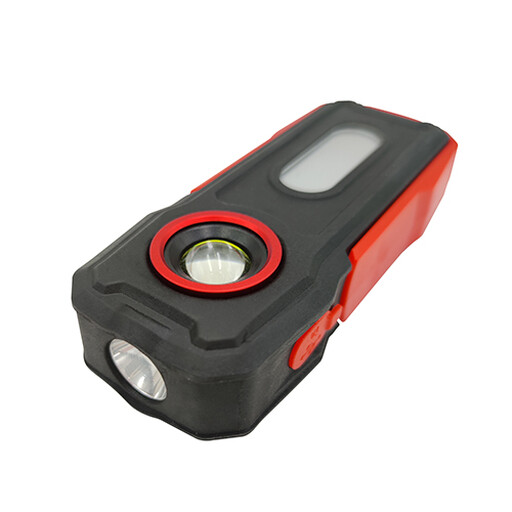
Why this model? Perfect for those looking for a handy tool for the car, DIY projects, or occasional camping. Its versatility makes it a useful companion in a multitude of everyday situations.
This product doesn't pretend to be an extreme tactical flashlight. It focuses on honest and genuinely useful features (300 lumens). Its USB-rechargeable battery and power bank function help avoid hidden costs and a lack of versatility.
Its triple function (flashlight, side lantern, power bank) and magnetic base make it an ultra-practical and versatile tool for a very accessible price.
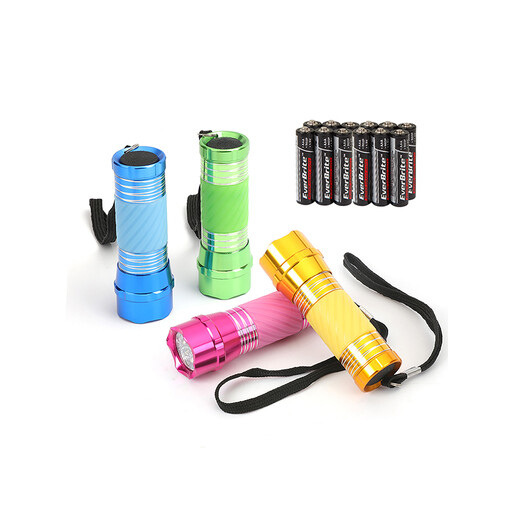
Why this model? The ultimate budget-friendly solution for equipping several strategic locations: the glove compartment, the nightstand, a child's backpack, or the kitchen drawer. Simple, colorful, and ready to use.
This pack doesn't fall into the trap of over-promising. It advertises a modest but sufficient 50-lumen output, perfect for close-range use. It's sold for what it is: a practical bundle, not a piece of survival gear.
Its quantity-to-price ratio is unbeatable. The pack includes batteries, offering an "all-in-one" solution that's immediately operational for the whole family.
We have compiled a comprehensive and up-to-date selection of products that meet our strict selection criteria and current safety regulations.
A flashlight's lifespan depends on two key components: the LED and the battery. Modern LEDs have an exceptional longevity, often exceeding 50,000 hours of use, so they are very unlikely to be the cause of failure. The battery, on the other hand, has a limited number of charge cycles (typically between 300 and 500 for Li-ion models). For a flashlight with an integrated battery, its lifespan is therefore directly tied to that of its battery.
It all depends on the activity. For camping or a night walk on a marked trail, 200 to 500 lumens are more than enough. For hiking in unfamiliar terrain or activities where you need to see far ahead, an output of 1,000 lumens or more is recommended. Finally, for search and rescue operations or exploring large open spaces, models exceeding 3,000 lumens become relevant.
In the vast majority of cases, yes. A USB-C rechargeable flashlight is more economical and eco-friendly in the long run than a battery-powered model. It also offers the convenience of being rechargeable anywhere via a power bank, car charger, or a simple wall adapter. The only drawback is the need for a power source to recharge it, which can be a constraint during very long expeditions completely off-grid.