
当日/次日达

品质保障

开启新人专享福利: 全场免邮 | 低至 2 折 | 免费试用 30 天 JoyPlus 会员
下载 Joybuy
Need to dry a construction site, air out a basement, or cool down an overheated workshop?? In these situations, a standard household fan is quickly overwhelmed. You're considering investing in a powerful air mover, but it's tough to navigate the jungle of marketing promises.
As a Product Expert at Joybuy, my mission is to help you cut through the noise. Together, we'll break down the common pitfalls and the criteria that truly matter, so you can make an informed choice that fits your needs—without overspending.
Before you even start comparing models, it's crucial to avoid the most common mistakes that lead to a disappointing purchase.
To make the right choice, forget the marketing hype and focus on these three technical criteria. They are what determine a model's real-world performance and its suitability for your needs.
Airflow, expressed in litres per second (L/s) or cubic metres per hour (m?/h), is THE crucial spec. It concretely measures the volume of air the unit is capable of moving.
The ability to direct the airflow is paramount. A good model should offer several tilt angles (e.g., horizontal, 45°, and vertical). This versatility allows you to?:
Likewise, multiple fan speeds are a real bonus for adjusting the power (and therefore the noise level) to suit the situation.
A professional floor fan must be durable, reliable, and practical on site.
Here is our selection, featuring models that perfectly meet the performance and reliability criteria we've just outlined.
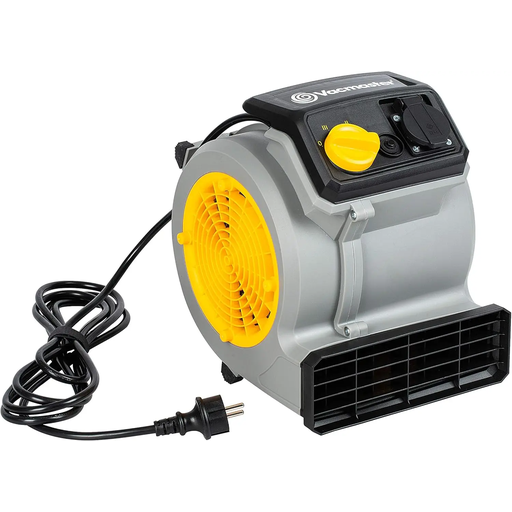
Why it's perfect for this user : Built for job site conditions, it's the ideal solution for painters, plumbers, or tradespeople who need rapid drying and heavy-duty ventilation. Its durability and portability make it a trusted ally.
It focuses on its 245 L/s airflow, not on Watts. Its rugged shell and stable design are built for the field, unlike flimsy consumer-grade units.
Its built-in service outlet allows you to daisy-chain up to 12 units, an essential pro feature for covering large areas without the clutter of power strips.
Why it's perfect for this user : Perfect for circulating air and cooling large spaces like a gym, warehouse, or large garage. Its excellent energy efficiency means you can run it for hours without driving up the electricity bill.
It avoids the high-consumption trap. At just 124 W, it delivers more powerful airflow than many more power-hungry devices. Its three tilt positions ensure perfect air circulation in any situation.
Its energy efficiency is stunning: according to Vacmaster, it uses 90% less energy than a typical 1000W fan heater. All while providing a far more effective cooling sensation through convection.
For more specific needs or to explore other types of units, we have selected products that meet a strict charter for quality and safety.
1. What's the difference between an air mover and a standard fan? The entire difference lies in the nature of the airflow. A standard fan disperses air in a wide, diffuse pattern. An air mover, however, uses its "turbine-like" shape to concentrate air into a powerful, directional jet. This is what makes it so effective for targeted drying or ventilating large spaces.
2. Do powerful air movers use a lot of electricity? Contrary to popular belief, the most powerful models are often very energy-efficient. For example, the Vacmaster AM1202 consumes only 124 Watts at full power. That's far less than a fan heater (often 1000 to 2000 Watts) and only slightly more than a living room fan, for incomparably greater effectiveness.
3. Can you use a job site blower to cool down in the summer? Absolutely. While it doesn't produce cold air like an air conditioner, an air mover generates such a powerful current of air that it creates an intense cooling sensation. By accelerating the evaporation of sweat on your skin, the effect is immediate and especially welcome in a workshop or gym during a heatwave.