
Livraison le jour même ou le lendemain

Qualité garantie

Débloquez vos offres de bienvenue: Livraison GRATUITE | Jusqu'à -80 % | 30 jours d'essai gratuits à JoyPlus
Téléchargez l'application
In the age of remote work and hyper-connected homes, the lack of electrical outlets has become a real headache. The obvious solution seems to be a power strip with USB ports. However, choosing the right model is far more complex than it appears. Between marketing promises and hidden flaws, it's easy to end up with an ineffective, or even dangerous, product.
As the head of product selection at Joybuy, my mission is to help you navigate the options. Let's forget the dense technical jargon and focus on what truly matters. Here are the 3 most common pitfalls to avoid and the keys to making an informed choice.
The 3 pitfalls to avoid when buying a power strip:
To avoid falling into these traps, you just need to check a few simple, yet absolutely crucial, technical points.
A true surge protector power strip is designed to protect your electronic equipment (computer, TV, gaming console...) from voltage spikes, especially during a thunderstorm. For reliable protection, there's one thing to look for: the NF EN 61643-11 standard certification. This certification guarantees that the device has been rigorously tested to absorb surges and protect your devices. Without it, the term "surge protection" is just a marketing claim with no real value.
Don't just trust the simple mention of a "USB port". True performance is measured in watts (W).
The design of a power strip directly impacts its daily usability.
Rather than an endless list, here are a few models that meet specific needs and perfectly illustrate how to avoid the most common pitfalls.
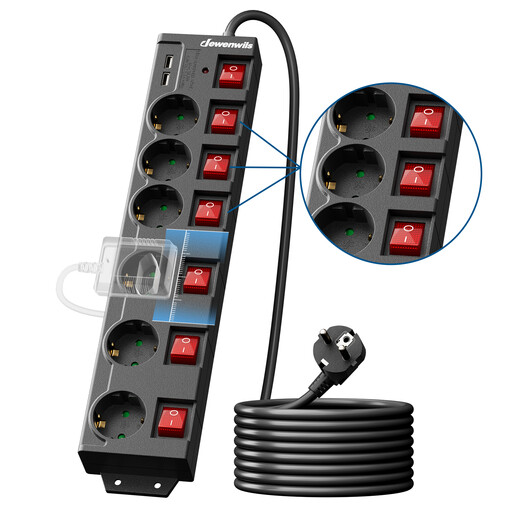
Why it's the right choice: This model is a true electrical command center. With its 6 outlets, USB ports, and a generous 5-meter cable, it meets the needs of a complete workstation (computer, monitor, printer...) or a living room setup (TV, console, internet box) without having to juggle extension cords.
The 90°-oriented and well-spaced outlets solve the headache of bulky chargers. The individual switches allow you to control standby power consumption, a classic pitfall of entry-level power strips.
Total control thanks to the 6 individual switches and great placement flexibility with the 5-meter cable. The overload and child safety protections are welcome additions.
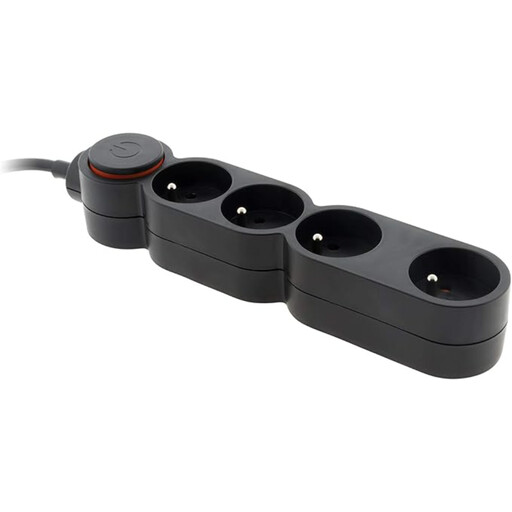
Why it's the right choice: Perfect for those who want to optimize every square inch. Behind a TV stand, a headboard, or a desk flush against the wall, this power strip solves a very real layout problem while remaining out of sight.
This model directly tackles the pitfall of poor design. Its extra-flat plug (about 8 mm thick) allows you to reclaim precious space for a cleaner and safer setup.
Its number one asset is its extra-flat plug, which frees up valuable space behind furniture. The product is of course compliant with NF and CE safety standards and includes child safety features.
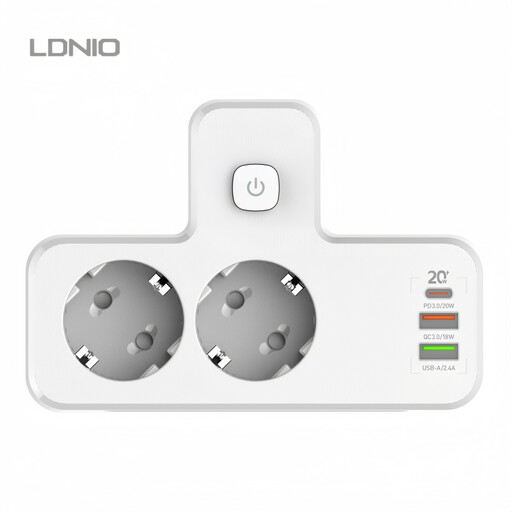
Why it's the right choice: This compact adapter is the ideal travel companion, but also a smart addition to any wall outlet. It transforms a single outlet into a modern charging hub, without the clutter of a cable. Perfect for hotels, airports, or simply to free up space on a nightstand.
It avoids the pitfall of underpowered USB ports by integrating a 20 W USB-C PD port, capable of fast-charging modern devices at full speed. A modern solution that finally meets current performance expectations.
The fast 20 W Power Delivery charging in an ultra-compact format, perfect for on the go. Its versatility also makes it an excellent travel adapter for many destinations.
We have curated a complete selection of products that meet our demanding selection criteria and French safety standards.
A standard power strip simply multiplies the number of available outlets. A surge protector power strip (or surge suppressor) integrates electronic components (most often varistors) capable of detecting and absorbing voltage spikes. It acts as a shield to protect the fragile circuits of your devices.
No, this is a practice that is strictly advised against. Plugging power strips into each other in a series (or "daisy-chaining") can cause an overload on the first power strip or the wall outlet, creating a major risk of overheating and fire. A power strip should always be plugged directly into a wall outlet.
Check the output power, indicated in watts (W). For fast charging, the keyword is Power Delivery (PD). Look for this technology, usually on a USB-C port, with a power output of at least 20?W. For comparison, a standard 5V/2.1A output (which is 10.5?W) will be much slower for a recent smartphone.