
Livraison le jour même ou le lendemain

Qualité garantie

Débloquez vos offres de bienvenue: Livraison GRATUITE | Jusqu'à -80 % | 30 jours d'essai gratuits à JoyPlus
Téléchargez l'application
Are your devices piling up, cables tangling under your desk, and every wall outlet already in high demand? If this sounds familiar, you know that organising your connections has become a real challenge, whether in a home office, living room, or workshop. A power strip with individual switches and USB ports is no longer just an accessory, but an essential tool for managing power, protecting your equipment, and controlling your energy consumption.
As a product expert at Joybuy, my role is to help you see things more clearly. This guide breaks down the essential criteria and presents a selection of models to meet specific needs, without any unnecessary marketing jargon.
Before you make a decision, let's review a few technical aspects that will make a real difference in your daily life.
While a power strip's primary function is to distribute electricity, its ability to protect your devices is just as crucial. A surge protector power strip is designed to absorb sudden voltage spikes (caused by lightning or grid fluctuations) that could damage your valuable electronics like computers, TVs, or gaming consoles. For homes with young children, a power strip with child safety features (protective shutters) is essential for peace of mind.
Assess the number of devices you need to plug in. A 6-outlet power strip is often a good starting point for a standard workstation. The integration of USB ports is a game-changer: it allows you to charge smartphones, tablets, and other gadgets without monopolising an AC outlet with an adapter. The latest models even offer USB-C power strip ports, compatible with fast charging (Power Delivery) for laptops and next-gen devices, transforming your power strip into a true desktop charging station.
The convenience of a power strip also lies in its design. Outlets oriented at 90° or spaced far apart allow you to plug in bulky adapters without blocking adjacent ports. If you want a clean setup, opt for a wall-mountable power strip with mounting holes to fix it to a wall or under a desk. Finally, the cable length is a detail that matters. A power strip with a long 5m cable offers great flexibility to reach a distant outlet and organise your space without constraints.
Here are a few models that stand out for their features and cater to a variety of uses.
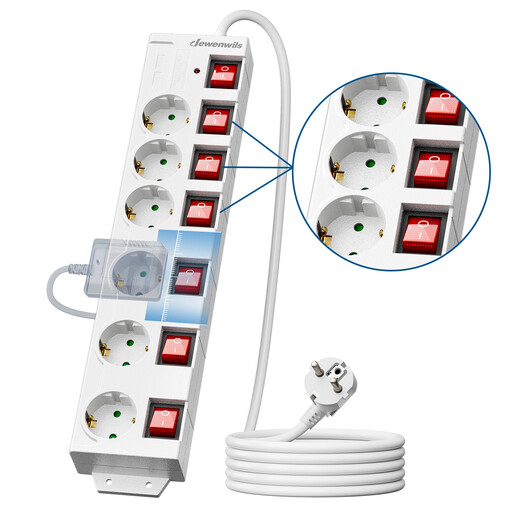
Why it stands out: This model focuses on simplicity and long reach. Its extra-long 5-metre cable makes it an ideal solution for large rooms or setups where the power source is far away.
Advantages:
Who is it for? Ideal for those who need to connect devices far from a wall outlet, such as in a living room for a TV/Hi-Fi corner, a large office, or a workshop.
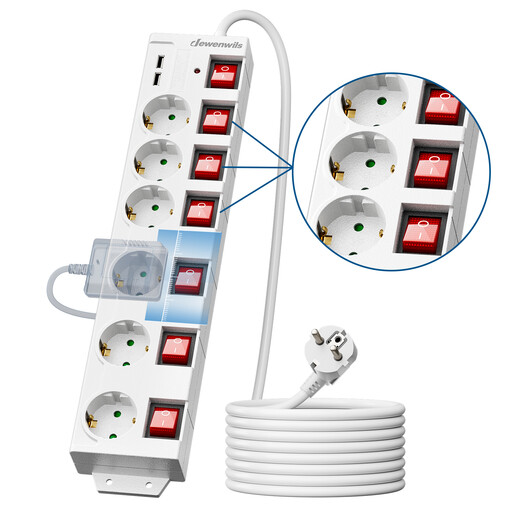
Why it stands out: It takes the strengths of the previous model (long cable, switches) and adds the convenience of two USB ports, making it a highly versatile all-in-one solution.
Advantages:
Who is it for? Perfect for the home office or bedroom, to plug in a computer, monitor, and lamp, while also charging a phone and tablet.
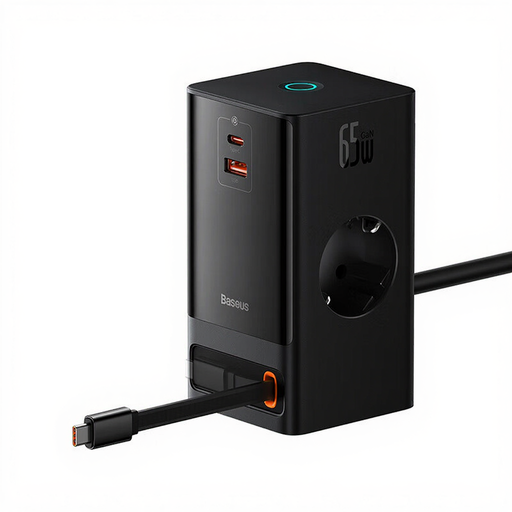
Why it stands out: This model is a truly compact and feature-packed desktop charging station. It incorporates GaN technology, a high-power USB-C port, and a retractable cable for a minimal footprint.
Advantages:
Who is it for? Aimed at professionals, remote workers, and tech enthusiasts looking to optimise and declutter their workspace with a powerful, modern solution.
The power strips featured here are designed for French outlets (Type E/F). If you have equipment that uses different standards, or if you are travelling, a more specific solution will be necessary. For example, an adapter is essential for devices purchased abroad.
To discover solutions suitable for other types of outlets, check out our selection of adapters.
Although the terms are often used interchangeably, there is a nuance. A surge protector guards against internal voltage spikes on the electrical grid (e.g., when a large appliance starts up). A lightning arrester is designed to handle much more powerful discharges, such as those caused by lightning. For home use, a good surge protector is generally sufficient to protect sensitive electronic devices.
Individual switches offer two major advantages. First, convenience: you can turn off a device without having to unplug it. Second, energy savings: many devices consume electricity even in standby mode (a "phantom load"). Cutting their power supply via the switch helps reduce this unnecessary consumption and lower your electricity bill.
Yes, provided it incorporates Power Delivery (PD) technology. A USB-C PD port can deliver much higher power (up to 65W or more on some models) than a standard USB-A port. This allows you to charge power-hungry devices like laptops, tablets, or modern smartphones much faster than with a conventional charger. Check the power in watts (W) specified for the USB-C port to know its capabilities.