
Livraison le jour même ou le lendemain

Qualité garantie

Débloquez vos offres de bienvenue: Livraison GRATUITE | Jusqu'à -80 % | 30 jours d'essai gratuits à JoyPlus
Téléchargez l'application
Juggling chargers, cables, and devices at the office and at home can be a real headache. Tangled cables, chargers monopolising outlets, and standby devices eating away at your electricity bill... To take back control, one solution stands out: the power strip with individual switches and USB ports. It promises organisation, energy savings, and connectivity tailored to our modern lives.
This guide will help you break down the key features and choose the model that perfectly meets your needs, without ever sacrificing safety. We've also selected a few top picks to guide you.
Before you jump on the first model you see, let's review the crucial criteria for a smart, safe, and long-lasting purchase.
When it comes to protection, not all power strips are created equal. While a basic model simply distributes power, a surge protector power strip acts as a real shield against power surges. These voltage spikes, caused by a thunderstorm or a simple grid fluctuation, can permanently fry your most valuable devices (computer, TV, games console).
For homes with young children, a child-safe power strip is essential. It is equipped with shutters that block access to the electrical contacts, giving you peace of mind. In any case, one thing to always check for is the CE marking, a guarantee of compliance with European safety standards.
Assess the number of outlets you really need, and think about your future purchases. Today, the inclusion of USB ports is no longer a gimmick, but a real asset. A USB-C power strip with Power Delivery (PD) technology ensures fast charging for your compatible smartphones and laptops, while standard USB-A ports remain practical for a host of other peripherals.
Don't underestimate the cable length. A 5m power strip extension cord will give you complete freedom to arrange your space without constraints and reach a distant wall outlet. Finally, individual switches or a power strip with a master switch?? It all depends on your habits. Separate switches are perfect for tackling standby power consumption device by device, while a single button allows you to turn everything off with a single press.
For a pristine desk and proper cable management, the wall-mountable power strip is the ultimate solution. Some models have mounting holes on the back, perfect for screwing them to a wall or under a desk. A detail that makes all the difference is the orientation of the outlets. Outlets angled at 45° or 90° prevent bulky chargers from blocking each other, allowing you to use every single outlet to its full potential.
Our editors have selected three models that stand out from the crowd, each meeting a specific need.
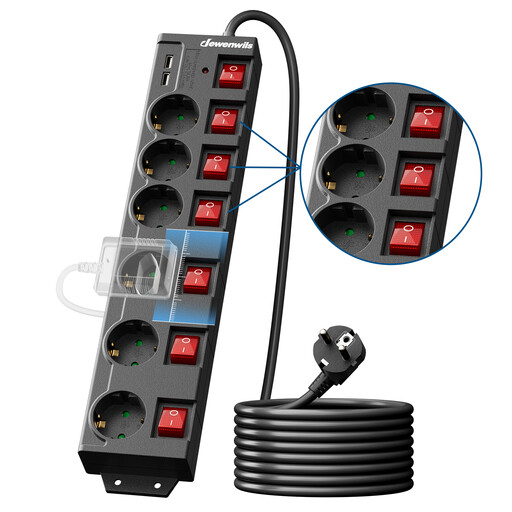
What sets it apart: This is the Swiss Army knife of power strips: it combines a large number of outlets, full control over each device, and an extra-long reach. Its massive cable and wall-mounting options make it perfect for complex setups.
Pros:
Who is it for? For those with a heavy-duty office or media setup who want total control over each device, even if the wall outlet is far away.
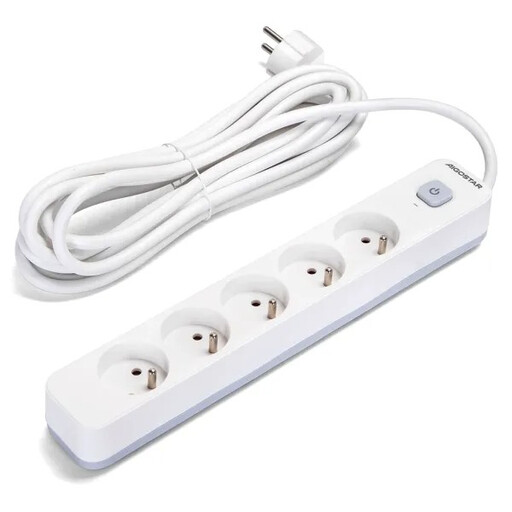
What sets it apart: Aigostar gets straight to the point: simplicity, robustness, and safety above all. With its fire-retardant materials and thick cable, it's built to last. Its master switch lets you cut power to everything with a single press. Simple and effective.
Pros:
Who is it for? For those primarily looking for a safe and durable power strip extension with a very long cable. Ideal for the living room or kitchen, if USB ports aren't your priority.
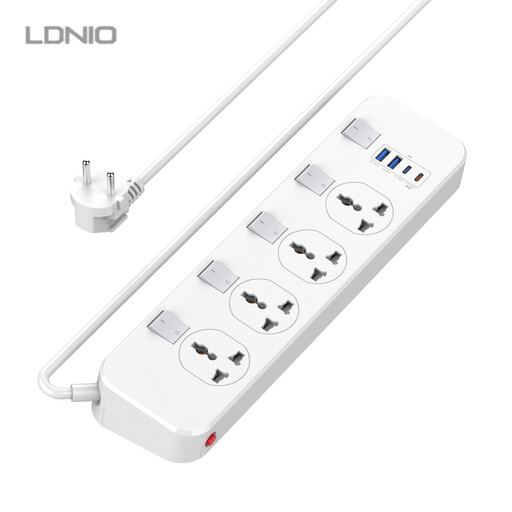
What sets it apart: Its killer feature: a 20W USB-C Power Delivery (PD) port to charge the latest smartphones and tablets in record time. It also adds individual switches for fine-tuned power management.
Pros:
Who is it for? For digital nomads and tech enthusiasts who want to charge their latest gadgets at full speed, whether at a desk or on a nightstand.
None of these models quite right for you? Need more outlets, a specific design, or another feature?
? Explore our full selection of power strips and switches
A basic power strip only duplicates a wall outlet. A surge protector power strip, on the other hand, integrates components (varistors) that act like a fuse: they detect and absorb power surges to protect your most expensive devices from damage caused by current spikes.
Absolutely not! Daisy-chaining power strips is extremely dangerous. This practice can cause an overload on the first power strip and the wall outlet, creating a high risk of overheating and fire. Always choose a power strip with a cable long enough to plug directly into the wall.
There are a few tell-tale signs of a quality power strip: