
Livraison le jour même ou le lendemain

Qualité garantie

Débloquez vos offres de bienvenue: Livraison GRATUITE | Jusqu'à -80 % | 30 jours d'essai gratuits à JoyPlus
Téléchargez l'application
Too many devices, not enough outlets, and standby power consumption driving up your electricity bill? If your desk or TV area looks like a jungle of cables, you know how crucial a good power solution is. The power strip with individual switches isn't just an accessory: it's a true command center for your equipment.
This guide is here to help you navigate the options and find the model that perfectly meets your needs for connectivity, safety, and energy savings.
Before you buy, it's essential to understand what really makes a difference. Let's review the key points to find the game-changing model for you.
While a power strip's primary mission is to distribute electricity, its ability to protect your valuable devices is just as fundamental.
A good power strip should adapt to your environment and your devices, not the other way around.
This is the feature that changes everything. A power strip with switches gives you back control.
Our editorial team has selected a few smart products that meet very specific needs.
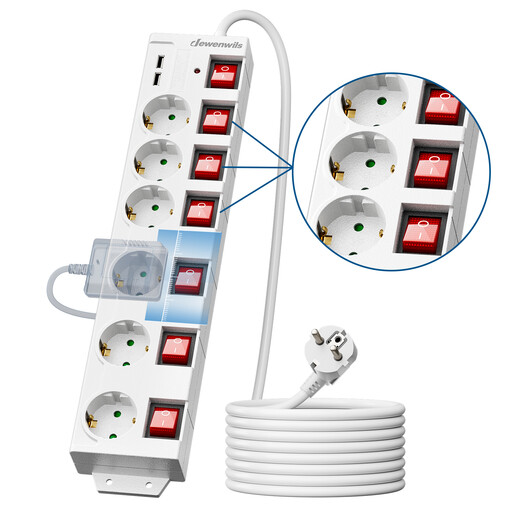
Why it stands out: This model checks almost all the boxes: six outlets with individual switches, a master switch, two USB ports, surge protection, and a generous cable. It's the all-in-one solution for a busy work setup or a heavy-duty multimedia corner.
Advantages:
Who is it for? For those who juggle numerous devices (PC, monitor, printer, lamps, etc.) and want total control over their power consumption without compromising on safety and convenience.
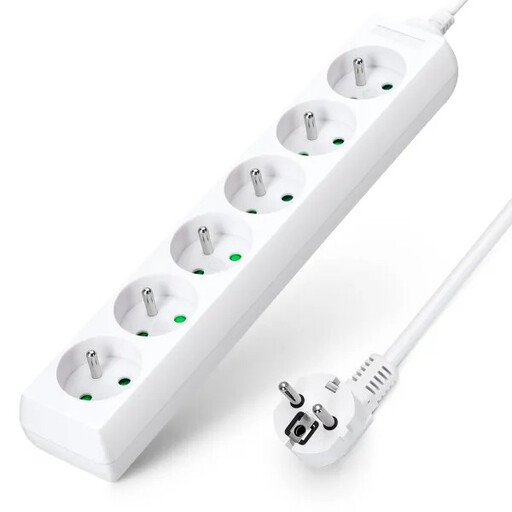
Why it stands out: This power strip gets straight to the point. With no switches, it does one thing, but it does it well: multiplying your outlets in a simple, reliable, and safe way.
Advantages:
Who is it for? For those who just want more outlets, safely and affordably, without worrying about managing each device. A simple and effective choice for the living room, kitchen, or bedroom.
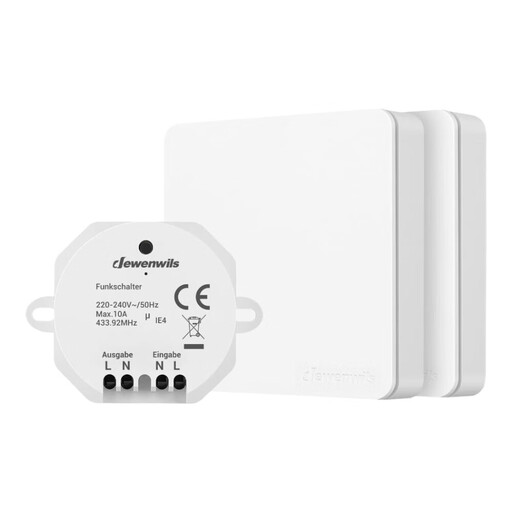
Why it stands out: Note, this isn't a power strip, but a remarkably clever remote control solution. This kit allows you to add a switch anywhere to control a lamp or appliance, without running a single wire.
Advantages:
Who is it for? The perfect solution for controlling an inaccessible device (a high-up lamp, a fan in a corner, etc.) without getting into electrical work.
If these models don't check all your boxes, or if you're simply curious to see other formats and features, feel free to explore our collection.
? Explore our full collection of white electrical switches to find the ideal solution for your home.
1. Why choose a power strip with individual switches? For one simple reason: to take back control of your power consumption. Many devices continue to draw electricity in standby mode (so-called "phantom loads" or "vampire power"). By cutting their power at the source, you save money on your bill and protect your equipment from micro-surges.
2. What's the difference between a standard power strip and a surge protector power strip? A standard power strip simply multiplies your outlets. A surge protector power strip, on the other hand, includes a component (a varistor) that acts like a smart fuse: it detects and neutralizes power surges. It thus protects the fragile circuits of your devices against voltage spikes, often caused by lightning or grid instabilities.
3. Can you plug a power strip into another power strip? This is a very bad idea and should be avoided at all costs. Each wall outlet is rated for a maximum power load (typically 3,680W at 16A in Europe). Daisy-chaining power strips is a perfect recipe for an overload, overheating, and, in the worst-case scenario, a fire hazard. Always opt for a single power strip with enough outlets and the right cable length.