
Livraison le jour même ou le lendemain

Qualité garantie

Débloquez vos offres de bienvenue: Livraison GRATUITE | Jusqu'à -80 % | 30 jours d'essai gratuits à JoyPlus
Téléchargez l'application
Managing the proliferation of electronic devices at home or in the office can quickly become a headache. Between tangled cables, a lack of wall outlets, and the phantom power consumption of devices on standby, finding a solution that is both practical and safe is essential. An individually switched power strip emerges as the ideal solution to these challenges, giving you back full control over every connected device.
Follow this guide to find the perfect model—one that will organise your space, tame your electricity bill, and protect your valuable equipment.
To make the right choice, several features should be carefully examined to ensure the product perfectly meets your needs.
While a power strip's primary function is to distribute power, its ability to protect your devices is just as crucial. A surge protector power strip includes a circuit that absorbs power surges (caused by lightning or spikes in the electrical grid), thereby safeguarding your sensitive electronic equipment like computers, TVs, or gaming consoles.
For households with young children, child safety is a non-negotiable feature. These power strips have built-in shutters that block access to the electrical contacts, preventing curious little ones from inserting objects.
The number of outlets is an obvious starting point. A 6-outlet power strip often provides a good balance for a desk or a media centre. Also, consider the spacing and orientation of the outlets. Outlets rotated 90° are key for plugging in bulky power adapters without blocking adjacent slots.
The trend is also moving towards models that integrate a power strip with USB ports. These ports allow you to directly charge smartphones, tablets, and other gadgets without monopolising a power outlet. A real plus for decluttering your setup.
Finally, don't underestimate the cable length—it's a crucial factor for convenience. A 5m power strip will give you comfortable leeway to reach a distant wall outlet and position the strip exactly where you need it.
The format of the power strip will depend directly on your use case. A classic wall-mounted power strip can be easily fixed using mounting holes, freeing up floor space and helping to organise cables for a clean installation.
For a more stylish and integrated solution, especially in a kitchen or workshop, a socket rail is a particularly elegant option. This modular system attaches to the wall and allows you to add, move, or remove socket blocks as you wish. The result? Maximum flexibility and a flawless finish.
Enough theory, let's get practical! Here is a selection of products that caught our attention, catering to a variety of needs, from all-in-one solutions to custom installations.
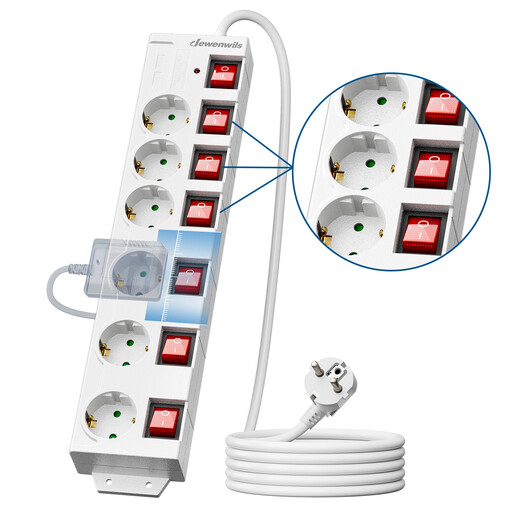
Why it stands out: This model checks all the boxes for home or office use. Its extra-long 5-metre cable and individual switches make it the perfect ally for managing devices scattered across a room.
Pros:
Who is it for? Ideal for those who need to connect devices over a wide area, such as in a living room with a TV corner and a desk space, or in a workshop.
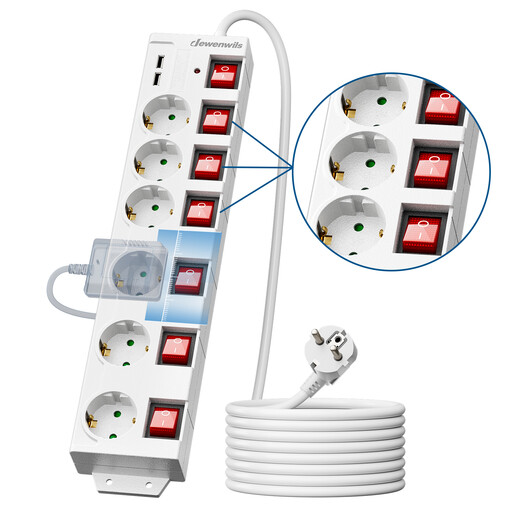
Why it stands out: This version adds the convenience of USB charging to an already solid foundation. It's the all-in-one solution for environments where mobile devices are ever-present.
Pros:
Who is it for? Perfect for home offices, student dorms, or bedside tables where computers, lamps, and portable devices coexist and need charging.

Why it stands out: The Goneo socket rail is a game-changer, offering a modern and modular approach to power distribution. Designed to replace a recessed outlet, it provides a clean finish and unparalleled flexibility.
Pros:
Who is it for? Aimed at renovation projects or design enthusiasts looking for a discreet and customisable power solution for a kitchen, living room, or workspace.
Our selection is just a glimpse of the possibilities. If you're looking for other configurations (compact power strips, more USB ports, specific designs), many alternatives await.
? Explore our full range of adapters and power solutions
The benefit is twofold: energy savings and convenience. By cutting power to devices that are not in use (TVs, chargers, computers), you eliminate their standby power consumption. It's also a significant practical gain: no more hassle of constantly unplugging and replugging devices, which also helps preserve the lifespan of the plugs and sockets.
A simple power strip merely distributes power to multiple devices. A surge protector power strip, on the other hand, integrates an electronic component (usually a varistor) capable of detecting a sudden voltage spike and diverting it to the ground. It acts as a shield, protecting your devices' circuits from often irreversible damage.
No, it is strongly advised not to plug power strips into each other. This practice, sometimes called "daisy-chaining," can cause an overload on the first power strip's circuit or the wall outlet, posing a significant risk of overheating and fire. For your safety, always plug a power strip directly into a wall outlet. If you need more outlets, opt for a power strip with more slots or, even better, have additional wall outlets installed by a professional.