
Livraison le jour même ou le lendemain

Qualité garantie

Débloquez vos offres de bienvenue: Livraison GRATUITE | Jusqu'à -80 % | 30 jours d'essai gratuits à JoyPlus
Téléchargez l'application
Managing the power supply for a modern office, living room, or workshop is often a real headache. Between computers, monitors, chargers, and other peripherals, finding a solution that is safe, practical, and efficient has become essential. But be warned: the power strip market is a minefield, where a poor choice can be disappointing, or even dangerous. To avoid buyer's remorse, here are the criteria that truly make a difference.
Many models promise the world, but their design flaws only become apparent once you get them home. Here are the most common issues:
To avoid these pitfalls, a few simple but essential technical points should be checked. These are the details that separate an unreliable gadget from a long-lasting investment.
This is the non-negotiable criterion. In France, a proper power strip must carry the NF C 61-314 standard. This certification guarantees crucial features, like child safety shutters to protect curious little ones.
Also, check the maximum supported power, expressed in Watts (W). For home use, the standard is 3,680 W (16 A). Exceeding this limit creates a risk of overheating and, consequently, fire. A good power strip with switches should include overload protection, which will automatically cut the power in case of danger.
A power strip has to be practical; otherwise, it becomes a hindrance. To stop getting frustrated with chargers blocking each other, opt for a 6-outlet power block with sockets angled at 45° or 90°, or simply with ample spacing.
The cable length also provides freedom. A power strip with a 5m long cable frees you from placement constraints and avoids risky extension cord setups. For a clean installation under a desk, a wall-mountable power strip with a switch featuring mounting holes is ideal.
At a time when our desks are overrun with gadgets, integrated ports are a real convenience. A desk power strip with USB frees up 230V outlets and declutters your workspace. The latest models go even further with fast-charging USB-C ports (Power Delivery) to power up smartphones and tablets at full speed.
Finally, the very focus of this guide: the power strip with individual switches. It's the ultimate weapon for hunting down hidden power consumption. With a single flick, you can cut power to standby devices and effortlessly lower your electricity bill.
Here are a few options that meet specific needs, taking into account the safety and practicality criteria we've discussed.
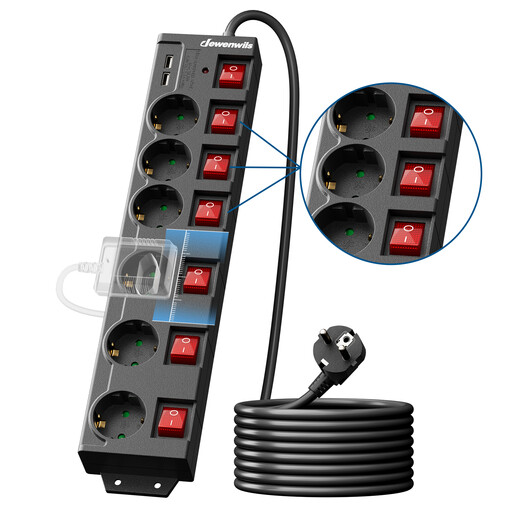
Why we chose it: It's the Swiss Army knife of the modern office. It checks all the boxes: six well-designed outlets, USB ports, switches for each device, and a 5-metre cable that offers complete installation freedom.
Its 90°-angled outlets are the perfect solution for plugging in multiple bulky power adapters without playing Tetris.
Its extra-long 5-metre cable, combined with wall mounts, allows you to create a clean setup and make the jungle of cables under your desk disappear.
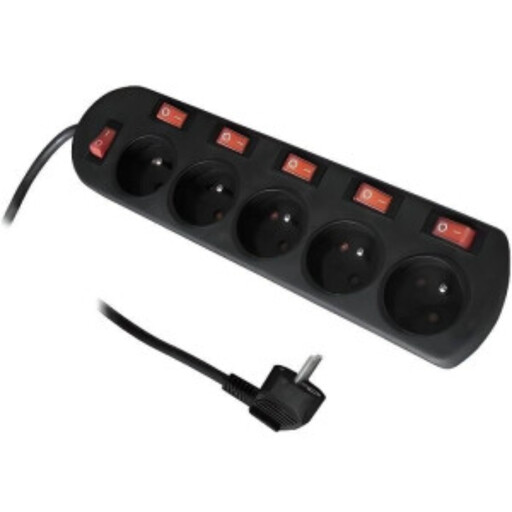
Why we chose it: Perfect for TV/Hi-Fi setups or home studios where every device needs to be managed with precision. It offers a switch for each outlet, plus a master switch.
Its switches, built to last, are both sturdy and illuminated. No more worrying about a switch breaking, even with heavy use.
The dual safety. Its overload protection and NF certification make it a reliable safeguard for protecting your valuable equipment (TVs, consoles, audio gear).
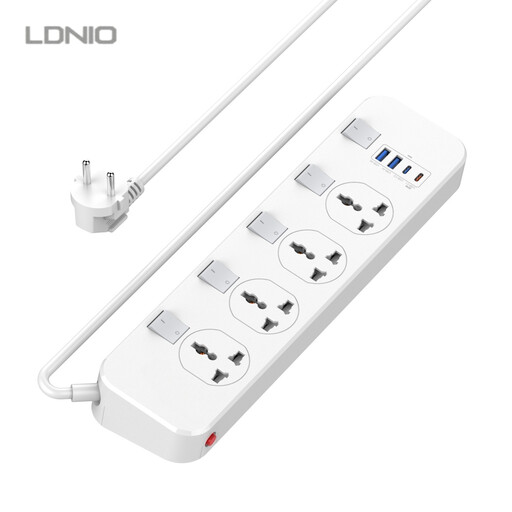
Why we chose it: The ally for tech enthusiasts who collect gadgets. In addition to its individual switches, it includes a 20W USB-C Power Delivery port to charge smartphones and tablets at top speed.
Thanks to its well-spaced universal sockets, you can forget about compatibility issues with devices bought abroad or adapters with unusual formats.
Its 20W USB-C PD port. It allows you to enjoy fast charging without sacrificing an external charger, freeing up space and an AC outlet.
Explore our full selection of power strips that meet our criteria for safety and quality, as well as current French standards.
It all depends on the build quality and frequency of use. A good, NF-certified model can last over 10 years. As a general rule, if the plastic is yellowing, the cable shows signs of wear, or a switch becomes difficult to operate, it's time to replace it without hesitation.
Absolutely not. Plugging power strips into each other in a series (or "daisy-chaining") is extremely dangerous. This practice creates a major risk of overload and overheating, which can lead to a fire. A power strip should always be plugged directly into a wall outlet.
When all the individual switches are in the "Off" position, power consumption is virtually zero. Only the indicator light on the master switch, if it has one and it stays on, consumes a negligible amount of energy (less than 0.1 W). This makes it an excellent solution for eliminating phantom load from standby devices.