
Livraison le jour même ou le lendemain

Qualité garantie

Débloquez vos offres de bienvenue: Livraison GRATUITE | Jusqu'à -80 % | 30 jours d'essai gratuits à JoyPlus
Téléchargez l'application
A power strip, a trivial purchase? Not so fast. We've all known the frustration of bulky chargers blocking adjacent outlets, underpowered USB ports that take forever to charge a smartphone, or worse, a low-end model that fries our precious devices. Choosing the right power strip isn't just about the number of outlets. It's a matter of convenience, safety, and longevity.
To ensure you don't regret your purchase, here are the 3 pitfalls to avoid at all costs:
USB power strip seems like a great idea! Except when its ports sluggishly share a mere 1A or 2.1A. The result: excruciatingly slow charging, completely unsuitable for modern smartphones and tablets that need plenty of juice to power up efficiently.surge protector power strip. The former cuts power during an overload (too many devices plugged in), whereas a surge protector is the only thing that can absorb a sudden voltage spike from the grid and save your devices.For a smart purchase, forget about design for a moment. It's the technical specifications that guarantee performance and safety.
The ability of a power strip or an extension cord to safely power your devices depends directly on its cable's cross-section (or gauge). This information is usually indicated in a format like 3G1.5?mm? or 3G1?mm?.
For a cable reel, it is imperative to fully unwind the cord before using high-power devices. A coiled cable can overheat and create a fire hazard, even when operating well below its rated maximum wattage.
A quick glossary of protection features is essential to safeguard your equipment.
surge protector power strip integrates components (varistors) that absorb dangerous voltage spikes (caused by lightning or grid fluctuations). This is an indispensable safety feature for televisions, computers, and hi-fi equipment.The environment of use dictates the type of product to choose.
power block with an H05VV-F type cable is sufficient. For tight spaces behind furniture, models with a flat plug are a very practical solution.waterproof extension cord or a power strip with an IP44 rating. This standard guarantees protection against water splashes. The cable should be more robust, such as an H07RN-F type, to withstand abrasion and outdoor conditions. A job site power strip will meet these durability requirements.Rather than an endless catalogue, we've selected models that meet specific needs while avoiding the classic pitfalls.
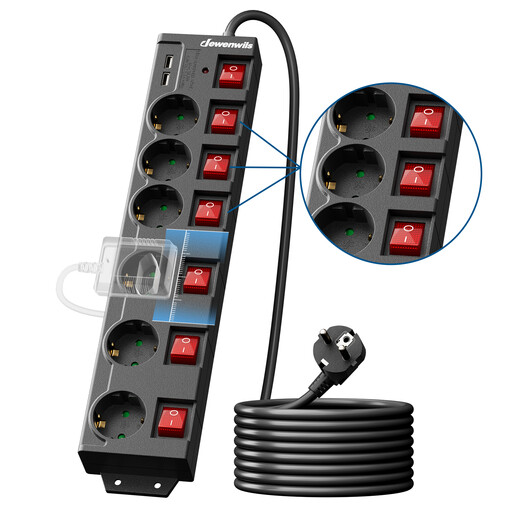
Why it's the right choice: Perfect for a desk or a TV corner. It lets you plug everything in (computer, monitor, printer) and charge your devices, all while controlling power consumption with dedicated switches. Its 5-meter cable offers welcome installation flexibility.
Its 90°-angled outlets accommodate bulky chargers without blocking adjacent ports. As for USB, the shared 2.1A output ensures a decent charge for everyday devices.
6 individual switches for precise energy management; extra-long 5-meter cable; surge and overload protection.
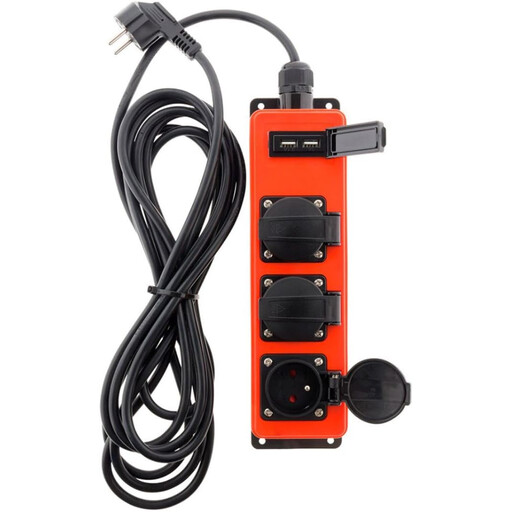
Why it's the right choice: Essential in a garage, workshop, or on a covered patio. Its rugged design and splash-proof protection (IP44) make it the perfect ally for damp or dusty environments, whether for plugging in tools or task lighting.
The IP44 certification and spring-loaded protective covers aren't just for show: they guarantee real safety against water splashes. The USB ports are a handy bonus for charging a phone without sacrificing a 230V outlet.
Waterproof design (IP44); protected master switch; integrated USB ports for added versatility.
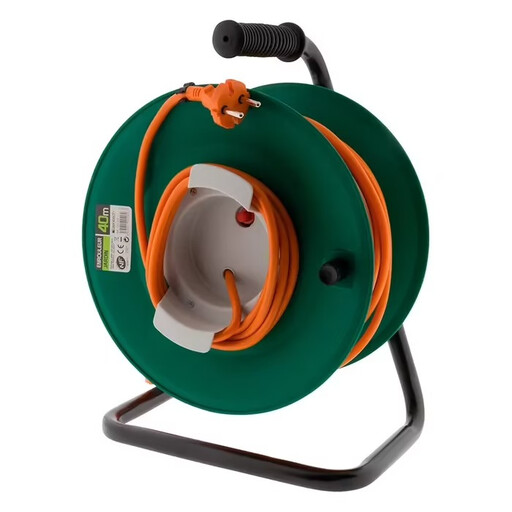
Why it's the right choice: Designed for job sites, large gardens, or event setups. Its 40-meter length and robust metal frame meet the demands of professionals who need to safely power heavy-duty tools.
The thermal circuit breaker is an essential safety feature that prevents any risk of overheating, a very real danger with long cable runs. Its metal frame gives it far superior stability and durability compared to plastic models.
Generous 40m length; ultra-stable metal frame; enhanced safety with a thermal circuit breaker; ergonomic carrying handle.
Explore our full selection of power strips and extension cords that meet our quality criteria and safety standards.
A standard power strip, even one with a switch, merely cuts off the power in case of an overload (too many devices plugged in). A surge protector power strip, on the other hand, integrates components capable of absorbing violent voltage spikes from the grid. It's the only thing that can save your valuable devices (computer, TV, gaming console, etc.) from certain death in the event of a power surge.
Never! Plugging power strips into one another in a series (also known as "daisy-chaining") is strictly forbidden and extremely dangerous. This practice creates a major risk of overloading the first power strip and the wall outlet, leading to a significant risk of overheating and fire. It is a practice prohibited by electrical safety codes worldwide, such as the NF C 15-100 standard in France.
The maximum wattage, expressed in watts (W), must be indicated on the product, often stamped on the casing (e.g., "Max 3,680W"). The calculation is simple: add up the wattage of all the devices you plan to plug in and ensure the total does not exceed this limit. The wattage of each device is listed on its label or in its user manual.