
Livraison le jour même ou le lendemain

Qualité garantie

Débloquez vos offres de bienvenue: Livraison GRATUITE | Jusqu'à -80 % | 30 jours d'essai gratuits à JoyPlus
Téléchargez l'application
Whether you're plugging in a computer, setting up a TV area, or running your power tools, a power strip is an essential accessory. However, this seemingly harmless object hides technical subtleties that can compromise the safety of your devices, and even your home. A poor choice can lead to overheating, short circuits, and irreparable damage to valuable equipment.
Before you head to the checkout, it's wise to understand the most common pitfalls. Not all models on the market are created equal: some features, marketed as benefits, turn out to be useless at best and dangerous at worst. Here are the 3 mistakes you must not make.
To make the right choice, a few technical points are essential to verify. These are what distinguish a reliable, safe product from a simple, potentially dangerous gadget.
A power strip's ability to safely power your devices depends on two inseparable factors: the maximum power rating (in Watts, W) and the cable's cross-section (in mm?).
In Europe, a standard wall socket delivers up to 3680 W (16A x 230V). Your power strip should never exceed this total value. Always check the combined wattage of the devices you plan to plug in.
The cable's cross-section is just as important:
For a cable reel, the maximum allowed wattage differs depending on whether the cable is fully unwound. A coiled cable heats up more, so its capacity is reduced (e.g., 1100 W coiled vs. 3200 W uncoiled). Always remember to fully unwind it for intensive use.
A quality product must display CE and NF markings. These certifications guarantee that the power strip complies with European and French safety standards.
Beyond these basic certifications, several protective features deserve your attention:
A power strip's design isn't just about aesthetics; it's also about practicality. A flat plug, for example, lets you slide it behind furniture without pushing it away from the wall. The orientation of the sockets is also crucial for plugging in multiple bulky chargers without them blocking each other.
Today, our needs go beyond traditional outlets. Many power strips now include:
Rather than an exhaustive list, we've matched specific products to user profiles to help you find the solution that precisely fits your needs.
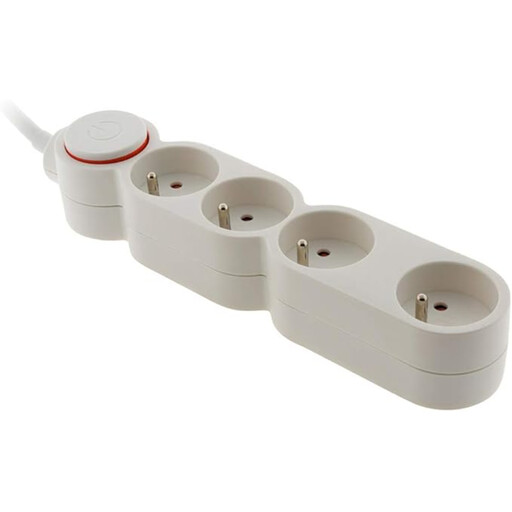
Why we chose it: Ideal for organising a living space or office. Its flat plug is designed to slip discreetly behind a bookshelf or TV stand, optimising space without blocking the wall socket. Its four outlets are more than enough for standard multimedia use (TV, set-top box, console, etc.).
This NF and CE certified model includes child safety, covering the fundamental requirements. Its H05VV-F 3G1.0mm? cable is strictly designed for indoor use, which avoids the classic pitfall of using an unsuitable product.
Its ultra-flat plug (approx. 8 mm) allows furniture to sit flush against the wall, a major advantage in tight spaces.
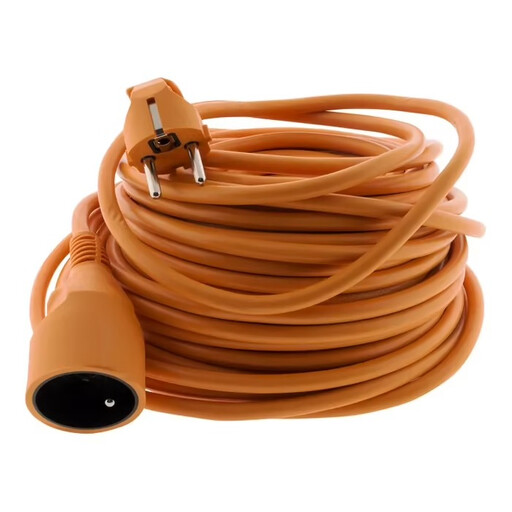
Why we chose it: Essential for outdoor work. Its 25-metre length provides comfortable freedom of movement for a lawnmower or hedge trimmer. Its bright orange colour makes it impossible to miss on the grass, reducing the risk of trips or accidental cuts from a blade.
This garden extension cord is designed for the outdoors, and its 3G1.5mm? cable supports up to 3500 W, which is ideal for powerful tools. It thus avoids two major pitfalls: using an unsuitable cable and underestimating the required power.
Long reach (25 m) and high visibility for safe outdoor use.
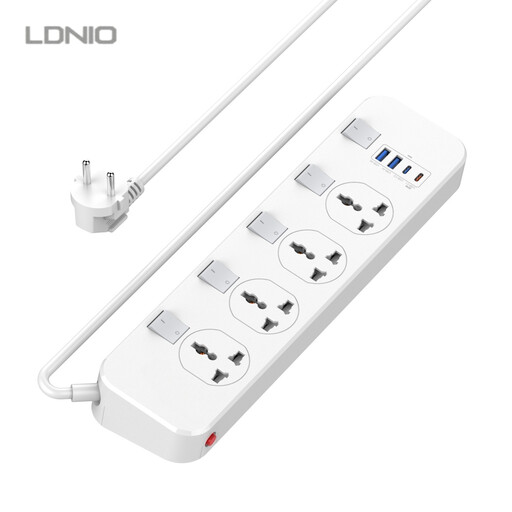
Why we chose it: This is the perfect power hub for a modern office. It combines mains sockets, USB-A ports, and most importantly, a 20W USB-C PD port for fast charging. The individual switches provide full control over each connected device.
It includes surge protection, an essential shield for your valuable devices. Its dedicated USB ports free up the mains sockets from bulky chargers, optimising space and charging efficiency.
An all-in-one solution that powers and fast-charges all your devices (computer, monitor, smartphone) from a single unit.
We have selected a full range of products that meet our safety criteria and comply with French and European standards.
A simple power strip just multiplies the number of available sockets. A surge protector includes an electronic component (a varistor) that absorbs sudden voltage spikes on the electrical grid. It acts as a shield for your sensitive electronics, which could be irreversibly damaged by a power surge.
It is strongly advised not to plug power strips into each other in a series. This practice, known as "daisy-chaining," significantly increases the risk of overloading the first power strip and the wall socket. The maximum allowed wattage (typically 3680 W) can be easily exceeded, causing overheating and a fire hazard. Always plug your power strip directly into a wall socket.
For outdoor use, two points need to be checked. First, the IP (Ingress Protection) rating: an IP44 rating is the minimum required to guarantee protection against water splashes. Second, the cable type: a rubberised H07RN-F model is far more robust against weather, abrasion, and temperature changes than a standard H05VV-F cable, which is designed for indoor use only.