
Livraison le jour même ou le lendemain

Qualité garantie

Débloquez vos offres de bienvenue: Livraison GRATUITE | Jusqu'à -80 % | 30 jours d'essai gratuits à JoyPlus
Téléchargez l'application
Buying a power strip? It seems like a simple task. Yet, the wrong choice can quickly become a daily headache and even threaten the safety of your devices and your home. Faced with an overwhelming market full of marketing promises and technical jargon, it's hard to know where to start. As a product expert at Joybuy, my mission is to shed some light on the subject.
Before you grab the first model you see on sale, let's review the most common pitfalls that turn a good idea into a guaranteed hassle.
USB power strip is convenient, but only if the ports can deliver. Too many models settle for 1A (5W) ports that will take forever to charge your smartphone. The result: a gimmicky feature that's completely useless for daily use.Identifying these pitfalls is the first step toward a smart purchase.
To find the perfect power strip that is safe and suited to your needs, a few technical specifications need to be scrutinised. Far from being insider jargon, they are the guarantee of your setup's performance and safety.
This is the non-negotiable criterion. Insist on the presence of the NF (Norme Fran?aise) logo. This certification is your assurance that the power block meets a strict set of specifications, including:
For your expensive and sensitive electronic devices (TV, computer, gaming console), a surge protector power strip is more than an option: it's a wise precaution. It includes a dedicated circuit that absorbs power surges (caused by lightning or power grid instability), shielding the fragile components of your equipment.
A power strip with a switch allows you to cut power to everything with a single press. It's the easiest and most effective way to eliminate phantom power consumption from devices on standby. For more granular control, some models go further with individual switches for each outlet.
Cable length is an often underestimated but essential criterion. An extension cord or a cable reel of several metres offers maximum flexibility to reach a distant wall outlet. A crucial safety note with cable reels: it is imperative to fully unwind the cable before connecting power-hungry devices to avoid overheating.
No, the designer power strip is no longer an oxymoron. Extra-flat plugs, rotating sockets, cubic blocks, or under-desk mountable units... manufacturers are competing with ingenious designs to make these practical objects blend into your decor.
If you opt for a USB power strip, be uncompromising on power output. For decent fast charging, aim for at least 2.4A (12W) ports. The gold standard? The presence of USB-C PD (Power Delivery) ports, which are essential for efficiently powering modern devices (smartphones, tablets, and even some laptops).
There's a right power strip for every need. We have selected models for you that meet specific use cases, all while avoiding the pitfalls mentioned earlier.
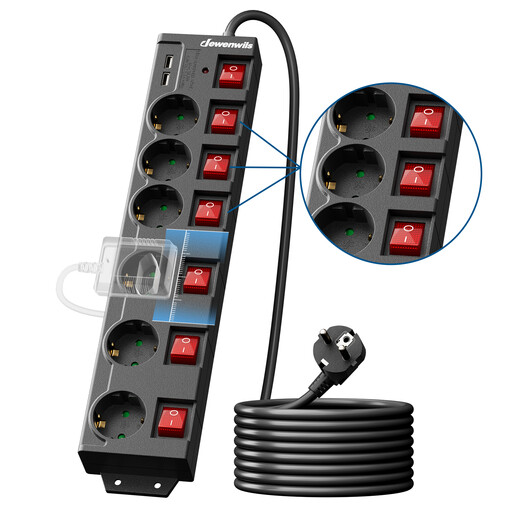
Perfect for a complete home office setup (computer, monitor, printer) or a fully-equipped media centre (console, internet box, soundbar). Its very long 5-metre cable offers maximum placement flexibility, while the individual switches are perfect for controlling the power consumption of each device.
Its outlets are cleverly angled to accommodate the bulkiest power adapters without ever blocking the adjacent outlet. On the safety front, it checks all the boxes with integrated overload and surge protection.
6 individual switches for total control and an extra-long 5-meter cable.
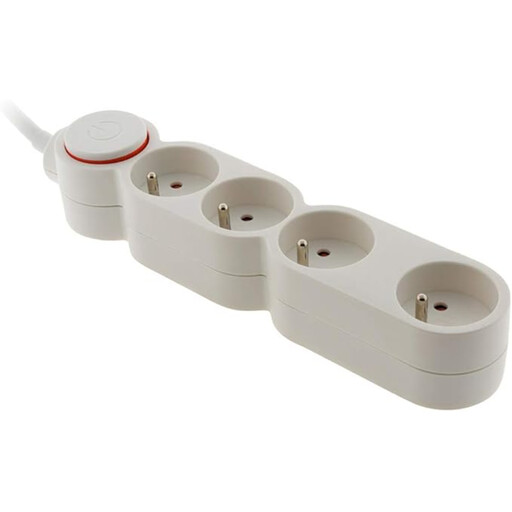
The perfect solution for sliding behind a sofa, bookshelf, or headboard. Its minimalist design and especially its extra-flat plug allow you to connect your devices without having to move furniture away from the wall. A true space-saver.
It tackles the impractical design pitfall head-on with its plug that's barely 8 mm thick. Compliant with NF and CE standards, it covers the safety essentials, including the indispensable protective shutters.
Extra-flat plug for maximum space saving behind furniture and 4 grounded 2P+E outlets.
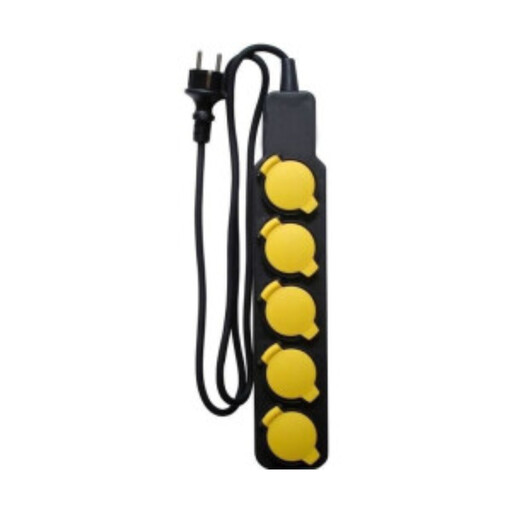
Built for tough environments: garage, workshop, covered patio... Its robustness and weatherproof certification make it the safe choice for plugging in power tools, an electric barbecue, or garden lighting.
Thanks to its IP44 certification, this `weatherproof power strip` is specifically designed for damp environments. It eliminates the danger of using a standard indoor model, which is completely unsuitable. Its spring-loaded covers protect each outlet from dust and water splashes.
IP44 rating against water splashes and individual protective covers on each outlet.
Explore our full selection of power strips, all rigorously selected for their compliance with French safety standards and their everyday practicality.
Can you plug a power strip into another power strip? No, this is a very bad idea. Daisy-chaining power strips is strongly advised against. This dangerous practice creates a major risk of overloading the first power strip and the wall outlet, which can lead to overheating and a fire. A golden rule: always plug your power strip directly into a wall outlet.
What is the difference between a power strip and a surge protector power strip? A standard power strip simply increases the number of available outlets. A surge protector power strip goes further by adding a vital layer of protection: it includes a circuit capable of detecting and absorbing voltage spikes (surges). It's an essential insurance policy for protecting your valuable electronic devices (computer, TV, console...) from the fluctuations of the power grid.
How many devices can I plug into a power strip? It's not the number of devices that matters, but their combined power draw. The key criterion is the total wattage. A standard power strip (16A) supports a maximum power of 3680?Watts (W). To avoid exceeding it, simply add up the wattage of each device you want to plug in (this information can be found on their label or charger). The total must never, ever exceed the power strip's limit.