
Livraison le jour même ou le lendemain

Qualité garantie

Débloquez vos offres de bienvenue: Livraison GRATUITE | Jusqu'à -80 % | 30 jours d'essai gratuits à JoyPlus
Téléchargez l'application
At home and in the office, our electronic devices are multiplying, but the number of wall outlets isn't keeping up. The power strip has become an indispensable accessory. However, choosing the right one isn't so simple. A poor choice can be frustrating in daily use, and even dangerous for your safety and your valuable devices. To make sure you don't make a mistake, here are the pitfalls to avoid.
The 3 mistakes to avoid when buying a power strip:
To help you see clearly, here are the features that truly matter. Once you've mastered these few technical points, you'll be ready to choose a model that is both safe and suited to your needs.
Safety is the absolute non-negotiable criterion. In Europe, the CE mark and other national certifications (like NF in France) attest that a product has undergone rigorous testing and meets quality and safety requirements. Always look for these logos on the packaging.
Next, ask yourself if you need a surge protector power strip.
Every power strip is designed to handle a maximum power load, expressed in watts (W). Typically, for a standard 16-amp (A) outlet, this limit is 3680 W. It is imperative never to exceed this value by adding up the power consumption of all devices plugged in simultaneously. And above all, never daisy-chain power strips (plugging one into another)! The risk of overload and fire becomes extremely high.
Also, consider the configuration:
Once safety is guaranteed, it's the practical aspects that will make a difference in your daily routine.
To help you make your choice, here is our selection of products suited for different uses, all vetted for safety and practicality.
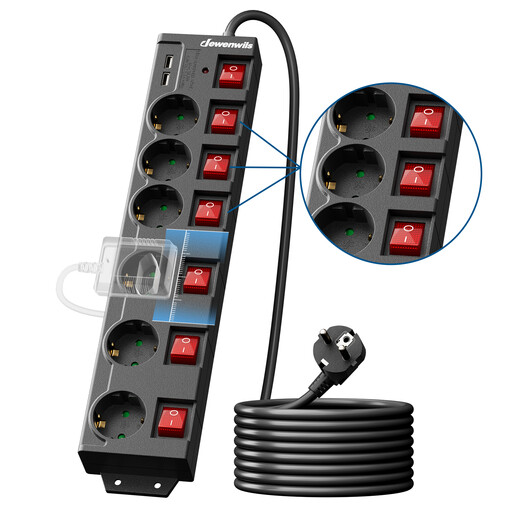
Why we love it: With a generous 5-meter cable, 6 outlets, and 2 USB ports, this power block is a comprehensive solution for a TV area or home office. The individual switches are a real plus for managing the power consumption of each device.
This model checks all the safety boxes with its overload and surge protection. The 90° orientation of the outlets is well-designed to prevent bulky chargers from blocking adjacent sockets.
The independent control of each outlet and the generous cable length, which offer maximum flexibility for daily use.

Why we love it: For those who want a solution that is both stylish and integrated, this wall-mounted track is an excellent choice. It's perfect for a kitchen countertop or a minimalist desk, as it allows you to add and move outlet blocks at will. No more trailing cables!
Its modular concept definitively solves the problem of bulky chargers. The aluminum alloy casing and flame-retardant materials are a guarantee of safety and durability.
Its modularity and aesthetics. The ability to customize the arrangement of the outlets is a unique advantage.
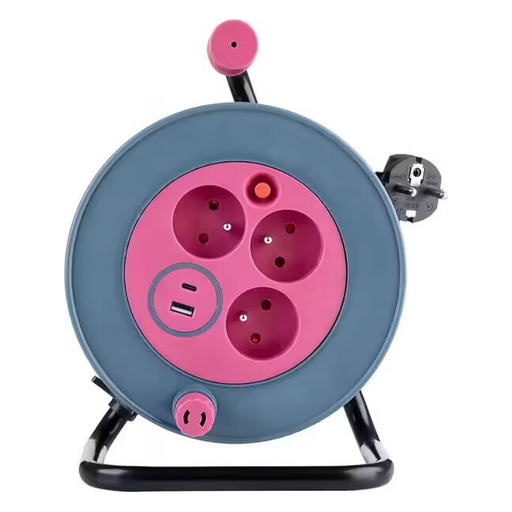
Why we love it: For DIY, gardening, or any mobile project, this cable reel is the ideal companion. Its 12-meter cable offers excellent reach, its steel frame exudes durability, and the USB ports are a handy bonus for charging a phone on the job site.
Unlike a living room power strip, this is designed for heavy-duty use. Its integrated thermal circuit breaker protects it against overloads, an essential safety feature for this type of application.
Its robustness and long reach. Its portable design with an ergonomic handle makes it easy to carry and store after use.
Now that your devices are plugged in, it's time to tame the cable jungle. Discover our selection of products for a clean and secure setup, all chosen for their quality and compliance with standards.
No, this is a very bad idea. Plugging power strips in series (or "daisy-chaining") is strongly discouraged. This practice dangerously increases the risk of overloading the first power strip and the wall outlet, which can lead to overheating and even fire. A power strip should always be plugged directly into a wall outlet.
A standard power strip, as its name suggests, simply multiplies the number of available outlets. A surge protector goes a step further: it integrates a protection circuit (often based on varistors) capable of absorbing sudden voltage spikes. It thus protects your valuable devices (computer, TV, hi-fi system) from damage that can be caused by power grid surges or lightning.
The real limit is not the number of devices, but their combined power consumption. You must add up the wattage (W) of all the devices you plan to use at the same time. This sum must never exceed the maximum power rating of the power strip, which is typically 3680?W for a standard model (16?A / 230?V). This crucial information is always printed on the product or its packaging.