
Livraison le jour même ou le lendemain

Qualité garantie

Débloquez vos offres de bienvenue: Livraison GRATUITE | Jusqu'à -80 % | 30 jours d'essai gratuits à JoyPlus
Téléchargez l'application
By Joybuy, your product recommendation expertPublished: August 26, 2026
Running out of power at the worst possible moment? It's a fear we all know. The solution seems obvious: a power bank. Yet, faced with a sea of options and tempting marketing promises, an impulse buy often leads to disappointment. To make the right choice, it's crucial to read between the lines and avoid the most common pitfalls.
To avoid throwing your money away, here are the three most common traps to watch out for:
To choose the right portable charger, ignore the marketing hype and focus on concrete technical criteria. Here are the three points to examine closely.
A power bank's capacity is expressed in milliampere-hours (mAh). However, the advertised capacity (that of the internal battery cells) is not what your device will actually receive. Due to voltage conversion and heat loss, you can expect a real-world efficiency of 60% to 70%.
Charging speed doesn't depend on mAh, but on the output power, measured in Watts (W). To benefit from true fast charging, check the power bank's wattage and its compatibility with your devices' protocols (like Power Delivery, or PD).
Never underestimate the practical aspects. A compact power bank will slip more easily into a pocket or bag. Also, consider features that make your life easier:
Enough theory, let's get practical. Here is our selection of power banks tailored for specific user profiles, all tested and approved according to our performance and safety criteria.
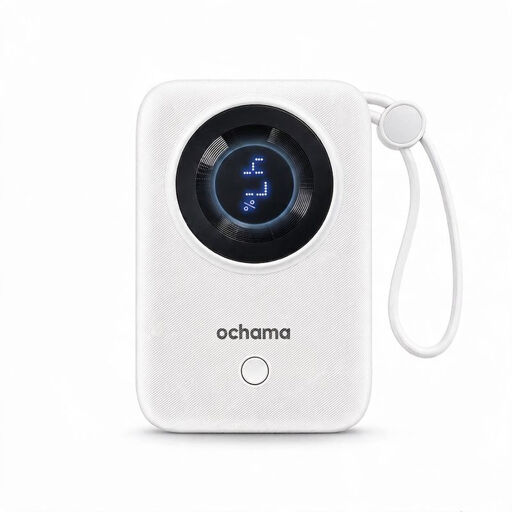
Why it's for you: Ideal for those looking for an all-in-one, ready-to-use solution. Its compact design and built-in cables (Lightning and USB-C) save you from carrying extra chargers. The perfect everyday companion.
The 22.5W power output is clearly stated, guaranteeing verifiable fast charging. The integrated cables solve compatibility and forgetfulness issues right out of the box.
The inclusion of the two most common cables (Lightning and USB-C) and its screen displaying the battery percentage make it an incredibly convenient model.
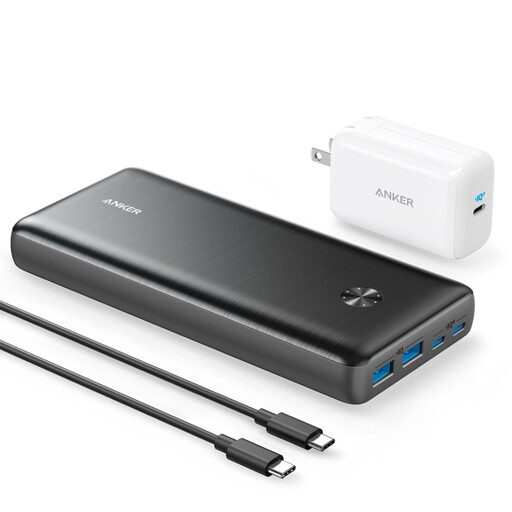
Why it's for you: For those who juggle multiple devices (phone, tablet, laptop) on the go. Its colossal capacity and serious firepower can quickly revive even a MacBook Air or a Dell XPS.
No empty promises here. The 25,600 mAh capacity and 87W via USB-C PD are precise technical specs that guarantee top-tier performance.
Its ability to recharge a laptop makes it a true mobile power station, far more than just a simple backup phone charger.
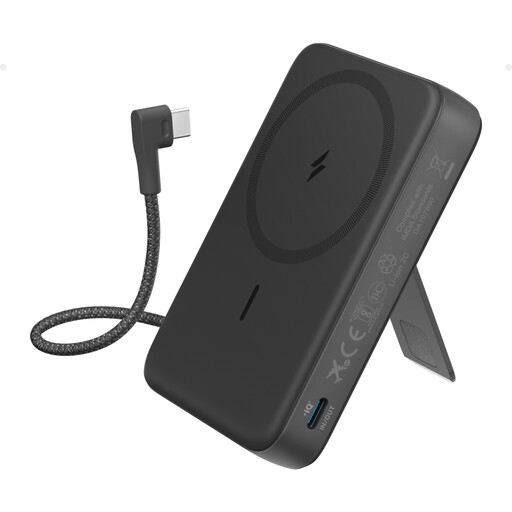
Why it's for you: Designed for recent iPhone owners and fans of simplicity. The magnetic charger snaps perfectly onto the back of the phone, while the built-in stand is ideal for watching a video while charging.
The manufacturer is transparent by clearly distinguishing the wireless charging power (7.5W) from the much faster wired charging power (30W). This helps manage expectations about charging speeds.
It's the Swiss Army knife of modern charging: magnetic charging, a built-in USB-C cable, and a foldable stand. A 3-in-1 accessory that's as versatile as it is stylish.
We have compiled a complete and up-to-date selection of power banks that meet our selection criteria and European safety standards.
It all depends on your usage. For daily use and charging your smartphone once or twice, a 10,000 mAh power bank offers the best balance between portability and capacity. For long trips, using multiple devices, or charging a tablet, aim for a 20,000 mAh model or larger.
No, as long as you choose a quality model. A certified power bank (CE, RoHS) equipped with protections against overcharging, overheating, and short circuits poses no risk to your phone. Models from reputable brands systematically include these safety features. Steer clear of unbranded or suspiciously cheap products, which often skip these standards.
A power bank doesn't last forever. Its lifespan is measured in charge cycles (a full charge from 0 to 100%). Most quality models retain about 80% of their original capacity after 300 to 500 cycles. In practice, with regular use, this translates to a lifespan of two to three years before its performance begins to decline noticeably.