
Livraison le jour même ou le lendemain

Qualité garantie

Débloquez vos offres de bienvenue: Livraison GRATUITE | Jusqu'à -80 % | 30 jours d'essai gratuits à JoyPlus
Téléchargez l'application
The ritual of slow coffee, or manual filter coffee, is winning over more and more enthusiasts. A world away from automatic machines, this method champions control, precision, and the pleasure of a masterful brew. However, with a plethora of options available, assembling your first pour-over coffee kit can seem complex. As a Product Recommendation Manager at Joybuy, my role is to help you navigate the choices, providing objective benchmarks for selecting durable, suitable equipment without being swayed by marketing hype.
Before diving into specific products, it's helpful to understand the fundamentals. Here are the key criteria to guide your choice, aligning with consumer expectations for quality and safety.
Material Quality and Compliance: Your coffee comes into direct contact with your equipment, so it's crucial to choose materials known for their neutrality and durability. Food-grade stainless steel (type 304) and borosilicate glass are excellent choices. They are heat-resistant, do not retain odours, and ensure safe use in compliance with European standards.
Precision of Brewing Tools: A great filter coffee rests on two pillars: a consistent grind and a controlled pour.
Modularity of the Setup: A good beginner barista kit shouldn't be a closed system. Opting for separate components (grinder, kettle, dripper, carafe) allows you to start with a solid foundation and upgrade your setup over time, replacing one piece at a time as your skills and budget grow.
Here is a selection of products that meet our criteria for quality, durability, and functionality, designed for slow coffee maker enthusiasts.
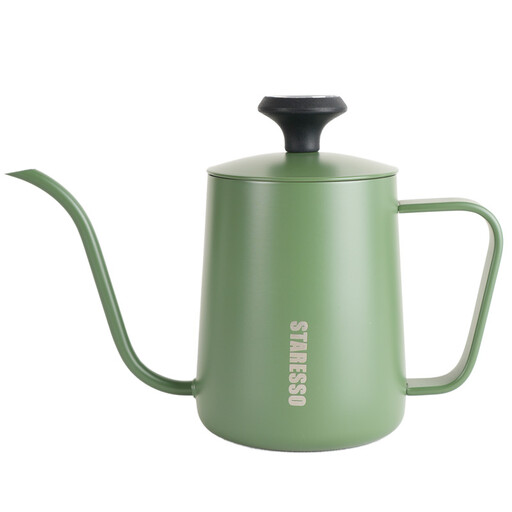
Why we recommend it: This kettle is an excellent starting point for anyone looking to master the art of pour-over. The combination of the 0.4 cm gooseneck spout and the lid's integrated thermometer gives you total control over the two key variables of extraction: water flow and temperature. Its 304 stainless steel interior ensures food safety and durability.
Advantages:
Who is this product for?: Ideal for beginners who want to learn the proper technique from the start, as well as for more experienced enthusiasts looking for a precise and reliable tool for their daily brews.
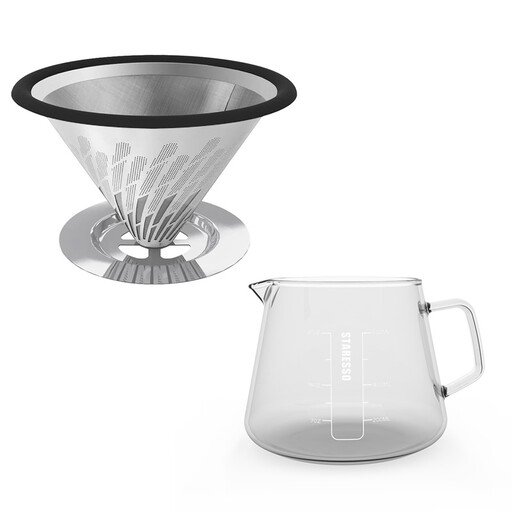
Why we recommend it: This set combines a stainless steel coffee dripper and a borosilicate glass coffee carafe—two premium materials. Its main advantage is the permanent, dual-layer stainless steel filter. It eliminates the need for paper filters, making it both economical and eco-friendly, while allowing the coffee's natural oils to pass through for a richer, full-bodied brew.
Advantages:
Who is this product for?: Perfect for eco-conscious users and those who appreciate a coffee with more body and aroma. Its ease of use also makes it highly accessible for novices.

Why we recommend it: Great coffee starts with a great grind. This manual coffee grinder features stainless steel conical burrs and a dual ball-bearing system, a configuration that ensures a fast, uniform, and effortless grind. The internal click-based adjustment allows you to dial in the fineness with high precision, whether for pour-over, French press, or espresso.
Advantages:
Who is this product for?: Essential for any coffee lover looking to switch to whole beans. Its compact size also makes it practical for use at home, while travelling, or at the office.
Assembling a manual filter coffee set piece by piece offers great flexibility. However, for those who prioritise simplicity, durability, and a minimal footprint, other options exist. Exploring our range of stainless steel coffee makers can be an interesting way to discover integrated and long-lasting solutions.
A stainless steel dripper is lightweight, unbreakable, and has low heat retention, allowing it to preheat quickly. It's ideal for travel. A ceramic dripper is heavier and has higher thermal mass, meaning it holds heat longer once preheated, which can contribute to a very stable extraction. The choice often comes down to your priorities: durability and convenience (stainless steel) versus thermal stability (ceramic).
It's not mandatory, but it is highly recommended. Using freshly ground coffee radically transforms the tasting experience, revealing more intense and complex aromas. A conical burr grinder will give you a uniform grind—essential for a balanced extraction—something that pre-ground coffee or coffee from a blade grinder cannot guarantee.