
Livraison le jour même ou le lendemain

Qualité garantie

Débloquez vos offres de bienvenue: Livraison GRATUITE | Jusqu'à -80 % | 30 jours d'essai gratuits à JoyPlus
Téléchargez l'application
A painting easel should suit your space, the size of your canvases and the way you like to work. A model that looks appealing in a photo can quickly prove bulky, unstable or impractical after a few sessions. Before you place your order, watch out for three common mistakes: confusing the overall height with the maximum canvas size, underestimating how much room the easel takes up when set up, and giving too much weight to the accessories included.
This guide looks at the main styles: wooden easels, adjustable easels, tabletop easels, children’s easels, double-sided easels, folding easels and freestanding easels for displaying artwork.
An easel that is 150 or 175 cm tall isn’t necessarily designed to hold a canvas of that height. The key thing to check is the maximum canvas height, as well as the position of the ledge and clamps. Some models described as canvas easels can hold canvases from 100 to 134 cm tall, while the stated height refers to the entire frame.
A lightweight tripod can be perfectly suitable for a poster or small canvas. However, it may wobble as soon as you start applying firmer brush strokes. For regular use, check the width of the base, the number of contact points, whether the feet are non-slip and the quality of the tightening mechanism. A level surface is still essential, especially with a wooden artist’s easel.
A drawer or simple shelf won’t necessarily provide the right storage for your brushes, palettes and paint tubes. On a small table, a folding easel with compartments can be more practical than a large model with no storage. In a studio, an integrated shelf or separate storage box will usually give you more flexibility.
Check at least these three measurements:
A freestanding studio easel is suitable for large canvases and displaying artwork. For smaller canvases, drawing, watercolour or occasional use, a tabletop easel will often be a better choice.
Pine is widely used for wooden easels: it’s relatively light and has a traditional look. Beech and birch are more commonly used for sturdier frames. If you paint outdoors or move your easel around frequently, folding aluminium and steel models are practical options. Their stability, however, depends largely on the design of the legs and the quality of the support.
Also check for clamps, non-slip feet and adjustments that are easy to use. A mechanism that needs to be overtightened may wear out prematurely or damage the wood.
An adjustable tilt lets you set the support at the right angle for drawing, painting or displaying your work. Some models offer several set positions, while others allow continuous adjustment up to 80° or 90°. The right choice depends on the medium you use and whether you prefer to work sitting, standing or at a table.
For a child, choose a stable frame at a suitable height, with accessories kept clear of walkways. Models intended for children over 3 years old may refer to EN71-1-2-3 or EN717-1 standards. Check these details in the product information; they don’t replace adult supervision.
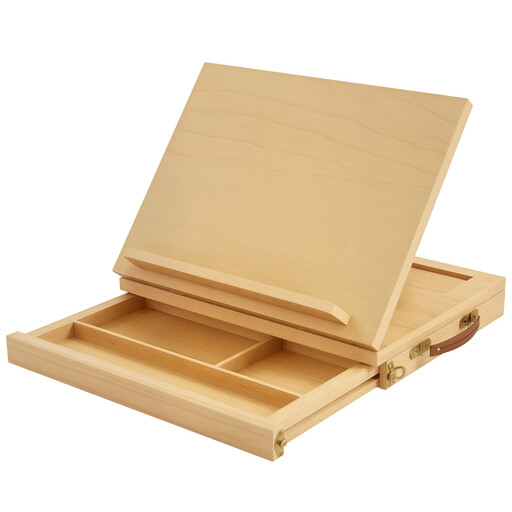
Why it suits this type of user: This wooden tabletop easel is ideal for small canvases, sketching and your first painting sessions in a flat or at a desk.
When folded, it measures just 33.5 × 26 × 7 cm, so it’s easy to store. The built-in drawer also means you won’t need to buy a separate box straight away.
Four angle settings from 0° to 57°, storage compartments and non-slip PP feet.
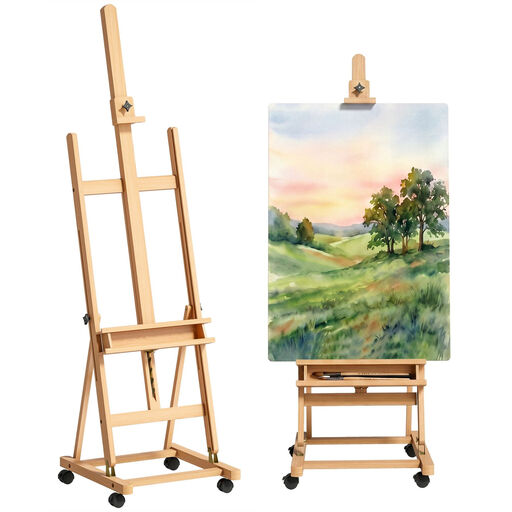
Why it suits this type of user: With its birch frame, adjustable height and wheels, this model is designed for artists who switch between sitting and standing, and regularly move their easel around the studio.
The adjustable height of 178 to 238 cm and tilt of up to 90° make it easy to position your canvas precisely before you start.
It holds canvases up to 118 cm tall, folds easily and has wheels, as well as an integrated pencil tray measuring 38.5 × 6.5 × 6 cm.
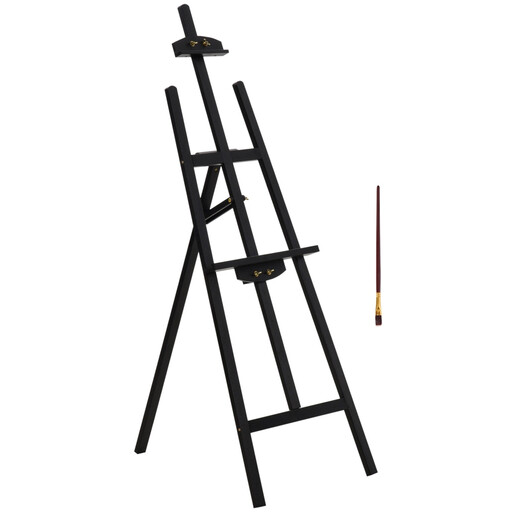
Why it suits this type of user: This freestanding easel is made for large canvases, studio work and displaying artwork at an exhibition or event.
Its tripod base and adjustable support help keep it steady. The product information also states that it can hold canvases up to 108 cm tall.
Tilts up to 90°, measures 51.5 × 71.5 × 134.5 cm and takes up less room when folded, at around 51.5 × 143 cm.
We’ve put together a comprehensive, regularly updated selection of products that meet these demanding criteria and European safety requirements.
For a child, a double-sided easel with a chalkboard, whiteboard and paper roll offers a range of activities without taking up room with extra furniture. The AIYAPLAY and HOMCOM models available on Joybuy are generally listed as suitable for children aged 3 and over, and include storage baskets. Adult supervision is still recommended.
If you need to display a poster, sign or painting at a wedding, market or exhibition, a folding easel in aluminium or steel is often easier to transport. Check the maximum weight it can hold, its length when folded and whether it comes with a carry bag. A display easel won’t necessarily offer the same adjustments as a model designed for painting.
A tabletop easel is suitable for small canvases and limited spaces. If you prefer to paint standing up or work on larger canvases, choose an adjustable freestanding model. If so, check the maximum canvas height it can hold and the width of the base.
Place it on a flat floor, extend the legs fully and tighten the adjustments without overtightening them. Spread your accessories across the shelf and avoid moving the easel when it’s loaded. With some H-frame models, wall fixing is recommended to reduce the risk of tipping.
Its lifespan depends in part on the weight of the canvases, how often you adjust it and the level of humidity. Wipe off splashes promptly, store the easel somewhere dry and check the screws, hinges and clamps regularly. Handle a folding model gently and avoid forcing its joints.