
Livraison le jour même ou le lendemain

Qualité garantie

Débloquez vos offres de bienvenue: Livraison GRATUITE | Jusqu'à -80 % | 30 jours d'essai gratuits à JoyPlus
Téléchargez l'application
Post-it repositionable notes may all seem to serve the same purpose: write a reminder, stick it somewhere, then move it. However, choosing the wrong size or an adhesive that is unsuitable for the surface can quickly make a pad unusable at the office, school or home.
Before buying Post-it adhesive notes, watch out for these three common pitfalls:
To make a well-balanced choice, compare the dimensions, number of sheets, type of adhesive and how frequently you plan to use them.
Size has a direct impact on readability and possible uses:
Large adhesive notes are more practical when you need to write several lines. However, they take up more space on a screen, in a diary or on a ring binder.
A repositionable adhesive is designed to be removed and stuck down again, but not all surfaces react in the same way. Paper, cardboard and folders generally offer different levels of grip compared with glass, a smooth door or a painted wall.
The manufacturer presents Post-it Super Sticky models as offering enhanced adhesion, particularly on vertical or less adhesive surfaces. This feature can be useful on a planning board, during a meeting or for a reminder placed at eye level.
If you are looking for residue-free repositionable notes, you should still check the manufacturer’s guidance and test one on an inconspicuous area. Dust, moisture, texture and paint can all affect the result.
A pad of 90 or 100 sheets is suitable for everyday use. For a team, classroom or household that uses memo notes every day, multipacks and cubes can help avoid frequent restocking.
Also look at the number of pads, not just the total number of sheets. Several smaller pads make it easier to share them between desks and different rooms in the home. A cube containing 450 sheets creates less packaging, but remains centralised at a single workstation.
Finally, certifications should be interpreted accurately. Several products featured here specify 100% PEFC paper, associated with code SGSCH-PEFC-COC-110078. According to the information provided on the product page, this refers to the certified origin of the paper; it does not mean that the entire packaging or adhesive automatically carries the same certification.
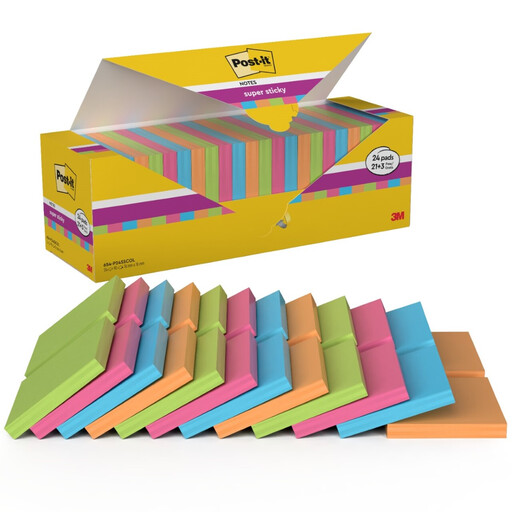
Why this product suits this user: This pack contains 21 pads, plus 3 free pads, with 90 sheets per pad. That gives you a generous supply for everyday tasks, homework, family messages or organising a small office.
The square 76 × 76 mm format means you do not have to reduce every message to just a few words, while the quantity helps reduce the risk of running out of sheets too quickly.
Assorted colours, 100% PEFC paper specified on the product page and repositionable Super Sticky adhesive, according to the manufacturer’s information.
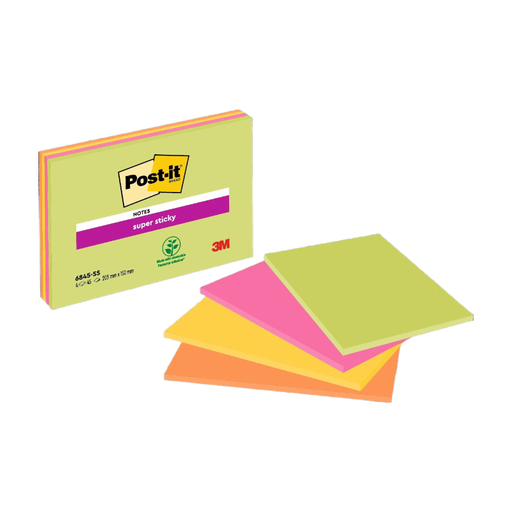
Why this product suits this user: Professionals running meetings, workshops or projects have enough space to write sentences, lists and diagrams that are easy to read from a distance.
The large lined format helps prevent messages from becoming difficult to read and sheets from becoming overcrowded. The product page states that the adhesive is twice as strong as that used on standard Post-it notes.
203 × 152 mm format, printed lines, 45 sheets per pad and 100% PEFC paper specified on the product page.
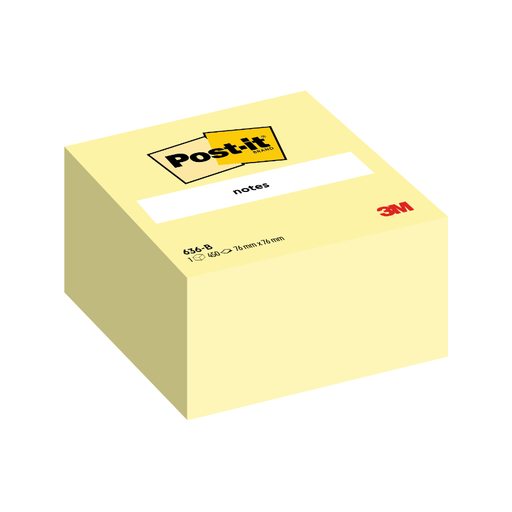
Why this product suits this user: With 450 sheets in a single cube, this product is suitable for shared workstations, teachers, families and anyone who regularly writes reminders.
The clearly stated volume means you do not need to accumulate several small pads. The 76 × 76 mm format remains versatile enough for lists, messages and everyday reminders.
450 sheets per pad, canary yellow shade, repositionable adhesive and 100% PEFC paper stated in the specifications.
We have brought together a complete, real-time updated selection of products that meet these demanding selection criteria and European safety standards.
Store your adhesive note pads in a dry, temperate place away from dust. Avoid leaving them near a damp window, a radiator or in a car exposed to significant temperature changes.
Before sticking a note down, clean the surface and dry it thoroughly. Then remove the note slowly, peeling it away from one edge rather than pulling it off in one go. On delicate paintwork, old paper or a porous surface, always test one sheet in an inconspicuous area first.
Repositionable notes do not have a fixed shelf life: how well they stick depends on storage conditions and how often they are handled. A sealed, properly stored pad can remain usable for a long time, while a pad exposed to moisture may lose its adhesive properties more quickly.
The product pages state that several references can be removed and repositioned without leaving any residue. However, the result may vary depending on the surface, dust, moisture and how long the note has been stuck down. On painted walls and delicate furniture, it is best to carry out a preliminary test in an inconspicuous area.
The 76 × 76 mm format is suitable for short lists and office reminders. For a detailed list, meeting notes or a collaborative workshop, choose large adhesive notes, such as 101 × 152 mm or 203 × 152 mm.
A Z-Notes dispenser lets you pull out accordion-folded sheets with one hand. It is useful during a phone call, while taking an order or during any other activity that requires you to keep one hand free. Check that the dispenser is compatible with Z-Notes refills before buying.