What should you consider before choosing?
Start with the materials you need to vacuum. How often you will use the machine and how much you need to collect are not enough, on their own, to determine the filtration you need.
Wet and dry vacuum
Worth considering: for compatible, non-hazardous household debris, especially if you also plan to use the machine for other cleaning jobs.
Limitation: being able to vacuum up water does not mean the machine is suitable for hazardous dust.
Site vacuum with suitable filtration
Worth considering: when the type of dust you have identified, or the use of a power tool, calls for a site vacuum designed for the job.
Limitation: L, M or H classes should not be chosen at random; INRS distinguishes between them according to the risks associated with dust.
Hiring for occasional use
Worth considering: for a one-off job when you do not want to keep a bulky machine.
Limitation: you will need to arrange transport and return, and book a machine suited to the materials rather than simply the volume of debris.
| Criteria |
What to check |
Who this matters to |
| Type of dust and filtration |
Identify the materials involved, then check which types of dust the exact model can handle and, if needed, its filtration class. If the material is hazardous or you are unsure, do not continue with a domestic vacuum. |
I am not sure exactly what dust the work has left behind and want to establish what protection I need before cleaning; around 42% of consumers would make identifying the dust their priority. |
| Volume and compatible debris |
Check which dry debris and liquids the machine can handle, the tank capacity, hose reach and the space needed to store it. |
I have a lot of compatible debris to clear, but I also need to be able to move and store the machine; nearly 33% of consumers would prioritise capacity and versatility. |
| Occasional or repeated use |
Compare how long you expect to use the machine with the requirements for transport, storage and maintenance. If hiring, confirm the category of machine you have booked. |
I will only use the machine for this job and do not want to keep it afterwards; around 25% of consumers would prioritise this one-off need. |
Brands to know when comparing ranges
These examples help you compare the features of particular ranges and models. They do not mean that every machine from a brand is suitable for your job.
Kärcher
The WD range includes wet and dry vacuums designed, among other things, for DIY use at home.
- According to Kärcher France, the WD 3 S V-19/4/20 has a 19 L tank, while the WD 6 P S V-30/8/35/T has a 30 L tank, a drain plug and a filter-cleaning system.
- These features apply to the models listed and do not show that they are suitable for hazardous dust.
Nilfisk
Nilfisk offers domestic wet and dry vacuums for cleaning garages, workshops and outdoor areas, as well as separate professional models.
- Its domestic range includes models with stated capacities from 8 to 30 L, designed to handle both dry dirt and liquids.
- Check the filtration and permitted materials for each model. Nilfisk recommends letting a filter dry completely after using it to vacuum liquids before dry cleaning.
Bosch Professional
The site vacuum range includes L, M and H class models, which should be considered according to the dust produced by the work.
- Bosch Professional lists automatic filter cleaning on its GAS 35 M AFC and GAS 35 H AFC models, which are classed as M and H respectively.
- A model’s class does not apply to other models, and does not remove the need to identify the material and any necessary precautions.
A wet and dry vacuum on Joybuy
This model is an option for vacuuming compatible household debris with a wet and dry vacuum. Choosing it does not replace the need to identify the dust first or to use a suitable site vacuum when the situation calls for one.
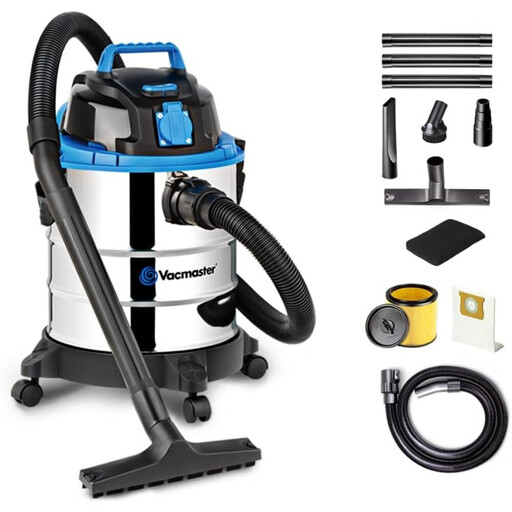 Image unavailable
Vacmaster VQ1220SC, 20 L wet and dry vacuum
Worth considering for clearing compatible dry and wet dirt after DIY work at home, or for use in a workshop.
20 L stainless steel tank, 1,250 W motor, stated suction power of 20 kPa, 2,430 W tool socket and blower function.
Before vacuuming small rubble or fine dust, check which materials the exact model can handle and its filtration. Do not use it for hazardous dust.
View on Joybuy
Frequently asked questions
Can I use my household vacuum for rubble or water?
Choose a machine whose manual explicitly says it can handle the materials you need to clear and, for water, can vacuum liquids. UFC-Que Choisir links canister vacuums with the needs created by major building work, including dust and small rubble. That does not mean every model can handle every type of debris.
Is a standard wet and dry vacuum suitable for silica or asbestos?
No. Do not assume that a standard machine is suitable for this kind of dust. INRS distinguishes filtration classes according to the risks associated with particles, while situations involving asbestos require specific measures. If the material is suspect or unknown, stop domestic cleaning and find out what procedure is appropriate.
Should I dry the filter after vacuuming water?
Check the model’s manual before switching back to dry vacuuming. Nilfisk recommends removing the filter after vacuuming liquids and letting it dry completely. Some other machines are described as suitable for both wet and dry use without changing the filter, but you should still follow their maintenance instructions.
What should I check if suction drops while I’m cleaning?
Check the filter and tank as directed in the machine’s manual. Nilfisk says a blocked filter reduces airflow. If your model has a filter-cleaning system, use it in accordance with the manufacturer’s instructions.
When should I hire a site vacuum rather than buy one?
Hiring is worth considering for a one-off clean if you do not plan to use or store the machine afterwards. Before booking, confirm which materials it can handle, the filtration you need, and the arrangements for transport, consumables and return.


