
Livraison le jour même ou le lendemain

Qualité garantie

Débloquez vos offres de bienvenue: Livraison GRATUITE | Jusqu'à -80 % | 30 jours d'essai gratuits à JoyPlus
Téléchargez l'application
A portable fan can make commuting, days at the office and summer nights much more comfortable. However, some models disappoint from the very first use: battery life is too short, the airflow is barely noticeable, recharging is inconvenient or the mount will not stay in place in the car.
Before buying a mini portable fan, it is therefore worth looking beyond the marketing claims and checking a few practical specifications. Here are the criteria to consider, the pitfalls to avoid and a selection of models suited to different uses in France.
A high-capacity battery does not guarantee several hours of use at full power. Battery life varies according to the selected speed, ambient temperature and battery condition. The maximum runtime advertised generally refers to the lowest fan speed.
To compare two models, check:
A rechargeable fan with a battery indicator also helps prevent unexpected shutdowns during a journey, a day at a festival or a concert.
Five or ten speed settings do not necessarily mean that the airflow will be more powerful or more comfortable. The blade design, motor, air outlet and stability of the device are just as important.
For a handheld or pocket fan, check whether the technical specifications mention air speed, airflow or power. This information is more useful than a simple promise of ‘powerful airflow’. When a maximum value is provided, treat it as a measurement obtained under specific conditions, not as guaranteed performance at every setting.
A USB fan placed on an uneven surface may vibrate, slide or eventually fall over. In a car, a poorly secured device could obstruct visibility or become unstable during even slight braking.
For use in a car, check:
A rechargeable fan is easy to take on public transport, camping trips, while queuing or during outdoor activities. A USB model can be powered by a computer, power bank or compatible mains adapter. However, make sure the power source provides sufficient output.
For an office or bedroom, a USB desk fan is convenient if you have a nearby port. In a car, a model connected to the cigarette lighter socket means you do not have to rely on an internal battery, but it will only work while the power source is available.
A compact device is easier to slip into a bag or glove compartment. Pocket models weighing between 130 and 180 g are well suited to commuting and festivals. The trade-off is that their smaller size often means a more limited ventilation area.
If you want to keep your hands free, choose a folding fan with a lanyard, stand or neck-wear option. For stationary use, an oscillating model distributes air more effectively around a small room, while an adjustable head lets you direct the airflow precisely towards one person.
A quiet fan is especially useful in the office or bedroom. However, advertised noise figures should be treated with caution: when a decibel level is provided, check which fan speed it relates to.
Whatever the model, do not use the device in a damp environment and never touch the blades while they are moving. For devices fitted with a lithium-ion battery, use the recommended cable or charger, avoid high temperatures and stop using the device immediately if its casing swells, cracks or becomes unusually hot. Also remember to check the relevant regulatory marking, whether instructions are provided in French and the contact details of the responsible person established in the European Union.
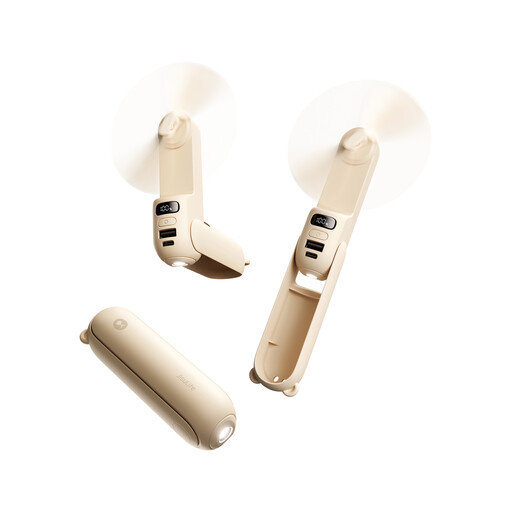
Why this choice suits this profile : At around 130 g and with a folding design, it slips easily into a bag. Its battery-powered operation is ideal for daily commutes, travelling and summer outings.
The LED display shows the selected speed and remaining battery level. This helps you avoid unpleasant surprises caused by a maximum runtime advertised under highly favourable conditions.
Three speeds and a 2,500 mAh battery, plus a handy torch function and power-bank capability according to the product listing.
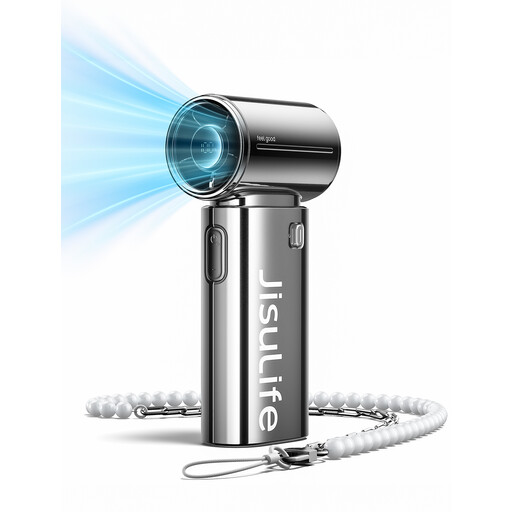
Why this choice suits this profile : This handheld fan is designed for users looking for an especially compact format, multiple settings and precise control, whether at a concert, on public transport or during outdoor activities.
The listing specifies five speeds and a display showing both the selected speed and battery level. This is more useful than a vague promise of power.
A 5,000 mAh battery, advertised battery life of up to 22 hours depending on the setting and a stated weight of 180 g.
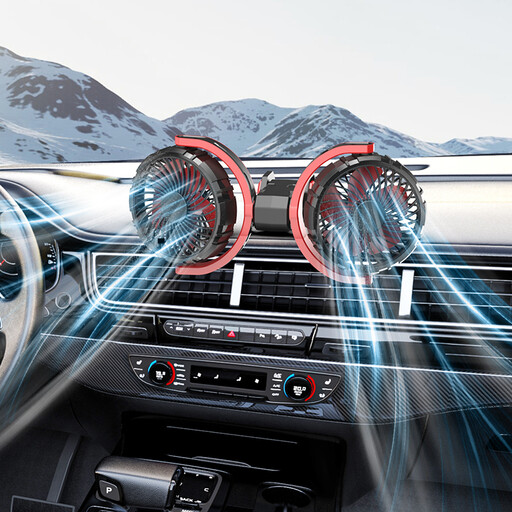
Why this choice suits this profile : Its two adjustable heads are designed for use in the car. They let you direct the airflow towards the driver and passengers, both on daily journeys and longer trips.
The stated 12 V/24 V compatibility covers compatible cars, vans and heavy goods vehicles. Its folding design makes storage easier once the journey is over.
Three speeds, advertised multi-directional rotation and two USB ports for powering compatible devices during the journey.
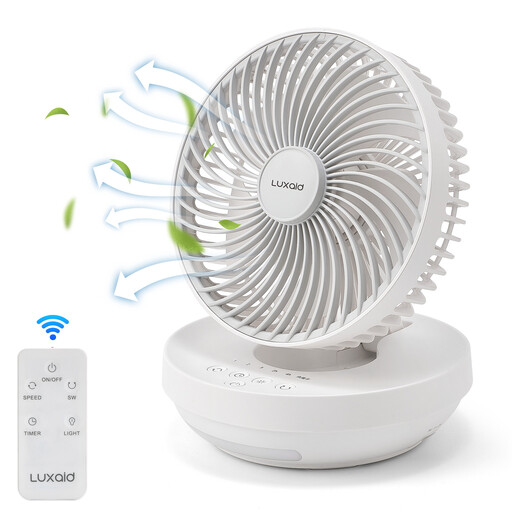
Why this choice suits this profile : Its folding design, remote control and night-light function are ideal for an office or bedroom where you want to minimise handling.
The four-hour timer and three speeds let you adapt operation to your needs instead of leaving the device running unsupervised.
Advertised 4,000 mAh battery, USB-C charging, oscillation and the option of wall mounting, depending on the configuration.
We have put together a complete, real-time selection of products that meet these demanding criteria as well as European safety requirements.
Yes, some models claim between 15 and 24 hours of battery life. However, this figure depends on the selected fan speed. At a high speed, battery life will generally be much shorter. To last a full day without a nearby socket, choose a model that displays the battery level or plan to use a compatible power bank.
A fan intended for use in a car must be compatible with the available power source. A 12 V/24 V model connected to the cigarette lighter socket is suitable for compatible vehicles. A USB fan, meanwhile, can be connected to a car charger or power bank. An adjustable head or suction-cup mount makes it easier to direct the airflow, provided you never place the device in the driver’s field of vision.
It depends on the motor’s power and how long the fan is used. A small USB fan generally uses less electricity than a more powerful pedestal fan, but check the wattage stated in its technical specifications. To estimate the cost, multiply the power in kilowatts by the number of hours of use, then by the tariff charged by your electricity supplier.