
Livraison le jour même ou le lendemain

Qualité garantie

Débloquez vos offres de bienvenue: Livraison GRATUITE | Jusqu'à -80 % | 30 jours d'essai gratuits à JoyPlus
Téléchargez l'application
A portable air conditioner lets you cool a bedroom, home office or living room without carrying out permanent building work. It is a particularly practical solution for tenants, older homes or rooms that are only occupied for a few hours a day. There is one important caveat, though: product descriptions do not always tell you everything.
Before placing your order, three common pitfalls are worth bearing in mind:
Cooling capacity is generally expressed in BTU/h or kilowatts. As a guide, the models featured here are suited to different requirements:
These figures are guidelines rather than absolute rules. A south-facing glazed door, poor insulation or an open-plan kitchen may require more power. Conversely, choosing an oversized appliance to cool the room more quickly could increase its footprint, energy consumption and on-off cycling.
A portable air conditioner with a window kit must expel hot air outside. Check the following points:
The hose should be kept as short and straight as possible. So-called universal kits will not necessarily fit every type of window. To improve the installation, a 3 m sealing strip or a 4 m strip can help prevent hot air from getting in, provided you check the dimensions of your window.
The noise level in dB should be compared under identical conditions. A quiet air conditioner is not necessarily inaudible: the compressor, fan and vibrations can still be noticeable. Night mode may reduce disruption, but it is better to look at the stated figure rather than rely solely on the marketing description.
To estimate energy consumption, check the energy rating, power input and, where available, the EER or SEER. The basic calculation is simple: multiply the electrical power in kW by the number of hours of use, then by the kWh price on your tariff. An A or A+ rating is a useful indicator, but it is not enough on its own to determine the actual cost.
Finally, a 3-in-1 model generally combines cooling, ventilation and dehumidification. A reversible portable air conditioner also provides heating, while a Wi-Fi-connected appliance can be controlled via a compatible app. These options can be useful, but they should not overshadow the unit’s power and the quality of its hot-air extraction.
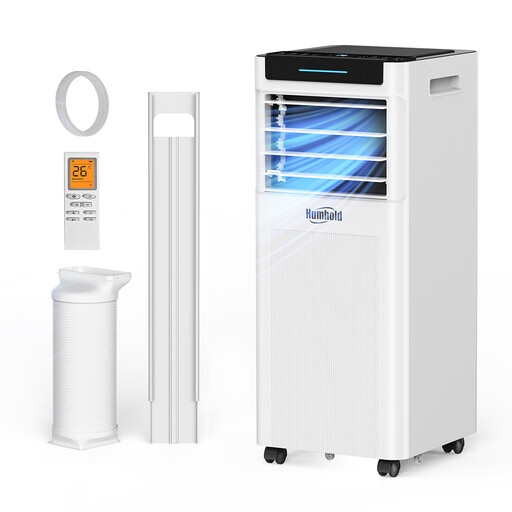
Why this choice suits this profile : Weighing 19.7 kg and fitted with castors, it can easily be moved from a bedroom to a home office. It provides cooling, dehumidification and ventilation for straightforward everyday use.
The product description states that it covers up to 28 m², includes a window kit and offers a night mode rated below 49 dB. This makes it easy to check whether the appliance is suitable for your room.
7,000 BTU capacity, 24-hour timer, washable filter and R290 refrigerant stated in the specifications.
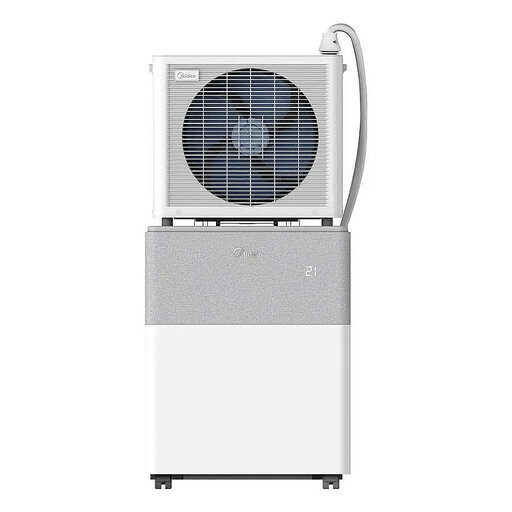
Why this choice suits this profile : Its portable split-style design is intended for larger spaces of up to 42 m². Wi-Fi control and the heating function provide genuine versatility for both homeowners and tenants who want to use their appliance all year round.
The product description clearly distinguishes between the dimensions and weight of the indoor and outdoor units. You will therefore need to plan a suitable location and carefully follow the supplied connection instructions.
12,000 BTU, A+ rating, heat-pump heating, dehumidification, Wi-Fi, plus advertised silent and night modes.
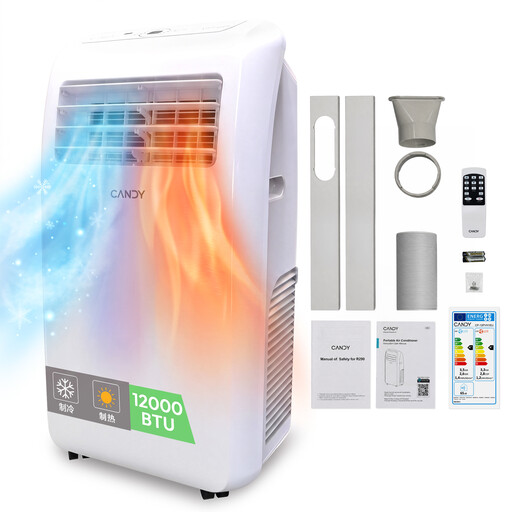
Why this choice suits this profile : With four modes and an advertised airflow rate of 400 m³/h, this model is designed for anyone who wants to cool, ventilate, dehumidify or heat a room of up to 35 m².
The product description clearly distinguishes cooling, which is designed for areas of up to 35 m², from heating, which is limited to 25 m². This prevents you from automatically assuming that the same coverage applies in both modes.
12,000 BTU, advertised A+ rating, 24-hour timer, remote control and window kit compatible with vertically or horizontally sliding windows.
Install the appliance on a stable floor near a window, leaving the clearance recommended by the manufacturer. The exhaust hose must not be crushed or excessively bent. Connect the air conditioner directly to a suitable socket, and avoid using extension leads or multi-socket adaptors if the instructions advise against them.
Routine maintenance generally includes:
Appliances using R290 refrigerant must not be pierced or dismantled by the user. Follow the instructions in the manual, particularly after transporting the appliance: some models require a waiting period before they are switched on for the first time.
We have put together a complete, real-time updated list of products that meet these strict selection criteria and European safety regulations.
A 9,000 BTU model is an interesting option for a room advertised as up to 25 or 30 m². You should also consider sun exposure, insulation and the presence of appliances that generate heat. In a very sunny room, compare the power in kW and the airflow rate carefully.
Consumption varies according to the electrical power, length of use, selected temperature and quality of the insulation. Check the power input and energy label, then multiply the kW consumed by the tariff charged by your supplier. The timer and night mode can reduce running time, but they cannot guarantee a precise saving.
Yes. A monobloc model fitted with an exhaust hose and a window kit generally requires no drilling into the wall. You will still need to vent the hot air outside and make the opening as airtight as possible. Before ordering, check that the kit is compatible with your type of window.