
Livraison le jour même ou le lendemain

Qualité garantie

Débloquez vos offres de bienvenue: Livraison GRATUITE | Jusqu'à -80 % | 30 jours d'essai gratuits à JoyPlus
Téléchargez l'application
A portable air conditioner is particularly useful for tenants, home workers and homeowners who want to cool a room without starting renovation work. Easy to move around, it can be placed in a bedroom, living room or home office, provided you check a few key points before buying.
Power, noise levels and the window kit are usually the first details highlighted in product specifications. However, three common pitfalls are often overlooked:
BTU/h refers to the appliance’s cooling capacity. However, it cannot by itself determine the area it will cool effectively.
As a general guide, taking the room’s insulation and exposure into account:
So, don’t automatically choose a 12,000 BTU air conditioner for a small room. An appliance that is too powerful may be bulkier, use more electricity and be less pleasant to use every day. For a bedroom or home-working space, a 9,000 BTU air conditioner will often offer a better balance.
A monobloc air conditioner must expel hot air outside using an air conditioner exhaust hose. Place it near a window, on a stable, level floor, leaving enough space around the air intake and outlet grilles.
In particular, check:
A universal kit will not necessarily fit every window. A 3 or 4 m draught-proofing strip can reduce air entering around the hose, but measure the opening’s perimeter first. A no-drill installation is convenient in rented accommodation, provided the whole setup remains stable and the hose is not crushed by overly tight bends.
A quiet air conditioner will not necessarily be silent. Depending on the product and selected mode, technical specifications generally state noise levels of between 48 and 64 dB. For a bedroom, look for a clearly documented night mode, while bearing in mind that the compressor may restart as soon as the temperature rises.
The energy rating and EER allow you to compare appliances on a standardised basis. However, the actual cost depends on how long the appliance is used, the selected temperature and the home’s insulation. To estimate it, multiply the stated electrical power by the number of hours of use, then by the tariff set out in your electricity contract.
Some features can also make a real difference:
Bear in mind, however, that during very humid periods, dehumidification mode may fill the water tank more quickly. Read the draining instructions and locate the “Water Full” indicator before using the appliance for the first time.
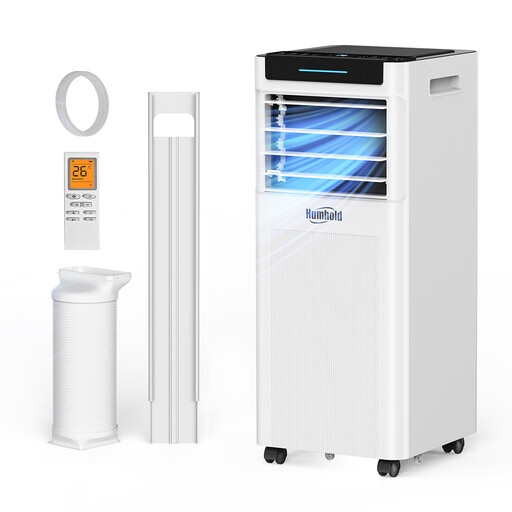
Why it suits this type of user : With 2.0 kW of power, a stated weight of 19.7 kg and three modes, this model is designed for small rooms and users who need to move their appliance regularly.
The stated power and coverage area are clearly specified, while the window kit and hose are included.
Night mode rated below 49 dB, 24-hour timer, washable filter and dehumidification function.
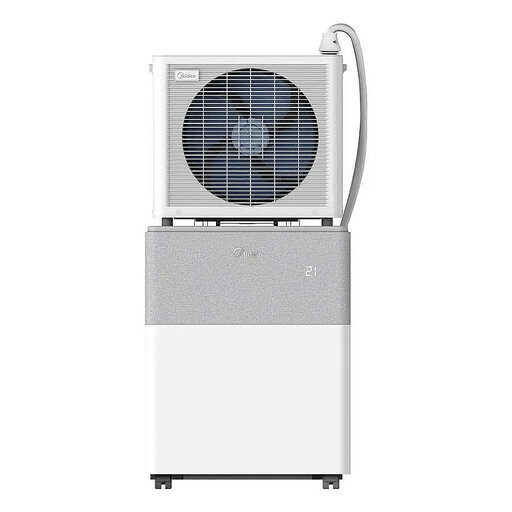
Why it suits this type of user : Its separate portable system, heating functions and Wi-Fi connectivity are aimed at users looking for a more comprehensive installation.
The specifications distinguish between the dimensions and weight of the indoor and outdoor units. Check the available space before ordering.
12,000 BTU power, A+ rating, heat-pump heating, Wi-Fi, quiet mode and window kit included.
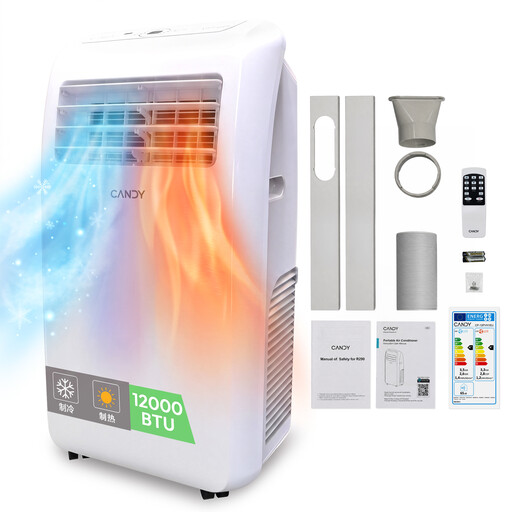
Why it suits this type of user : Its four modes and stated dehumidification function meet the needs of a living room used all year round.
The kit is stated to be compatible with vertical and horizontal sliding windows, making it easier to check suitability before installation.
Cooling, dehumidification, fan and heating modes, stated airflow of 400 m³/h, 24-hour timer and A+ rating according to the specifications.
Before switching it on, leave the appliance upright for the period specified by the manufacturer if it has been transported in a tilted position. Plug it into an earthed socket, without using a multiway adaptor or extension lead if the instructions prohibit them. As a general rule, leave at least 50 cm of clear space around the appliance and never block its grilles.
Clean the filter as often as recommended, usually every two weeks with regular use. It must be completely dry before being put back in place. Also inspect the exhaust hose, window seal and various connections. If the appliance uses R290, never attempt to pierce the refrigeration circuit: all internal work must be carried out by a qualified professional.
We have put together a complete, real-time updated list of products that fully meet these strict selection criteria and European safety regulations.
Yes. When a monobloc air conditioner operates in cooling mode, it must expel hot air outside. The hose should be as short and straight as possible. A window seal or suitable panel helps prevent hot air from entering around the opening.
It all depends on the electrical power consumed, the price per kilowatt-hour and the number of hours the appliance runs. Check the power rating in watts on the technical specifications, then use the following formula: power in kW × usage time × kWh tariff. Night mode and the timer can prevent unnecessary operating hours, although they cannot guarantee a specific saving.
A reversible portable air conditioner has a heating function, sometimes provided by a heat pump. Check the available heating power, the corresponding energy rating and the minimum outdoor temperature stated in the instructions. A model designed solely for cooling should not be considered a heating solution.