
Livraison le jour même ou le lendemain

Qualité garantie

Débloquez vos offres de bienvenue: Livraison GRATUITE | Jusqu'à -80 % | 30 jours d'essai gratuits à JoyPlus
Téléchargez l'application
A portable air conditioner lets you cool a bedroom, home office or living room without carrying out permanent building work. It is therefore particularly suitable for tenants, older properties and rooms used only during periods of extreme heat. But behind promises such as “fast cooling”, “quiet” or “low energy consumption”, certain details can turn an appealing purchase into a real disappointment.
Before comparing models, check three essential points: suitable power for the room, effective hot-air extraction and a realistic noise level. An incorrectly sized or poorly installed appliance may use more energy, run for longer and provide fairly limited comfort.
A 9000 BTU portable air conditioner will not necessarily be equally effective in every room. The area it can cool depends in particular on insulation, exposure to sunlight, ceiling height and the number of occupants.
As a guide, the products featured here claim to cover around 25 to 30 m² at 9000 BTU. A 12000 BTU model may, for its part, be rated for 35 to 42 m², depending on its design. These figures are estimates provided by the manufacturer: a loft room or a room with extensive glazing may require more power.
A single-hose unit extracts hot air through a duct. If the window is left widely open around it, hot, humid air may enter the room. The air conditioner then has to work harder while delivering poorer results.
A portable air conditioner with window kit simplifies installation, but the accessories supplied will not necessarily fit every configuration. For casement, sliding or unusually sized windows, a window sealing strip or portable air conditioner window seal can complete the setup. Measure the opening before ordering.
Even a quiet air conditioner contains a compressor and a fan. The quoted noise level may vary depending on the selected mode and the measurement distance. In the selection featured here, figures range from under 49 dB in sleep mode for the Humhold model to 64 dB for some more powerful appliances.
For a bedroom, compare the measured noise level, whether a night mode is available and whether you can programme the appliance to switch off. The simple marketing claim “quiet” is not enough.
Cooling capacity is expressed in BTU/h or kilowatts. Models from 7000 to 9000 BTU are generally aimed at small and medium-sized rooms, while a 12000 BTU portable air conditioner is intended for larger spaces.
Also look at the airflow rate, expressed in m³/h. This indicates the amount of air circulated, but on its own it cannot predict the final temperature. Installation also plays a decisive role: leave the recommended clearance around the appliance, do not block the grilles and avoid bends in the exhaust duct wherever possible.
An appliance with a dehumidifier can be useful in a damp room. However, this mode may fill the tank more quickly. Automatic shut-off and a “tank full” indicator are therefore far from being optional extras.
A reversible portable air conditioner adds a useful heating function for the mid-season. Nevertheless, check the stated coverage in heating mode: it may differ from the figure given for cooling. Wi-Fi lets you programme the appliance from a smartphone, but it cannot compensate for poor installation. Also check app compatibility and the quality of your home network.
The energy class, EER and COP allow you to compare performance under the conditions specified in the technical data sheet. An A or A+ rating does not mean that the appliance will use little energy in every situation: operating time, the selected temperature and the quality of the insulation all have a direct impact on your bill.
The models featured use R290, a naturally derived refrigerant. The circuit must never be pierced or modified. Connect the appliance to an earthed socket and avoid using an extension lead or multi-socket adaptor if the instructions advise against it. After transporting the appliance in a tilted position, observe the stated waiting period before switching it on.
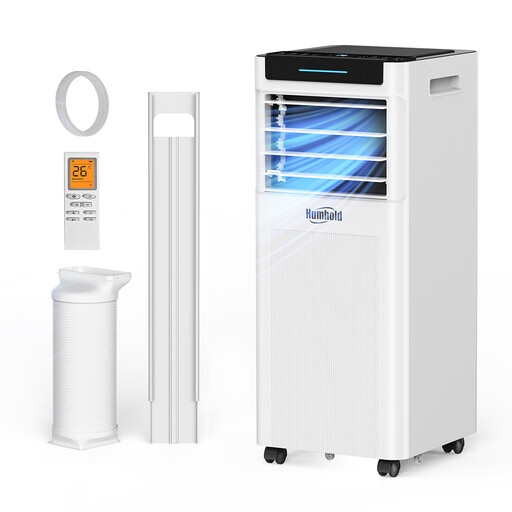
Why this choice suits this profile: Weighing 19.7 kg and fitted with castors and a window kit, this model is suitable for a bedroom, home office or small room of up to 28 m², according to the product details.
The stated 2.0 kW capacity is clearly linked to an indicative room size, while the window kit helps limit hot-air entering once the appliance is installed.
Three modes, sleep mode rated at under 49 dB and a 24-hour timer.
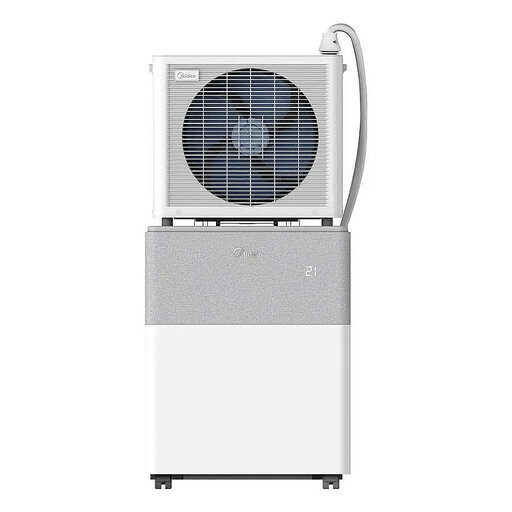
Why this choice suits this profile: This reversible portable air conditioner, made up of an indoor unit and an outdoor unit, is designed for rooms of up to 42 m² and can be controlled via Wi-Fi using the SmartHome app.
The product details specify noise levels from 39 to 59 dB(A), the tube length, fixed at 2 m, and the accessories included. However, you will need to allow enough space for both units.
12 000 BTU, heat-pump heating, dehumidification and quiet mode.
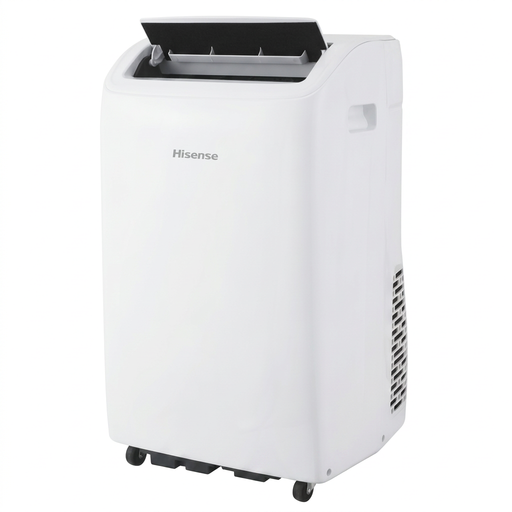
Why this choice suits this profile: With heating and cooling modes, Wi-Fi control and a 24-hour timer, it is suitable for regular use in a room stated as measuring 14 m².
The product details clearly distinguish between 2.6 kW of cooling power and 2.4 kW of heating power, with a minimum noise level of 50 dB.
A energy rating for cooling, R290, remote control and night mode.
We have put together a complete, real-time updated list of products that meet these strict selection criteria as well as European safety regulations.
Sealing strips measuring 3 or 4 m should be chosen according to the window’s perimeter. Check its opening type and measure the required length before buying: a strip that is too short or incorrectly positioned will let hot air through.
A 7000 to 9000 BTU model may be suitable for this area, depending on insulation and exposure. For a very sunny room, a loft room or a poorly insulated space, rely on the power in kilowatts and the stated coverage rather than the BTU figure alone.
Yes. On a single-hose model, the duct generally needs to expel hot air outside. The window kit makes installation easier. Poor sealing reduces cooling efficiency and may increase the running time.
It depends on the electrical power, how long it is used, the selected setting and the outdoor temperature. Check the input power, energy label and EER or COP data. A timer and regular maintenance can also prevent the appliance from running for longer than necessary.