
Livraison le jour même ou le lendemain

Qualité garantie

Débloquez vos offres de bienvenue: Livraison GRATUITE | Jusqu'à -80 % | 30 jours d'essai gratuits à JoyPlus
Téléchargez l'application
Low tyre pressure can make a journey more difficult, increase fuel consumption and accelerate tyre wear. To avoid having to stop at a petrol station, many drivers equip themselves with a portable tyre inflator. But you need to choose a model that suits your needs – not all are designed for the same vehicles or the same uses.
Before placing an order, check the power source, airflow rate, measurement accuracy and battery life. Here are the key criteria to consider when finding the right device for a car, motorbike, bicycle, SUV or motorhome.
A rating like 150 PSI or 160 PSI refers to the device’s theoretical maximum pressure. On its own, it doesn’t tell you how long it will take to inflate a tyre. The airflow rate, measured in L/min, along with the design of the motor and cylinder, also matters.
For a simple top-up, a modest flow rate may be enough. However, reinflating a nearly flat tyre, an SUV wheel or several tyres in a row requires more power, sometimes with breaks to let the compressor cool down.
A cordless tyre inflator is especially handy in a car park, by a cycle path or on a day out. Its battery life depends on the battery capacity and the pressure you need to reach.
A 12 V tyre compressor that plugs into the cigarette lighter socket saves you from having to charge a battery before you set off. On the downside, its cable must be long enough to reach all four wheels. For extended use, it’s best to keep the engine running to reduce the strain on the battery, as recommended by the manufacturer.
An inflator with a digital screen makes it easier to set and read the pressure. However, the stated accuracy doesn’t replace your vehicle manufacturer’s recommendations. Check the label inside the door frame or your owner’s manual, rather than the figure on the tyre sidewall – that usually indicates the maximum pressure, not the everyday recommended pressure.
For a car air pump, a maximum pressure of 150 PSI generally covers the everyday needs of a car, motorbike, bicycle or sports ball. That doesn’t mean the device is suitable for heavy goods vehicle tyres or all motorhome wheels. Always check the required pressure and the limits stated in the product description.
The flow rate, given in L/min, gives a more practical idea of how quickly it inflates. Car tyres naturally need more air than bicycle tyres. For regular car use, a model with multiple cylinders may be more suitable, as long as you follow the recommended running times and cooling breaks.
For a rechargeable electric tyre inflator, look carefully at:
The Porbi Q19, for example, has a 4,000 mAh battery, with a stated charging time of 3.5 hours and a usage time of up to 25 minutes depending on conditions. Its product page also mentions a flow rate of 26 L/min, five inflation modes and a maximum pressure of 150 PSI. These details help you understand its position: a portable tyre pump suited to top-ups and occasional use.
A pump for car, motorbike and bicycle tyres should come with the right adaptors. A needle for sports balls or a nozzle for air mattresses can also come in handy on a family day out or a camping trip.
Also check the length of the hose and 12 V cable, how the accessories are stored, how easy the screen is to read, and whether there’s a built-in light. Automatic shut-off at the set pressure reduces the risk of over-inflating. Even so, it’s still a good idea to double-check the pressure with a reliable gauge when needed.
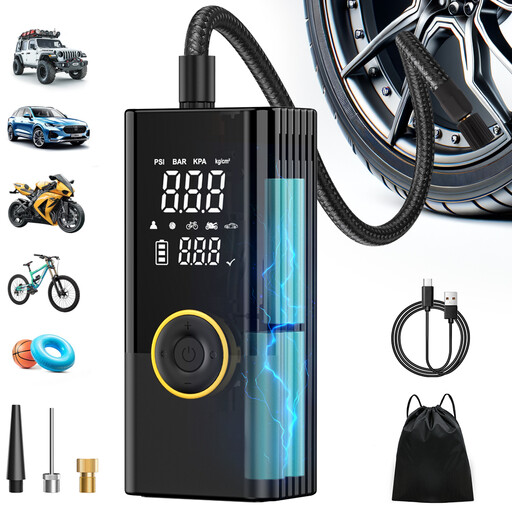
Why this suits this profile: Its cordless design and digital screen make it a simple device to keep in the boot or on a two-wheeler.
The digital display lets you monitor pressure in real time, while the lack of a cable means you’re not tied to a 12 V socket.
Cordless operation, built-in light and dedicated modes for car, motorbike, bicycle and sports ball.
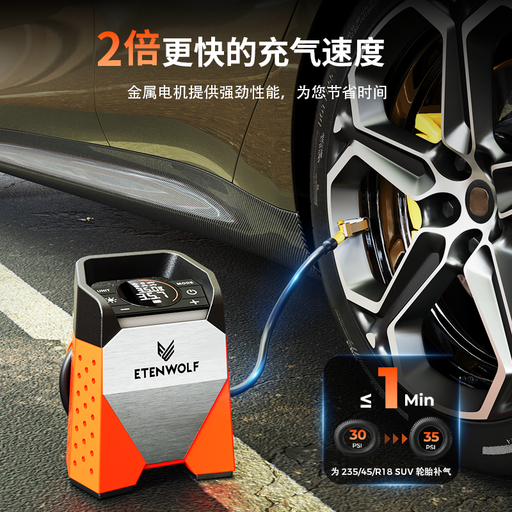
Why this suits this profile: This rechargeable model has a stated maximum pressure of 160 PSI. It’s aimed at users who want more capacity for different vehicles and accessories.
The product page specifies the battery supplied, the maximum power of 132 W and the included accessories, making for a more concrete comparison.
Lithium-ion battery included, stated pressure of 160 PSI and adaptors for Presta valves and sports balls.
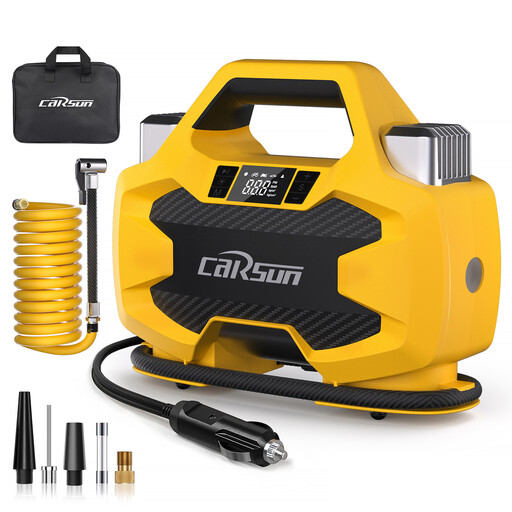
Why this suits this profile: Its twin-pump design and usage guidelines make it suitable for SUVs, motorhomes and tyres that need longer inflation sessions.
The product page recommends starting the engine when using 12 V power and letting the device cool down after extended use.
30-cylinder architecture, portable design and stated suitability for SUVs and motorhomes.
We’ve put together a comprehensive, real-time list of products that meet these demanding selection criteria and European safety standards.
Yes, some models can, but the time needed varies depending on the tyre volume, motor power and target pressure. A compact device is best suited to top-ups and emergency situations. For reinflating several SUV or motorhome tyres, choose a product page that clearly states the flow rate, usage time and required breaks.
The cordless model is quick to set up and gives you plenty of freedom to move around the vehicle, as long as its battery is charged. The 12 V compressor is a good option for long journeys, since it doesn’t rely on an internal battery. However, its cable must be long enough to reach the valve. Some devices combine both power modes and can suit drivers who alternate between daily commutes and trips.
The electricity consumption for a simple top-up is generally low. The cost mainly depends on charging the battery or the energy supplied by the vehicle. To keep the device in good condition and extend its lifespan, follow the cooling times, avoid exposing it to water and only use accessories that are compatible with the valve.