
Livraison le jour même ou le lendemain

Qualité garantie

Débloquez vos offres de bienvenue: Livraison GRATUITE | Jusqu'à -80 % | 30 jours d'essai gratuits à JoyPlus
Téléchargez l'application
Insufficient tyre pressure increases fuel consumption, accelerates tyre wear and can make driving less safe. However, choosing a portable tyre compressor is not simply a matter of picking the maximum pressure figure shown on the packaging. In everyday use, battery life, actual airflow, power supply and pressure-gauge accuracy matter far more.
A model rated at 150 PSI or more may be suitable for car, motorbike or bicycle tyres, as well as inflatables. However, this figure indicates a theoretical limit, not how quickly the device will inflate a tyre. To assess performance, it is better to look at the airflow rate, expressed in L/min.
Also check the usage limits. A small cordless tyre pump may be perfectly suitable for topping up the pressure, but it can heat up quickly if you ask it to inflate a whole tyre or several tyres in succession.
A battery-powered electric tyre inflator gives you plenty of freedom to move around. However, its battery life varies depending on battery capacity, the pressure to be reached and the ambient temperature. For long journeys, camping trips or an electric vehicle, a backup cable can prove very useful.
By contrast, a 12 V car compressor does not rely on an internal battery, but you need access to a 12 V socket. During prolonged use, the vehicle’s engine will generally need to be running to prevent the battery from going flat.
A digital pressure gauge should show pressure clearly and, if possible, offer several units such as PSI, BAR or kPa. The recommended pressure is usually shown on the label inside the door frame, inside the fuel flap or in the vehicle handbook. It should not be confused with the maximum pressure marked on the tyre sidewall.
For a passenger car, a stated maximum pressure of between 120 and 160 PSI will generally cover everyday top-up requirements. That does not necessarily mean the compressor will inflate every tyre quickly to that level.
Remember to check which accessories are included:
A versatile car tyre inflator should also clearly state its compatibility limits. Some mini models are suitable for bicycles, motorbikes and small cars, but are not designed for lorry or trailer tyres or heavy vehicles.
The automatic shut-off lets you set a target pressure before starting inflation. It means you do not need to monitor the device constantly, but it is still best to check the pressure with a reliable instrument, especially before a long journey.
The connector must be properly secured to the valve to minimise air leaks. A reading that stabilises after a few seconds is preferable to a display that constantly fluctuates.
For a cordless portable air pump, compare the battery capacity, charging time and whether an additional power source is available. A device fitted with a 12 V cable can take over when the battery is nearly empty.
Follow the instructions in the manual: avoid excessively long periods of continuous use, allow the casing to cool down and never operate the compressor unattended. For night-time use or when stopped at the roadside, an emergency LED light or flashing mode can improve visibility, although it does not replace legally required signalling equipment.
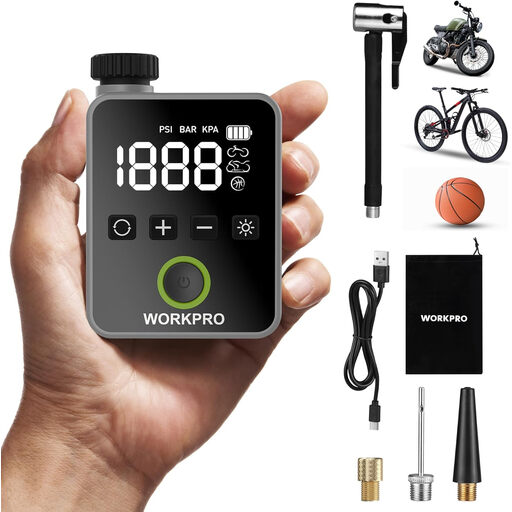
Why this choice suits this profile : Weighing just 270 g, this compact model fits easily in a glove compartment, bicycle bag or camping bag. Its bicycle, motorbike and ball modes cover the most common top-up needs.
The digital screen lets you choose between PSI, BAR and kPa, while the automatic shut-off reduces the risk of exceeding the set pressure. However, the product details specify that the device is not intended for lorry or trailer tyres.
Stated maximum pressure of 140 PSI, USB-C charging, real-time pressure display and three LED lighting modes.
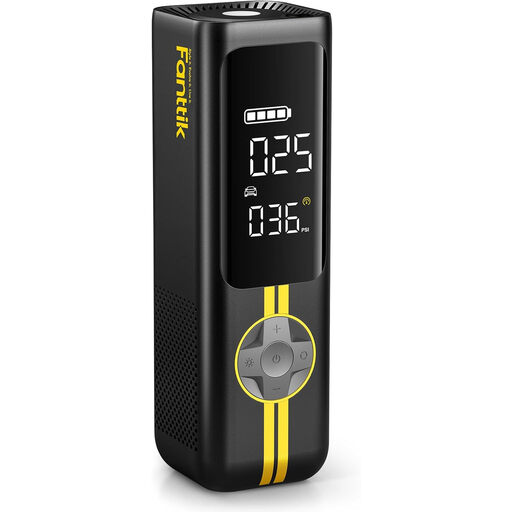
Why this choice suits this profile : This model is aimed at drivers looking for a versatile cordless pump that is easy to adjust and, according to its product details, can handle tyres up to 26.3 inches, or approximately 66.8 cm.
The four preset modes and PSI, kPa and BAR units help avoid approximate settings. The automatic shut-off activates once the selected pressure has been reached.
Stated maximum pressure of 150 PSI, dual display, 46 cm hose, LED light and USB charging function for a mobile device.
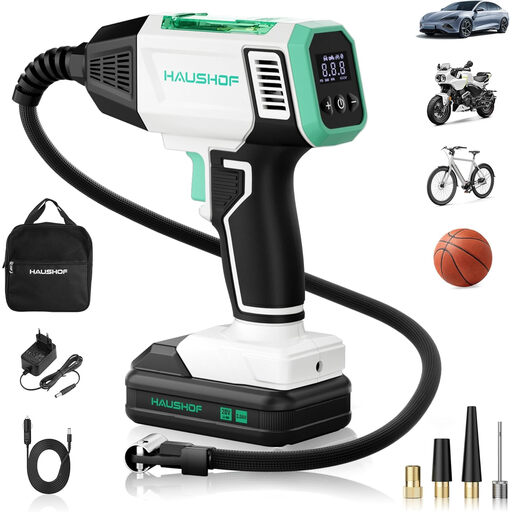
Why this choice suits this profile : Powered by a 2 000 mAh battery or a 4 m 12 V cable, it can accompany you on the move, while camping or when inflating different types of tyres and equipment.
The dual power supply reduces reliance on the internal battery. For prolonged use, the product details recommend using the 12 V cable and taking regular breaks to allow heat to dissipate.
Stated airflow of 22 L/min, maximum pressure of 150 PSI, four preset modes, manual adjustment, digital display and integrated LED.
We have put together a complete, real-time updated selection of products that meet these demanding criteria and European safety standards.
Yes, provided the model is compatible with the size and pressure of the tyres concerned. A cordless device avoids tying up a 12 V socket, while a corded model can serve as a backup. Check the battery level before setting off and follow the pressure recommended by the manufacturer.
It depends on the tyre’s volume, its starting pressure, the airflow rate and the motor temperature. Manufacturers’ stated times correspond to very specific conditions. A simple top-up between two pressure levels is generally much quicker than inflating a completely flat tyre.
Recharge it after every use, store it away from damp and avoid long periods of use without a break. You should also check the hose, adapters and cable regularly. If you need to inflate several tyres in succession, a model with a 12 V cable or higher-capacity battery will reduce interruptions.