
Livraison le jour même ou le lendemain

Qualité garantie

Débloquez vos offres de bienvenue: Livraison GRATUITE | Jusqu'à -80 % | 30 jours d'essai gratuits à JoyPlus
Téléchargez l'application
For any electric vehicle (EV) or plug-in hybrid (PHEV) owner, the ability to charge anywhere is crucial. If installing a dedicated wallbox at home isn't feasible, a portable Type 2 EV charger is the ideal solution for powering up at home or on the go. But be warned: the market is a jungle of models with often misleading promises, and pitfalls abound.
This guide breaks down the essential criteria to check before you buy, helping you make a safe, informed choice that fits your needs—and steer clear of marketing hype.
Navigating the charger market can quickly become a headache. Here are the three most common mistakes that can prove costly—to you and your electrical system.
To avoid these pitfalls, focus on a few non-negotiable technical specifications. These are the true hallmarks of quality and safety for your mobile charging cable.
This is arguably THE most important feature: the ability to adjust the current amperage. A quality charger must offer multiple levels, typically between 6A and 16A.
For a portable charging station plugged into a domestic socket, the power output is inherently limited by the single-phase circuit.
Never overlook the built-in safety features. A quality charger must absolutely include several protections:
To help you navigate the options, here are a few models that perfectly exemplify these criteria and cater to well-defined user profiles.
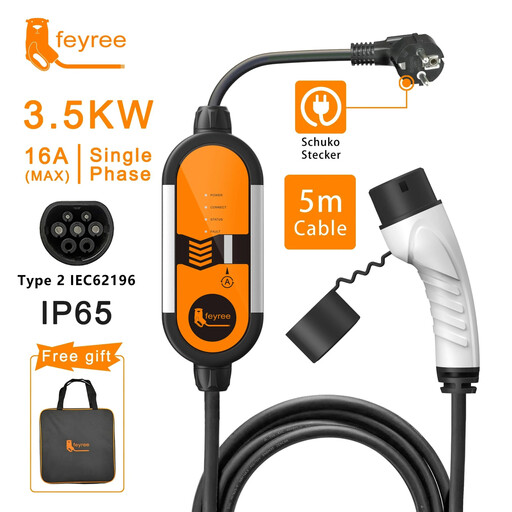
Why we chose it : The perfect solution for those who want a reliable, straightforward charger for home or supplemental use. It delivers the essentials, no frills attached.
Its adjustable current (8A/10A/13A/16A) prevents a standard domestic socket from overheating, thereby mitigating the primary safety risk.
Its OLED screen displays all key charging information in real time (current, voltage, duration), providing direct and reassuring visual feedback.
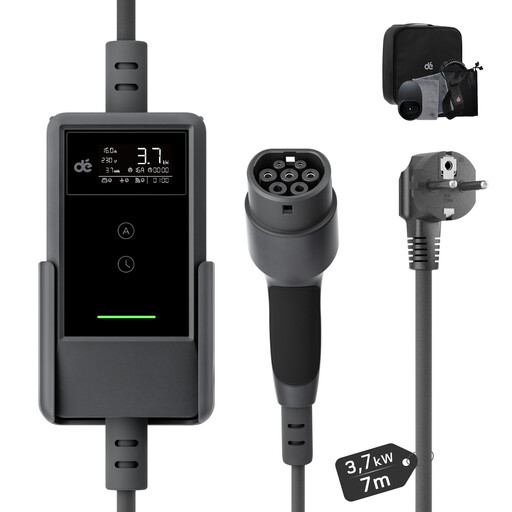
Why we chose it : Essential for those who often park far from a socket, or who simply want more flexibility in their garage and on the road.
In addition to its adjustable current (6A-16A), its generous length solves the very practical problem of socket access—a detail that is too often overlooked.
Its 7-metre cable provides maximum freedom of movement and prevents the need for an extension cord (a practice that is strongly discouraged for EV charging).
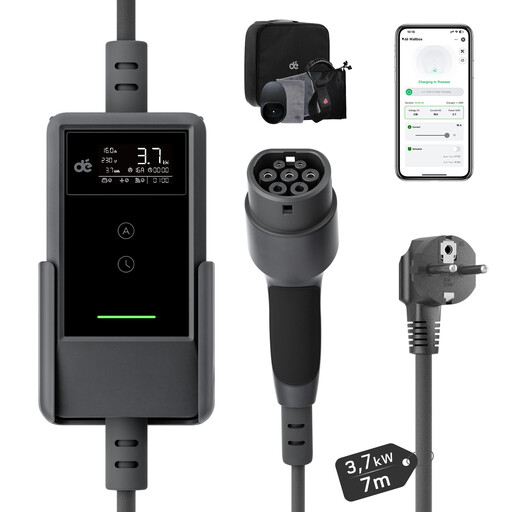
Why we chose it : For the user who loves managing everything from their smartphone: scheduling charges to take advantage of off-peak rates, monitoring consumption in real time, and more.
It combines the safety of an adjustable current with the convenience of remote control, thereby avoiding the trap of "smart" chargers that sometimes neglect the fundamentals.
The app control lets you schedule charging sessions to optimise your electricity bill and supervise everything remotely. A major plus.
We have selected a comprehensive range of products that meet our strict selection criteria and all current safety standards.
1. Can I leave a portable charger permanently plugged into a domestic socket? It's not recommended. For long-duration charging, such as overnight, it's safer to set the current to a low level (10A or less) to limit heat build-up. Also, ensure your socket is in good condition, properly grounded, and that the circuit isn't already burdened by other high-consumption appliances.
2. What is the difference in charging time between 10A and 16A? Charging at 16A (≈3.7 kW) is approximately 60% faster than at 10A (≈2.3 kW). In practical terms, to recover 20 kWh of energy, you can expect it to take about 5 hours and 30 minutes at 16A, versus nearly 8 hours and 45 minutes at 10A. It all depends on your urgency and, again, the robustness of your electrical installation.
3. Is this type of charger compatible with my Tesla Model Y or VW ID.3? Yes, absolutely. The Tesla Model Y, VW ID.3, and the vast majority of electric and plug-in hybrid cars sold in Europe use a Type 2 port for alternating current (AC) charging. Therefore, a portable Type 2 charger will be perfectly compatible. Compatibility depends on the connector standard, not the car brand.