
Livraison le jour même ou le lendemain

Qualité garantie

Débloquez vos offres de bienvenue: Livraison GRATUITE | Jusqu'à -80 % | 30 jours d'essai gratuits à JoyPlus
Téléchargez l'application
Are you looking for a home charging solution or something to use on the go, without having a fixed wallbox installed straight away? A portable Type 2 electric vehicle charger can be the perfect answer to this need, provided you check its compatibility with your vehicle and your electrical installation.
However, the market holds a few unpleasant surprises. The advertised power doesn't necessarily mean your car will be able to use it, while a standard 16 A domestic socket isn't always designed to handle prolonged charging at its maximum current. Here are the criteria to review before buying, along with a selection suited to different profiles.
A 3.5 kW, 3.68 kW or 7 kW electric vehicle charger displays a theoretical maximum capacity. The power actually delivered also depends on the vehicle's onboard charger, the voltage, the selected current and the condition of the electrical installation.
For example, a 7 kW model operating at 32 A requires a 230 V single-phase supply, along with a suitable circuit and socket. A standard 16 A Schuko socket cannot achieve this power under safe conditions.
A Type 2 charging cable can be fitted with a Schuko plug, a Type F plug or an industrial CEE connector. These formats don't meet the same needs:
If you're planning regular high-current charging from an older domestic socket, it's best to have the installation checked by a qualified electrician.
A Wi-Fi or Bluetooth connection can be used to schedule charging, monitor consumption or start a session remotely. It does not replace the electrical protections built into the portable EVSE charger. In particular, check for protection against overcurrent, overheating, overvoltage and leakage currents.
In the UK as in the rest of Europe, the Type 2 socket conforming to IEC 62196-2 is fitted to many electric vehicles and plug-in hybrids. This compatibility must be confirmed in your car's technical specifications, especially for AC charging.
A 3.5 kW or 3.68 kW charger is suitable for slow charging, typically done overnight. A 7 kW Type 2 model can reduce charging time, but only if the vehicle and the electrical circuit can handle a current of up to 32 A.
Adjusting the current allows you to adapt charging to the socket being used and the circuit's capabilities. Common models offer several levels, typically from 8 A to 16 A, while some 7 kW mobile chargers range from 16 A to 32 A.
This feature is particularly useful in an older house, on a socket shared with other appliances, or when your electricity supply is limited. Always choose a current compatible with the installation before connecting the connector to the vehicle.
A 5 m charging cable suits most garages. If the socket is far from the parking space, a length of 10 m, 15 m or 20 m can offer more flexibility. On the downside, the cable will be heavier and bulkier.
For frequent use, also consider checking:
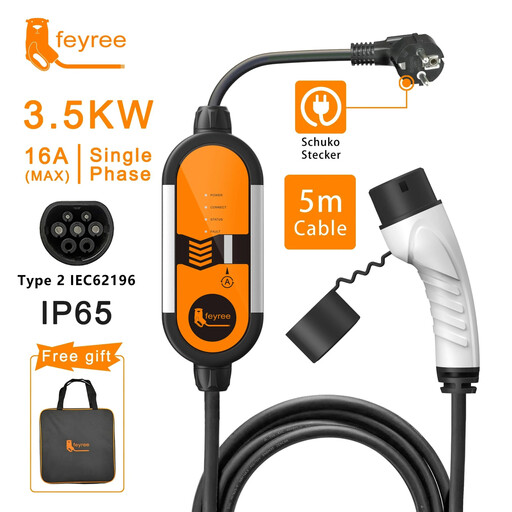
Why this choice makes sense: Its Schuko plug, 5 m cable and adjustable current make it suitable for home charging or top-ups, without needing a wall installation.
The 8, 10, 13 and 16 A settings prevent you from constantly running the installation at its maximum current.
Advertised power of 3.5 kW, OLED screen, protection against overheating, overload and leakage, with an IP65 rating stated.
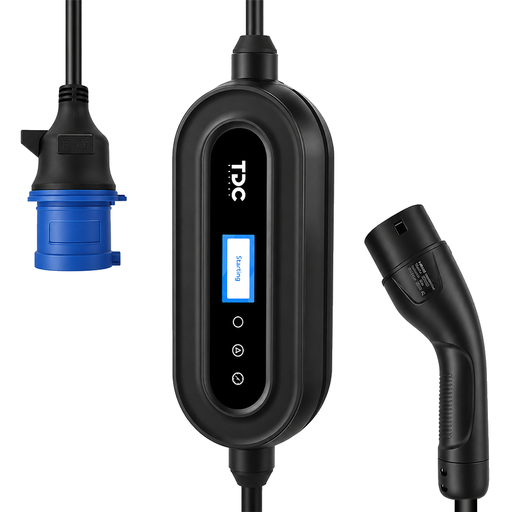
Why this choice makes sense: It's aimed at drivers who have a CEE 32 A socket and want to manage their charging with greater precision.
The CEE 32 A plug and the 16, 20, 24 and 32 A settings prevent you from mistaking a domestic socket for a suitable power supply.
Advertised power up to 7 kW, LCD screen, Wi-Fi and Bluetooth, 5 m cable, IP66 rating and Type A + 6 mA DC protection stated.
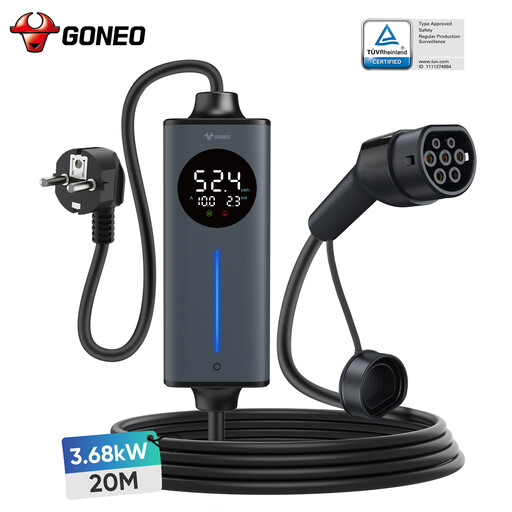
Why this choice makes sense: With its 20 m length, it can suit houses, courtyards or locations where the socket is far from the vehicle.
The specification states 30 mA AC + 6 mA DC residual current protection, earth detection and thermal control.
Power up to 3.68 kW, timer from 0 to 8 hours, voltage and current display, Type 2 cable available in several lengths.
We've selected a comprehensive and regularly updated list of products that meet these demanding selection criteria and European safety standards.
Before each session, inspect the mains plug, the Type 2 connector and the cable. Plug the charger directly into a properly earthed socket, without using a multi-socket adapter or an extension lead not designed for this purpose. Unwind the cable fully to reduce the risk of overheating.
If the plug, socket or control box becomes abnormally hot, stop charging immediately. At the end of the session, stop the charge before disconnecting the vehicle, then store the equipment in a dry place. For daily use, installing a dedicated socket may be worthwhile.
Yes, if the charger has a compatible Schuko or Type F plug and the socket is properly earthed. For prolonged charging, reduce the current if the circuit is not designed to handle 16 A continuously. If in doubt, seek advice from a qualified professional.
A 5 m cable is generally suitable for a garage. A length of 10 m, 15 m or 20 m offers more freedom when the socket is far away, but it requires more storage space and can be heavier to handle.
The cost depends mainly on the energy consumed by the vehicle and your electricity supplier's tariff. Scheduling charging during off-peak hours can help reduce the bill, but the actual saving depends on your contract, your vehicle and your habits.