
Livraison le jour même ou le lendemain

Qualité garantie

Débloquez vos offres de bienvenue: Livraison GRATUITE | Jusqu'à -80 % | 30 jours d'essai gratuits à JoyPlus
Téléchargez l'application
An underinflated tire isn't just an inconvenience: it's a genuine safety risk, not to mention a drain on your fuel economy. The portable tire inflator has thus become an essential accessory to keep in your trunk at all times. The problem: the market is flooded with models making tempting promises that, ironically, don't always hold up. Before you buy, it's crucial to know how to spot the hidden flaws that can render a device useless in just a few months.
Here are the 3 most common pitfalls to avoid:
To ensure you make the right choice, here are the technical specs that truly matter and define the performance and reliability of a portable air compressor.
The power source is a fundamental choice that will depend entirely on your use case.
Don't be fooled by the maximum pressure rating.
Far from being gimmicks, these two features are essential for both safe and precise use.
Rather than an endless list, we've selected products tailored to specific user profiles. The goal: to help you find the model that truly fits your needs.

Why we chose it: For the user seeking a "plug-and-play" solution to leave in the glove box. With no battery to charge, you just connect it to the 12V socket for absolute peace of mind in an emergency.
This corded model completely eliminates the risk of a dead battery at the worst possible moment. Its power source is your vehicle's own, guaranteeing it will work when you need it most.
Rock-solid reliability thanks to its 12V power source and an ultra-compact design for easy storage.
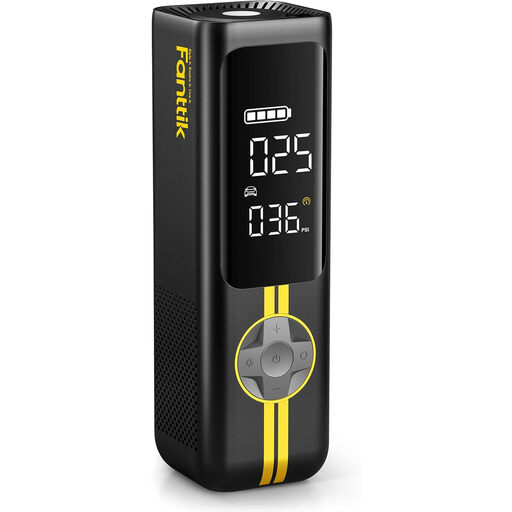
Why we chose it: For those who juggle cars, motorcycles, bikes, and recreational gear. This cordless model combines fast inflation speed, solid battery life, and bonus features (like a power bank mode), making it useful far beyond just a flat tire.
It sidesteps the slowness trap with its high-performance airflow. Its battery is designed to handle multiple inflations, preventing it from running out of power mid-job.
Speed and endurance for multiple and frequent uses. Its preset modes greatly simplify operation.
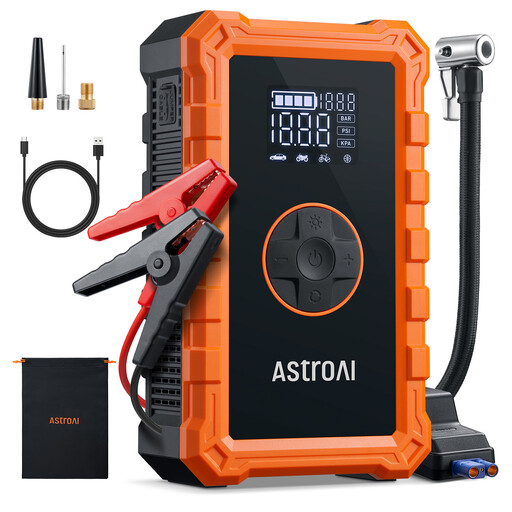
Why we chose it: Much more than a simple inflator, this is a true roadside survival kit. It's aimed at the driver who wants to be prepared for the two most common breakdowns: a flat tire and a dead battery. One device, two vital solutions.
It redefines the very concept of an emergency tool. Instead of being a simple inflator with sometimes-limited battery life, it packs a battery powerful enough to jump-start an engine, which in turn guarantees a massive power reserve for the compressor.
2-in-1 function (jump starter and air compressor) for maximum versatility in a pinch.
Explore our complete, up-to-date selection of products that meet our performance criteria and current safety standards.
Yes, most modern models are capable of this, but the process will take time and put a lot of strain on the device. For a flat tire, a corded (12V) model is often a wiser choice, as it won't risk running out of battery halfway through. With a cordless model, make sure it's fully charged and don't hesitate to let it cool down intermittently if recommended by the manufacturer.
The longevity of a lithium-ion battery depends on its charge/discharge cycles and storage conditions. To preserve it, avoid letting it fully discharge and do not store it in extreme heat or cold (for example, in direct sunlight inside a car during summer). It's advisable to recharge it every 2 to 3 months, even when not in use, to maintain its health.
On first use, it's a good idea to compare your inflator's reading with that of a reference gauge (like one you'd find at a gas station). Once its accuracy is confirmed, you can confidently rely on the auto-shutoff feature. It remains the safest way to reach the exact pressure recommended by your vehicle's manufacturer—no more, no less.