
Livraison le jour même ou le lendemain

Qualité garantie

Débloquez vos offres de bienvenue: Livraison GRATUITE | Jusqu'à -80 % | 30 jours d'essai gratuits à JoyPlus
Téléchargez l'application
An under-inflated tire is more than just an inconvenience: it's a genuine safety risk, not to mention the increased fuel consumption it causes. And relying on the often poorly calibrated gauges at gas stations is not a reliable solution. This is where a portable tire inflator becomes an essential accessory for any car owner serious about vehicle maintenance. The problem? The market is flooded with models making often misleading marketing claims. This guide is here to help you avoid the pitfalls and find the ideal travel companion.
Before you pull out your credit card, be wary of these often-exaggerated marketing claims that lead straight to disappointment.
To make the right choice, here are the three technical criteria that truly matter when evaluating an inflator's performance and practicality.
Here, it all depends on your habits and needs.
Don't be dazzled by flashy numbers like a maximum pressure of 150 PSI (about 10.3 bar). This is purely a marketing gimmick, as most car tires require a pressure between 2 and 3 bar (30-45 PSI).
The real deciding factor is the airflow, measured in litres per minute (L/min). The higher this number, the faster the inflation.
Beyond raw performance, certain options can transform a simple inflator into a true Swiss Army knife for drivers.
To help you see more clearly, here is a selection of models that tick the right boxes, suited for different user profiles.
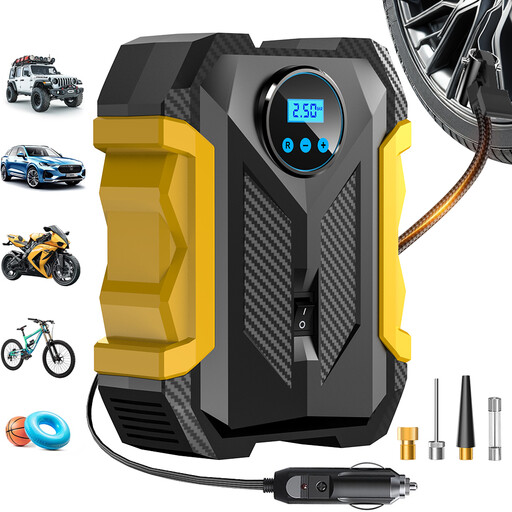
Why it's a match: The perfect solution for those who want a reliable device, always ready in the trunk. Its 12V connection ensures it's always available, without ever worrying about a dead battery.
As a corded model, it sidesteps the "overstated battery life" trap entirely. It delivers constant power as long as the ignition is on, ensuring a full inflation even in critical situations.
Reliable 12V power supply; 3-metre cable long enough for all tires; Digital display and LED light for optimal ease of use, day or night.
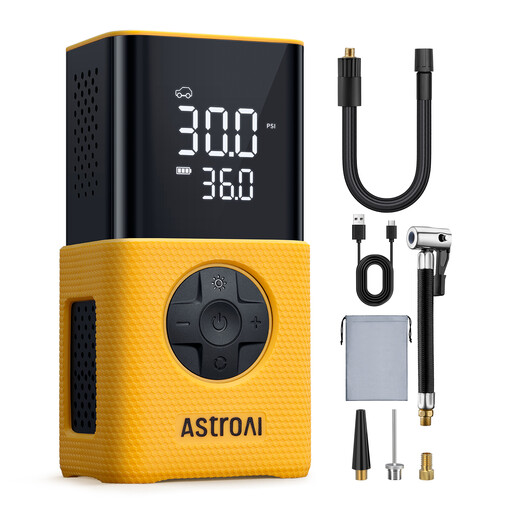
Why it's a match: For those looking for a do-it-all device: car, motorcycle, MTB, and kids' balls. Its cordless design, feather-light weight (460g), and preset modes make it a champion of versatility.
It tackles the "false precision" trap by highlighting its upgraded sensors. Plus, it advertises realistic performance (a 30 to 36 PSI top-up in 1.5 min), a far cry from fantasy claims.
Highly versatile (5 modes); 4000 mAh battery with Power Bank function; Ultra-compact and lightweight design, easy to take anywhere.
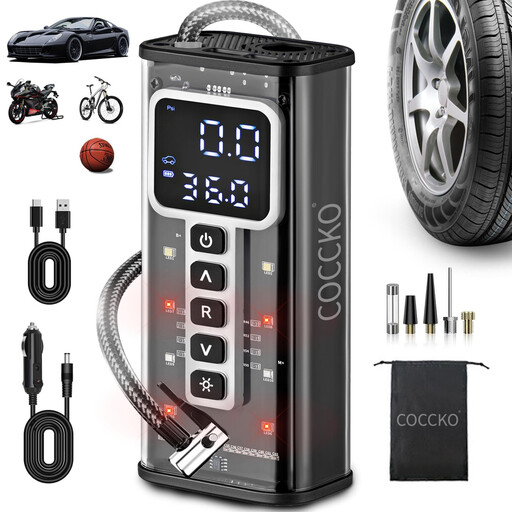
Why it's a match: Designed for those who refuse to compromise on performance. Perfect for multi-vehicle owners or for heavy-duty use, thanks to its high-capacity battery and superior airflow.
This model tackles the speed and battery life traps head-on by boasting powerful specs: an airflow of 35 L/min and a 6000 mAh battery—numbers that justify its superior performance.
XXL battery life thanks to the 6000 mAh battery; Fast inflation with a 35 L/min airflow; Dual power option (12V cable included).
Explore our full selection of products that meet our criteria for performance and reliability.
A well-made model, if properly maintained, can last for many years. On cordless models, the lithium-ion battery will determine its longevity. To preserve it, remember to recharge it at least once a quarter, even if the device is not in use.
This is strongly advised against. Lithium-ion batteries do not handle extreme temperatures well. The heat of a car's interior in summer or freezing temperatures in winter can irreversibly damage the battery and drastically reduce its lifespan. It's better to store it at room temperature or take it with you.
For everyday use, the accuracy of a good inflator with an auto shut-off feature is more than sufficient. However, for those seeking absolute performance (e.g., for track use), double-checking with a professional-grade handheld gauge when the tires are cold is still good practice. But for daily driving, the accuracy of modern devices is perfectly satisfactory.