
Livraison le jour même ou le lendemain

Qualité garantie

Débloquez vos offres de bienvenue: Livraison GRATUITE | Jusqu'à -80 % | 30 jours d'essai gratuits à JoyPlus
Téléchargez l'application
The portable speaker market is a crowded jungle of marketing promises. Finding the model that checks all the boxes—performance, durability, and a fair price—often feels like an uphill battle. Yet the goal is simple: to get the party started, set the mood at the beach, or enjoy a quality soundtrack on a hike, without worrying about a dead battery or a surprise downpour.
However, disappointment is often just around the corner when a product fails to live up to its claims. To avoid turning a promising purchase into a costly mistake, here are the pitfalls to watch out for.
To ensure your future speaker lives up to expectations, focus on a few key technical specifications. These, not the marketing, reveal a model's true performance and versatility.
A speaker's power is often expressed in Watts. It's crucial to rely on the RMS (Root Mean Square) value, which measures the real, continuous power the speaker can deliver without distortion. A 20W RMS wireless speaker already provides a very comfortable volume level to liven up an outdoor party with a dozen people or to fill a medium-sized living room with sound. To get bass with real punch and sound that doesn't distort, the presence of a passive bass radiator is an excellent sign. This clever component uses the air pressure generated by the active drivers to mechanically amplify low frequencies. It's a remarkably effective solution in a compact form factor.
The Ingress Protection (IP) rating is an international standard that classifies a device's resistance to water and dust. For a rugged speaker, an IPX6 rating is an excellent compromise. In practical terms, this means the device is protected against powerful water jets, regardless of their direction. Your IPX6 waterproof speaker will therefore have no problem with a heavy downpour, splashes by the pool, and can even be rinsed under a moderate stream of water after a day at the beach. It's a guarantee of peace of mind far superior to lower ratings like IPX4 or IPX5.
Beyond pure sound quality, certain features can be real game-changers.
Rather than an endless list, we've selected one product that checks all the boxes for a very common user profile, based on the objective criteria defined above.
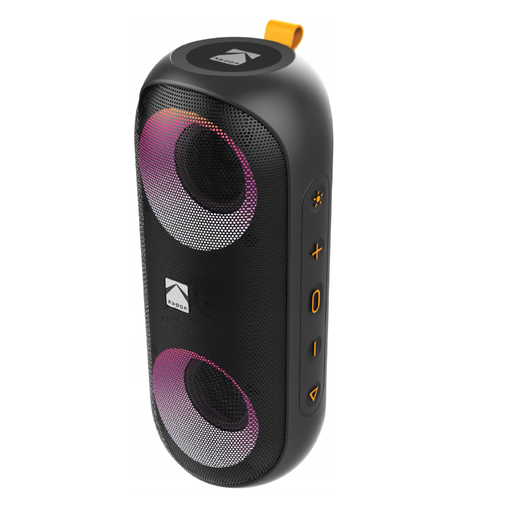
Why it's a perfect match: This user is looking for an all-terrain speaker that can handle everything from a backyard barbecue to a day at the beach or a hike. Their priorities: portability, durability, and balanced sound.
Its spec sheet is clear: 20W RMS and an IPX6 rating. No empty promises. The inclusion of a passive bass radiator guarantees solid low-end performance, avoiding the pitfall of flat, lifeless sound.
Powerful, balanced sound: The dual 10W drivers and passive radiator deliver a rich, immersive sound.
Rugged and practical design: The IPX6 certification and built-in mic for calls make it a reliable companion for all your adventures.
We have curated other products that meet our strict selection criteria and current safety standards.
TWS (True Wireless Stereo) mode is usually very simple to activate. Turn on your two compatible speakers and make sure they are not connected to any other device (phone, tablet, etc.). Then, a simple action (often a double-click on a dedicated button) on one of the speakers will initiate the pairing. Once successful, your phone will only detect a single Bluetooth device, but the sound will be broadcast in stereo across both speakers.
The entire difference lies in the level of water protection. An IPX6 speaker is protected against powerful water jets (equivalent to 100 liters/minute). It will easily withstand heavy rain or big splashes. An IPX7 speaker goes further: it is protected against temporary immersion (up to 1 meter deep for 30 minutes). For most portable uses (beach, hiking, backyard), an IPX6 rating is more than sufficient and provides excellent peace of mind.
Yes, the vast majority of modern portable speakers can operate while plugged into a wall outlet or a power bank. Just keep in mind that the charging speed will be slower if you are listening to music at a high volume at the same time. To get the most out of your battery life on the go, it's always best to fully charge the device before you head out.