
Livraison le jour même ou le lendemain

Qualité garantie

Débloquez vos offres de bienvenue: Livraison GRATUITE | Jusqu'à -80 % | 30 jours d'essai gratuits à JoyPlus
Téléchargez l'application
Turning your living room or garden into a private cinema is the dream! The centrepiece of this transformation? The portable projector screen. But be warned, the market is flooded with marketing promises that don't always deliver. To avoid disappointment and invest in a model that will last, it's crucial to know the most common pitfalls.
As a product expert at Joybuy, my mission is to help you see things more clearly. Let's break down the criteria that truly make a difference, going far beyond the sales pitch.
The wrong choice can quickly turn movie night into a frustrating experience. Here are the problems most often encountered by uninformed buyers.
To avoid these pitfalls, focus on objective technical specifications.
The quality of the projector screen fabric does 90% of the work. Good modern models favour a thick polyester fabric, sometimes called "polyester milk silk." This material offers several advantages:
The choice of size depends on your space and viewing distance. A 100-inch projector screen (a 2.54m diagonal) is an excellent all-rounder for a family home theatre or an outdoor cinema night.
A good portable screen should be a breeze to set up, take down, and transport. Make sure the included installation kit is both complete and robust:
A well-designed system allows for installation by a single person in just a few minutes.
Here are a few options that meet these selection criteria, suited for different needs and uses.
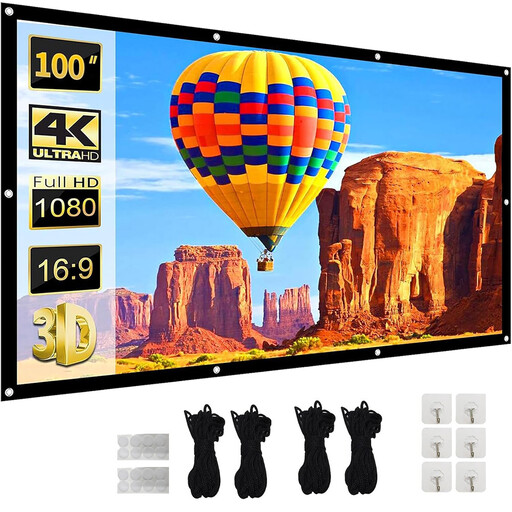
Why it's a great choice: This is the ultimate versatile and balanced solution. Its 100-inch diagonal is perfect for both the living room and the garden, offering great immersion without being too bulky. Easy to store and transport, it's the ideal companion for spontaneous movie nights.
Its thick polyester fabric significantly reduces the formation of stubborn wrinkles. The installation kit is complete, with long ropes and hooks, saving you from the unpleasant surprise of an unusable mounting system.
160° viewing angle: the whole family enjoys the same image quality. Front/rear projection compatible: offers more flexibility for projector placement.
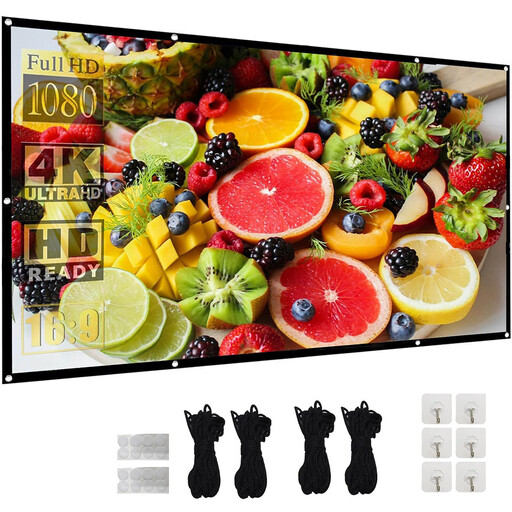
Why it's a great choice: For those who want to go big and recreate a true outdoor cinema experience, size is the number one criterion. At 120 inches (over a 3m diagonal!), this screen ensures maximum immersion, perfect for large gardens or events with friends.
Despite its large size, it features the same polyester fabric designed to be stretched easily. The mounting kit, which is crucial here, is sized to secure this large surface without any issues.
XXL 120-inch diagonal: perfect for large groups and open spaces. Washable fabric: a significant advantage for regular outdoor use.
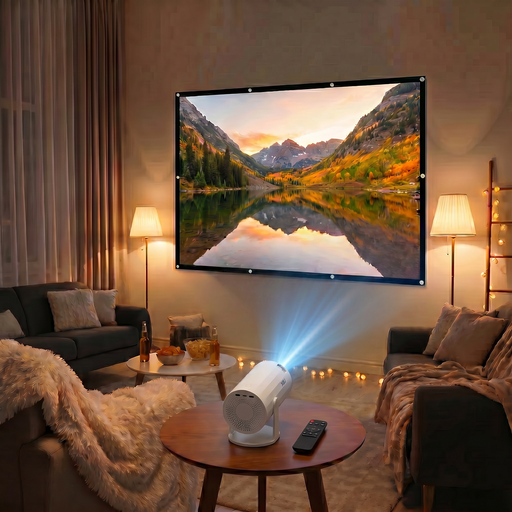
Why it's a great choice: For beginners who want an all-in-one solution without worrying about compatibility, this bundle is perfect. It combines a portable projector with a perfectly matched 100-inch screen, eliminating any uncertainty for a first-time purchase.
This bundle immediately eliminates the pitfall of incompatibility. The included 100-inch screen is the same as our family recommendation, guaranteeing a quality fabric and a reliable mounting system.
All-in-one solution: no need to search for a compatible projector and screen. Unbeatable convenience and value: the simplest and most cost-effective way to get fully equipped in one go.
We have put together a complete selection of products that meet our quality criteria and current safety standards.
The best technique is to start by securing the four corners, applying moderate and even tension. Then, attach the intermediate grommets, alternating between sides (top, bottom, left, right) to distribute the tension evenly. Most remaining wrinkles will naturally fade within 15 to 30 minutes.
This is strongly discouraged. These screens are not designed for permanent outdoor installation and are vulnerable to the elements (rain, strong wind, prolonged sun exposure). To ensure its longevity, it's best to store it in a sheltered area after each use.
Front projection is the classic setup: the projector is placed in front of the screen, on the same side as the audience. For rear projection, it is placed behind the screen. The fabric must then be specifically designed to be translucent. This is a very practical option for hiding the device and preventing anyone from walking through the light beam. Note that not all screens are compatible with this setup.