
Livraison le jour même ou le lendemain

Qualité garantie

Débloquez vos offres de bienvenue: Livraison GRATUITE | Jusqu'à -80 % | 30 jours d'essai gratuits à JoyPlus
Téléchargez l'application
The dream of a portable home cinema—one that's easy to set up and won't take over your living room—is finally within reach, thanks to the portable projector. Gone are the complex installations and giant screens that dominate your space. Today, a single compact device is all it takes to turn any wall into a cinema screen for a movie night, an intense video game session, or an impromptu screening under the stars.
The only problem? The market is flooded with models making tempting promises that can quickly lead to disappointment once you unbox them. As product experts at Joybuy, our mission is to help you decode the spec sheets to make an informed choice. Here are the three most common traps to avoid.
You'll often see dazzling brightness figures (5000, 8000, or even 10,000 lumens) displayed prominently on the packaging. Be careful: this is often an "in-house," non-standardised measurement. The only metric that truly matters is brightness expressed in ANSI lumens. To put it simply, a 300 ANSI lumen projector will deliver a much more vibrant and contrasted image than a model advertising "8000 lumens" without this certification. For comfortable viewing in a dark room, aim for a minimum of 200-300 ANSI lumens.
An integrated Android projector is a major asset, but not all are created equal. Many entry-level models use outdated versions of Android or uncertified interfaces. The result? Laggy apps, impossible updates, and, most importantly, the inability to natively play services like Netflix or Prime Video in HD due to anti-copy protections (DRM). You're then forced to connect an external device (Chromecast, Apple TV...), which defeats the whole purpose of an all-in-one concept.
Keystone correction is essential for getting a rectangular image, even if the projector isn't perfectly aligned with the wall. Many models boast "auto-correction," but this is often only vertical. If you place the projector off to the side, the image will remain distorted. True setup flexibility requires 4- or 6-point automatic correction (horizontal and vertical) and a responsive autofocus.
To avoid falling into these traps, here are the technical specifications on which you should make no compromises.
Don't confuse supported resolution (often 4K) with native resolution. Native resolution is the actual number of pixels the projector can display. It's what determines the true sharpness of the image.
A good Wi-Fi Bluetooth projector must incorporate the latest standards.
Portability isn't just about size. Ease of setup is just as crucial.
Here are a few options that meet these criteria, tailored for different types of users.
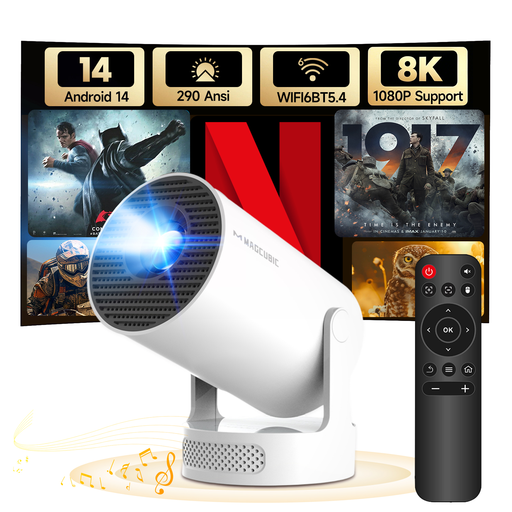
The Smart Pick: Ideal for students or families looking for a simple and affordable solution for occasional movie nights. Its compact size and integrated stand make it perfect for small spaces.
It includes a recent Android 14 system, avoiding the outdated OS trap. Its brightness is clearly stated at 290 ANSI lumens, and its 180° rotating stand compensates for the vertical-only keystone correction.
An unbeatable feature-to-price ratio. Modern connectivity with WiFi 6 and Bluetooth 5.4. The integrated 5W speaker is sufficient for on-the-go use.
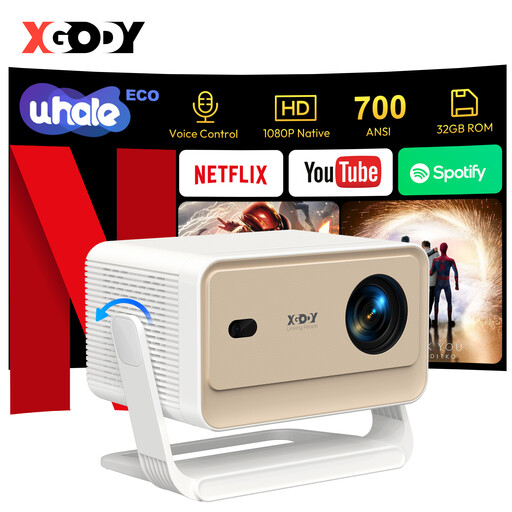
The Performance Choice: For those who want uncompromising image quality. Perfect for recreating an immersive cinema atmosphere at home, with a sharp and bright image even in a dimly lit room.
It sidesteps the "fake smart" trap with an official Netflix license and a smooth OS (WhaleOS 3.0). Its high brightness of 700 ANSI lumens is a real plus, and its fully automatic correction system (keystone, focus, obstacle avoidance) makes it incredibly simple to use.
Native 1080p Full HD resolution for impeccable image sharpness. 5W stereo speakers with 3D surround sound. Fully automated setup in seconds.
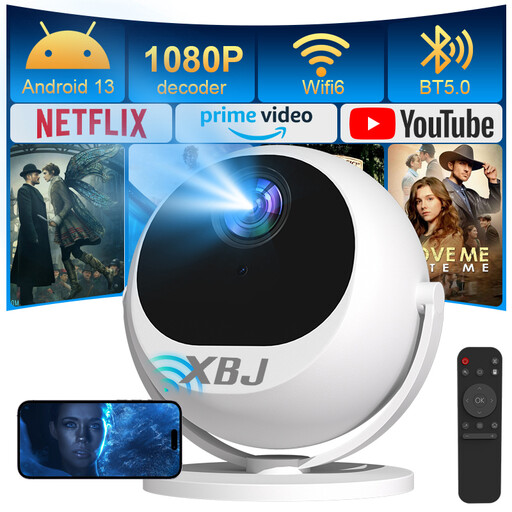
The Freedom Choice: For those who want total projection freedom. Project on a wall, a ceiling, or even a tent while camping. Its flexibility makes it as useful for entertainment as for impromptu business presentations.
It obliterates the limited correction pitfall with its 360° rotation and automatic 6D keystone correction. The image is always perfect, regardless of the angle. Its native 1080p resolution and high brightness (up to 900 ANSI lumens according to the manufacturer) are guarantees of quality.
Unmatched placement flexibility. Native Full HD 1080p resolution and HDR10+ image technology. Comprehensive connectivity with WiFi 6, Bluetooth 5.2, HDMI, and USB.
Even the best pico projector will have its image quality degraded by an unsuitable projection surface. A white wall can work in a pinch, but it's never perfectly smooth or neutral. A portable projection screen, like the 72-inch XBJ model, significantly improves contrast, colour fidelity, and perceived brightness. Easy to set up and transport, it's a small investment that elevates your viewing experience.
Find our full selection of products that meet our strict selection criteria and European safety standards.
The vast majority of modern portable projectors use an LED light source. Their lifespan is generally estimated to be between 20,000 and 30,000 hours. In practical terms, this represents more than 10 years of use at 5 hours per day. You'll be set for years to come!
It's not mandatory, but it is highly recommended. A wall, even a white one, absorbs some of the light and may have imperfections or a tint that alters the colours. A projection screen is designed with a special coating that reflects light optimally, providing a brighter image, more faithful colours, and much sharper contrast.
This depends entirely on the projector's brightness (in ANSI lumens) and the ambient light. A model below 500 ANSI lumens will be difficult to see unless it's in a dark room. More powerful models (700 ANSI lumens and up) can manage in a room with controlled light (e.g., curtains drawn). However, no consumer-grade projector can compete with direct sunlight. For an outdoor session, you'll have to wait until nightfall.