
Livraison le jour même ou le lendemain

Qualité garantie

Débloquez vos offres de bienvenue: Livraison GRATUITE | Jusqu'à -80 % | 30 jours d'essai gratuits à JoyPlus
Téléchargez l'application
The idea of a cinema on the go, capable of turning any white wall into a giant screen, is more appealing than ever. But be warned: the portable projector market is a jungle of often misleading marketing promises. Between fantasy brightness figures and "smart" features that are smart in name only, it's easy to make a misstep.
As a product expert at Joybuy, my mission is to help you cut through the noise. Let's break down the pitfalls to avoid and the real criteria that matter to make the right choice.
Before you even look at a spec sheet, it's crucial to know how to spot the marketing claims that lead straight to disappointment.
To avoid falling for these traps, focus on the few technical specifications that truly make a difference.
Brightness in ANSI Lumens: This is the only standardised metric that measures the actual brightness of the image on the screen. For comfortable viewing, here are a few concrete benchmarks:
Native Resolution: Don't confuse "supported" resolution (a marketing gimmick) with native resolution (the true definition of the image). A projector might accept a 4K signal but display it in 720p if its chip is limited. For a sharp and detailed image, aim for a minimum of Full HD 1080p (1920 x 1080 pixels) native resolution. This is currently the best balance of quality and price.
Auto-Correction Features: For a truly "plug-and-play" portable experience, automated setup features are essential. Look for models equipped with:
Operating System and Connectivity: A smart projector worthy of the name must integrate a responsive OS (like Android TV or Google TV) with certified access to the Play Store and popular apps (a Netflix projector). The inclusion of Wi-Fi 6 and Bluetooth 5.2 (or newer) ensures a stable connection for streaming and for connecting accessories like a soundbar or a game controller.
To illustrate this advice, here is a selection of models that check all the right boxes, for different uses and budgets.
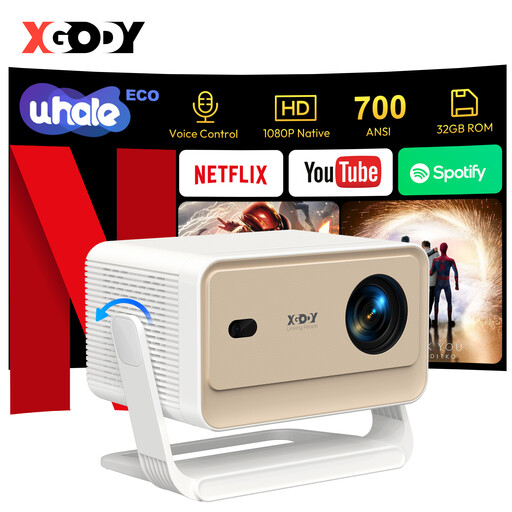
Why it stands out: Perfect for family use thanks to its incredible simplicity. You plug it in, and it does the rest. Direct access to Netflix, without any tinkering or hassle, is a real convenience for everyone to enjoy.
This model avoids the "fake smart projector" trap with its official Netflix license and an OS (WhaleOS 3.0) optimised for streaming. Its full automation (focus, keystone) eliminates tedious manual adjustments.
700 ANSI lumen brightness for a clear image even with ambient light. Native 1080p resolution and 100% automatic corrections for a "zero-effort" setup.
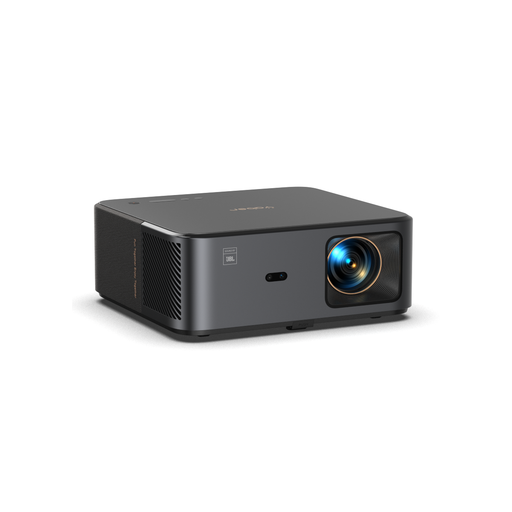
Why it stands out: For those who want a no-compromise portable cinema experience. The JBL-tuned sound quality and high brightness make it a top-tier choice for total immersion, whether for a blockbuster movie or a football match.
It doesn't fall for the fantasy brightness trap with its genuine 800 ANSI lumens. The integration of Google TV ensures access to a near-infinite catalogue of apps, with no unpleasant surprises.
JBL-tuned audio quality and Dolby Audio compatibility for powerful sound. Integrated Google TV for a complete ecosystem and NFC Screencast to mirror your smartphone's screen with a single tap.
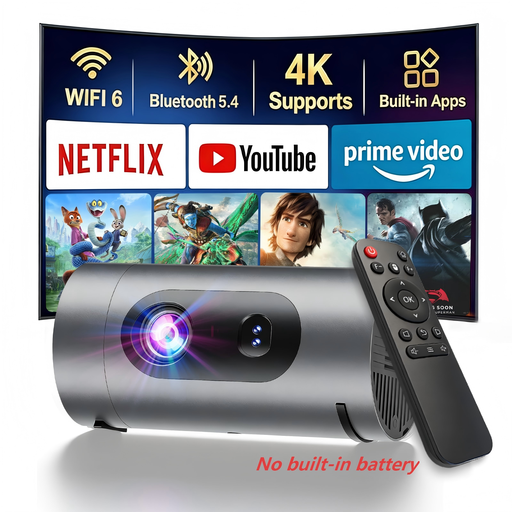
Why it stands out: Designed for camping and nomadic trips, this mini-projector stands out for its ability to be powered by a simple external battery (power bank). Its ultra-compact form factor allows it to slip into any backpack.
It tackles the "false portability" trap head-on by freeing itself from the need for a power outlet. Autofocus and automatic keystone correction radically simplify setup in the great outdoors, where flat surfaces are rare.
Power bank compatible for absolute freedom. Ultra-compact, can-shaped design, easy to take anywhere. Integrated Android system to launch content without needing another device.
We have selected other models for you that meet our demanding selection criteria and current safety standards.
"Lumens" (sometimes called "source lumens") measure the bulb's power, a figure often inflated for marketing purposes. ANSI lumens, on the other hand, are the result of a standardised measurement of the brightness of the image actually projected onto the screen. It is therefore the only reliable data for comparing the performance of two projectors.
No, it's not essential, especially for portable use. A smooth, white wall will do just fine for a good quality image. However, a real projection screen will visibly improve contrast, colour accuracy, and perceived brightness, as its surface is designed to reflect light optimally.
For watching movies, series, or gaming, a projector offers an immersion and screen size that a television at the same price can hardly match. However, for daily use in broad daylight (like watching the news in a sunlit living room), a television remains more suitable. The projector is an excellent entertainment solution, either as a supplement or a replacement, provided you can control the room's lighting to some extent.