
Livraison le jour même ou le lendemain

Qualité garantie

Débloquez vos offres de bienvenue: Livraison GRATUITE | Jusqu'à -80 % | 30 jours d'essai gratuits à JoyPlus
Téléchargez l'application
Having ice on demand, without relying on slow, bulky freezer trays, is a game-changing small luxury. A portable ice maker is the perfect solution for impromptu get-togethers, summer heatwaves, or even outfitting an office. However, the market is flooded with models making tempting promises that can sometimes hide deal-breaking flaws in daily use. Before you make your choice, it's crucial to know how to see through the marketing traps to invest in a machine that will truly meet your expectations.
The initial excitement of a purchase can quickly turn to disappointment if you don't pay attention to certain details. Here are the two most common pitfalls!
Many manufacturers highlight a record-breaking production time, like "ice in 6 minutes." While this statement isn't false, it's often misleading. This time usually refers to the first production cycle, which yields only a handful of small ice cubes. The true performance indicator is the production capacity over 24 hours (in kg) and the storage basket size. A machine that produces quickly but has a small basket that fills up in 30 minutes will force you to constantly empty it, which is anything but convenient.
A countertop ice maker is an appliance with a compressor and a fan, so its operation is never completely silent. The problem is that the noise level is often omitted from spec sheets. A powerful but noisy model can quickly become a nuisance in an open-plan kitchen, a studio apartment, or an office. A unit exceeding 50 decibels (dB) can disrupt a conversation or a moment of relaxation.
To ensure you make the right choice, focus on these three objective criteria.
The production capacity, expressed in kilograms per 24 hours (kg/24h), gives you a clear idea of the machine's output over a full day.
Also, check the ice basket capacity. A 0.6 kg basket fills up quickly; a model with 1 kg or more will offer greater autonomy.
A quiet ice maker is a significant comfort factor. Look for the noise level expressed in decibels (dB) on the technical specifications.
Stagnant water is a breeding ground for bacteria. A self-cleaning ice maker greatly simplifies maintenance and ensures impeccable hygiene. A single button press starts an internal rinsing cycle. Also, consider drainage: an easily accessible drain plug under the unit is a bonus for emptying leftover water without having to turn the machine upside down.
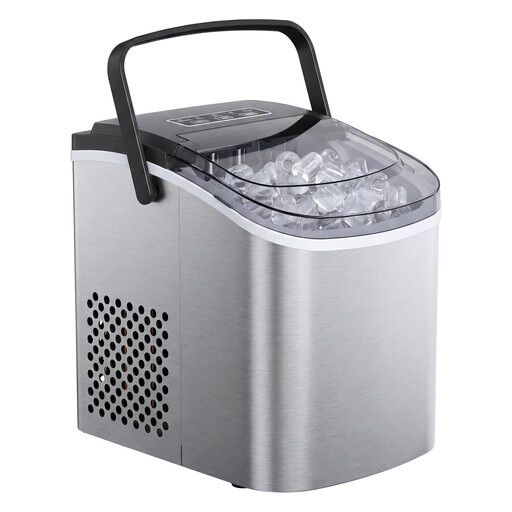
Why this model? Ideal for daily use or for hosting a few friends. Its compact footprint allows it to fit on most countertops, while its 12 kg/24h production effortlessly meets the needs of a family or a small group.
It sidesteps the noise trap by boasting a noise level below 45 dB. It also avoids the "express production" disappointment by focusing on a reliable, continuous output, all complemented by a highly practical self-cleaning function.
Its perfect balance of a compact design, quiet operation, and user-friendliness (intuitive controls and self-cleaning).

Why this model? Designed for those who need more. With a production capacity of up to 24 kg/24h and a large 3.2 L water reservoir, it's perfect for large families, home bar owners, or small offices that never want to run out of ice.
This model bypasses the small-basket trap with its superior production and storage capacity. The "24 ice cubes in 13 minutes" claim is a much more transparent indicator than just the first-cycle time, giving a realistic idea of its performance.
Its high production capacity ensures a constant flow of ice. Its stainless steel design provides durability and a premium aesthetic, perfect for modern kitchens.
We have selected other models that meet all our quality criteria and current safety standards.
The lifespan of a small ice maker depends on its build quality and maintenance. On average, a well-maintained unit can last from 3 to 5 years. To maximize its longevity, it's advisable to use filtered water to reduce limescale buildup and run the self-cleaning cycle at least once a month.
No, consumption is generally moderate. A fast ice maker in operation consumes between 100 and 150 watts, equivalent to an old incandescent light bulb or a small home appliance. Furthermore, it only runs in cycles to produce ice, not continuously like a refrigerator, which limits its impact on your electricity bill.
For hygiene reasons, it is recommended not to let water stagnate in the reservoir for more than 24 hours. If you don't plan to use the machine for several days, it's best to empty it completely using the drain plug, dry it, and leave the lid open to ensure proper ventilation.